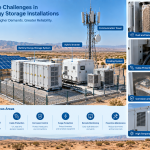
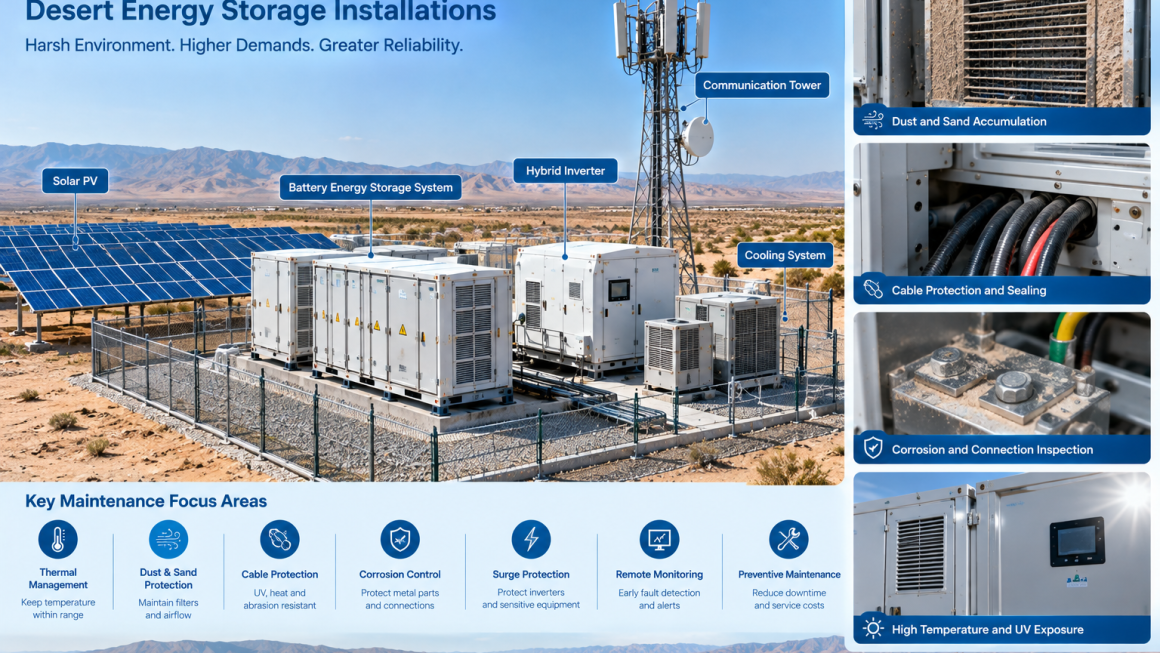
Desert environments offer significant opportunities for solar power generation and energy storage. Large areas of land, high solar irradiation, and increasing demand for renewable energy make deserts attractive locations for utility-scale PV and battery energy storage systems (BESS).
However, the same environmental conditions that make deserts attractive for renewable energy can create difficult operating conditions for energy storage equipment.
High temperatures, large temperature swings, fine dust, sand, strong sunlight, wind, limited water availability, and remote locations can all increase the maintenance requirements of a BESS installation.
For energy storage operators, desert BESS maintenance is therefore not simply a matter of scheduling periodic inspections. Long-term reliability depends on how the system is designed, protected, monitored, accessed, and serviced under harsh environmental conditions.
This article examines the major maintenance challenges in desert energy storage installations and discusses practical approaches for improving reliability and reducing avoidable service interruptions.
1. Why Desert BESS Maintenance Is Different
A typical energy storage system may include:
- Battery modules
- BMS
- PCS or hybrid inverter
- HVAC or liquid cooling equipment
- Fire detection and suppression systems
- Electrical distribution equipment
- Cable systems
- Communication equipment
- Monitoring and EMS
- Enclosures or containers
In a conventional indoor environment, many of these components operate within relatively stable conditions.
A desert installation is very different.
The system may experience:
High temperature + intense solar radiation + dust + sand + wind + large temperature changes + limited maintenance access
These factors interact with each other.
For example, high ambient temperature increases cooling requirements. Dust accumulation can reduce heat-transfer performance. Reduced cooling performance increases equipment temperature. Higher operating temperature can accelerate component aging.
This means that desert maintenance should be approached as a system-level reliability problem.
2. Extreme Temperature Is a Major Maintenance Challenge
Temperature is one of the most important environmental factors for BESS installations.
Desert sites can experience very high daytime temperatures, while temperatures may fall significantly after sunset.
This creates two different maintenance challenges.
High daytime temperatures
High ambient temperature can increase the thermal load on:
- Battery modules
- PCS
- Inverters
- Power electronics
- HVAC systems
- Control electronics
Cooling equipment may need to operate for long periods, increasing auxiliary energy consumption and component wear.
Large temperature variations
Repeated temperature changes can cause expansion and contraction of:
- Electrical connections
- Cable terminals
- Seals
- Enclosures
- Structural components
- Electronic components
Over long periods, thermal cycling may contribute to mechanical or electrical degradation.
Maintenance teams therefore need to inspect not only battery performance but also the physical condition of connections, seals, cooling systems, and enclosure components.
3. Dust Is a Continuous Maintenance Problem
Dust is one of the defining challenges of desert energy storage.
Fine dust can enter equipment through:
- Ventilation openings
- Cable entries
- Door gaps
- Damaged seals
- Cooling-system interfaces
- Maintenance access points
Once inside an enclosure, dust can accumulate on:
- Filters
- Heat exchangers
- Fans
- Electrical components
- Sensors
- Cable connections
Dust can also reduce airflow and heat-transfer efficiency.
The problem is not limited to visible dust.
Very fine particles can gradually accumulate in areas that are difficult to inspect during routine maintenance.
4. Cooling System Maintenance
Cooling systems are particularly important in desert BESS installations.
Depending on the design, the system may use:
- Air cooling
- Forced-air cooling
- Liquid cooling
- HVAC systems
- Hybrid thermal-management systems
Regardless of the technology, the objective is to keep equipment within its intended operating temperature range.
For air-cooled systems, maintenance may include:
- Filter inspection
- Filter replacement
- Fan inspection
- Airflow verification
- Heat exchanger cleaning
- Ventilation inspection
For liquid-cooled systems, additional attention may be required for:
- Coolant condition
- Pumps
- Valves
- Hoses
- Connections
- Heat exchangers
- Leak detection
A cooling system that appears to be operating normally may still have gradually declining performance because of dust accumulation or component degradation.
5. Solar Radiation and UV Exposure
Desert equipment can receive intense solar radiation for many hours each day.
UV exposure can gradually degrade polymeric materials.
Potentially affected components include:
- Cable jackets
- Cable sleeves
- Plastic connectors
- Sealing materials
- Flexible conduits
- Labels
- Protective covers
This is particularly important for outdoor cable systems.
A cable may remain electrically functional while its external protective layer becomes brittle or damaged.
Maintenance inspections should therefore include the physical condition of exposed cables and protective materials, not just electrical measurements.
6. Cable Protection in Desert BESS
Cable systems are often overlooked when discussing energy storage maintenance.
However, desert sites can expose cables to:
- UV radiation
- Sand abrasion
- Dust
- High temperature
- Mechanical vibration
- Sharp edges
- Wind movement
- Rodents
- Installation-related stress
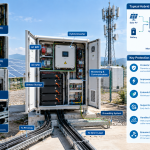
Cables entering battery containers, inverter cabinets, junction boxes, and distribution equipment require particular attention.
Protective solutions can include:
- Braided cable sleeves
- Self-wrapping cable protection
- High-temperature sleeves
- Fiberglass sleeves
- Aluminum-foil fiberglass protection
- Protective conduits
- Cable glands
- Sealing accessories
The correct solution depends on the cable type, temperature, installation environment, mechanical exposure, and required protection level.
7. Cable Glands and Sealing
Cable entry points are common weak points in outdoor energy storage equipment.
A BESS enclosure may have many cable penetrations for:
- DC power
- AC power
- Communication
- Sensors
- Auxiliary systems
- Grounding
Each penetration needs appropriate sealing.
If a cable gland becomes damaged or incorrectly installed, dust and moisture can enter the enclosure.
This can create problems that are difficult to identify during routine inspections.
Maintenance teams should therefore check:
- Cable gland tightness
- Seal condition
- Cracks
- Deformation
- Dust accumulation
- Water ingress
- Cable movement
- Unused openings
Good sealing is particularly important in desert environments because fine dust can penetrate surprisingly small gaps.
8. Sand and Wind Create Mechanical Problems
Desert wind can carry sand particles across exposed infrastructure.
Repeated sand exposure may contribute to:
- Surface abrasion
- Cable wear
- Coating degradation
- Enclosure surface damage
- Connector contamination
- Mechanical wear
Cables installed in exposed areas may experience movement caused by wind.
Over time, repeated movement can create mechanical stress at:
- Cable glands
- Connectors
- Terminals
- Cable trays
- Support brackets
Cable routing should therefore be inspected for both electrical and mechanical integrity.
9. Battery Maintenance Under High Ambient Temperatures
Battery performance is strongly influenced by temperature.
A BESS operating in a hot environment may require more active thermal management to maintain suitable operating conditions.
Maintenance teams should monitor:
- Cell temperatures
- Module temperature differences
- SOC
- SOH
- Voltage consistency
- Temperature alarms
- Cooling-system performance
- Abnormal temperature trends
The important point is to monitor trends rather than relying only on individual alarm events.
For example, a gradual increase in temperature difference between battery modules may provide useful information before a serious fault occurs.
10. HVAC Reliability Becomes a Critical Issue
In a desert BESS, the HVAC or thermal-management system can become almost as important to availability as the battery system itself.
If cooling capacity is reduced, operators may need to:
- Reduce system power
- Change operating schedules
- Limit charging/discharging
- Shut down affected equipment
- Dispatch maintenance personnel
This creates a chain reaction:
Dust → Reduced Cooling Efficiency → Higher Temperature → Operating Restrictions → Reduced Availability
Preventing the first stages of this chain can therefore be more effective than responding to the final alarm.
11. Dust Filters Need a Maintenance Strategy
Filters can provide important protection for air-cooled systems, but they also introduce a maintenance requirement.
A filter that becomes heavily loaded with dust can restrict airflow.
The correct replacement interval depends on:
- Local dust concentration
- Seasonal conditions
- System design
- Filter type
- Operating hours
- Measured pressure drop
- Cooling requirements
A fixed calendar-based replacement interval may not always be sufficient.
Where possible, maintenance teams can use actual operating data and inspection results to optimize filter replacement schedules.
12. Enclosure Integrity
BESS containers and outdoor cabinets are designed to provide environmental protection, but their performance depends on maintaining enclosure integrity.
Routine inspection should include:
- Door seals
- Gaskets
- Ventilation openings
- Cable entries
- Access panels
- Drainage
- Corrosion
- Physical deformation
A damaged gasket may not create an immediate electrical fault.
However, repeated dust ingress can gradually increase maintenance requirements and reduce equipment reliability.
13. Corrosion Can Still Be a Problem in the Desert
Desert does not automatically mean corrosion-free.
Some desert environments experience:
- High humidity during certain periods
- Condensation
- Saline dust
- Chemical contaminants
- Coastal influence
Metallic components can therefore still require corrosion inspection.
Potentially affected areas include:
- Cable glands
- Fasteners
- Cable trays
- Grounding connections
- Enclosure surfaces
- Electrical terminals
- Structural supports
Corrosion can increase electrical resistance and weaken mechanical connections.
14. Grounding and Electrical Connections
Electrical connections should receive particular attention in harsh environments.
Maintenance teams can inspect:
- Grounding conductors
- Grounding terminals
- Busbar connections
- Cable lugs
- Terminal blocks
- Protective devices
- Connector condition
Thermal cycling, vibration, and environmental exposure can gradually affect mechanical connections.
Infrared inspection can also be useful for identifying abnormal heating at electrical connection points, subject to the site’s maintenance procedures and safety requirements.
15. Surge Protection Maintenance
Desert BESS installations can still be exposed to lightning and transient overvoltage.
This is particularly relevant for large outdoor installations with extensive:
- PV arrays
- AC distribution
- DC circuits
- Communication networks
- Metallic structures
Surge protective devices should therefore be included in maintenance inspections.
Teams may check:
- SPD status indicators
- Alarm contacts
- Grounding connections
- Physical damage
- Replacement requirements
Surge protection should be considered together with grounding, cable routing, and enclosure protection.
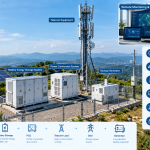
16. Communication Reliability in Remote Sites
Many desert BESS projects are located far from cities and maintenance centers.
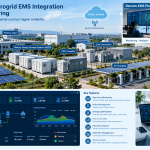
Remote monitoring therefore becomes essential.
A modern system may monitor:
- Battery SOC
- Battery SOH
- Temperature
- PCS status
- HVAC status
- Fire protection
- Door status
- Communication status
- Alarm conditions
- Energy production
- Energy consumption
Remote monitoring can reduce unnecessary site visits.
Instead of sending technicians to investigate every abnormal condition, operators can first determine whether the issue is related to:
- Battery
- Cooling
- Communication
- Power conversion
- Environmental protection
- Auxiliary equipment
This allows maintenance teams to prepare the required tools and spare parts before traveling to the site.
17. Remote Diagnostics and Predictive Maintenance
Desert BESS maintenance benefits significantly from historical data.
For example, operators can track:
Temperature → Cooling Power → Battery Performance → Alarm Frequency
If cooling power gradually increases while ambient conditions remain similar, this may indicate declining thermal-management efficiency.
Similarly, repeated temperature differences between specific battery modules may justify further inspection.
Predictive maintenance does not eliminate physical inspections, but it can help prioritize them.
18. Maintenance Access Is a Major Challenge
A remote desert installation can be technically reliable but still difficult to maintain.
The maintenance plan should consider:
- Distance from service centers
- Road conditions
- Extreme weather
- Technician availability
- Spare-part logistics
- Communication coverage
- Emergency response time
- Site access requirements
This means maintainability should be considered during system design.
Components that are easy to replace, inspect, and isolate can reduce long-term service complexity.
19. Spare Parts Management
Remote BESS sites often need a more deliberate spare-parts strategy.
A small component failure can create disproportionate downtime if the required part is several hundred kilometers away.
Potential spare parts may include:
- Filters
- Fans
- Pumps
- Valves
- Sensors
- Cable glands
- Sealing components
- Protective sleeves
- Fuses
- Circuit protection components
- Communication equipment
Critical spare parts should be identified according to failure probability, replacement time, system impact, and local logistics.
20. Cleaning Without Creating New Problems
Cleaning is necessary in dusty environments, but the cleaning method matters.
For electrical equipment, uncontrolled use of water can introduce additional risks.
Maintenance procedures should therefore distinguish between:
- External enclosure cleaning
- Filter cleaning
- Heat exchanger cleaning
- Electrical component cleaning
- PV panel cleaning
- Cable cleaning
The cleaning method should be compatible with the equipment manufacturer’s requirements and the site’s electrical safety procedures.
The objective is not simply to remove dust, but to remove it without damaging seals, connectors, insulation, electronics, or protective coatings.
21. Fire Protection and Environmental Conditions
Battery energy storage systems require dedicated fire safety measures.
In desert environments, maintenance teams also need to ensure that fire protection equipment remains functional under high temperature and dust exposure.
Inspection can include:
- Fire detection systems
- Smoke or gas detection
- Temperature sensors
- Suppression-system status
- Alarm communication
- Emergency shutdown systems
- Ventilation controls
Environmental protection and fire safety should be coordinated rather than treated as independent systems.
22. A Layered Maintenance Strategy
A practical desert BESS maintenance strategy can be divided into several layers.
Layer 1: Battery Health
Monitor:
- SOC
- SOH
- Voltage
- Temperature
- Cell consistency
Layer 2: Thermal Management
Check:
- HVAC
- Fans
- Pumps
- Filters
- Heat exchangers
- Cooling performance
Layer 3: Electrical Infrastructure
Inspect:
- Cables
- Terminals
- Grounding
- SPDs
- Protection devices
- Distribution equipment
Layer 4: Environmental Protection
Inspect:
- Enclosures
- Cable glands
- Seals
- Cable protection
- Dust ingress
- Corrosion
Layer 5: Monitoring and Communication
Verify:
- Data availability
- Alarm transmission
- Remote access
- Communication redundancy
- Historical data
Layer 6: Physical Site Conditions
Check:
- Access roads
- Drainage
- Equipment foundations
- Fencing
- Cable trays
- Vegetation or debris
- Wind and sand exposure
This layered approach helps maintenance teams avoid focusing exclusively on the battery.
23. Preventive Maintenance vs Condition-Based Maintenance
Traditional preventive maintenance often follows a fixed schedule:
Inspect every month → Clean every quarter → Replace components annually
This is simple, but it may not reflect actual site conditions.
A more data-driven approach combines scheduled inspection with condition monitoring.
For example:
Scheduled Inspection + Temperature Trends + Alarm History + Cooling Performance + Environmental Data
can provide a more accurate picture of equipment condition.
A heavily dust-exposed site may require more frequent filter maintenance than a cleaner desert location.
Likewise, an installation with excellent environmental sealing may require less frequent internal cleaning.
Maintenance intervals should therefore be adapted to actual operating conditions where practical.
24. Designing for Maintainability
The best time to address desert maintenance problems is before the BESS is installed.
Design considerations can include:
- Appropriate enclosure protection
- Reliable cable glands
- UV-resistant cable protection
- High-temperature materials
- Accessible filters
- Serviceable cooling equipment
- Clear cable routing
- Modular components
- Remote monitoring
- Replaceable protection components
- Adequate working space
A system that is easy to maintain can have lower long-term operational complexity than one that simply has high initial specifications.
25. Practical Desert BESS Maintenance Checklist
Before commissioning a desert energy storage system, operators can review the following areas.
Thermal Management
- Is cooling capacity appropriate for the local climate?
- Are filters accessible?
- Can cooling performance be monitored?
- Are temperature trends recorded?
Dust and Sand Protection
- Are enclosure seals intact?
- Are cable entries properly sealed?
- Are ventilation openings protected?
- Are exposed cables mechanically protected?
Electrical System
- Are cables protected from UV and abrasion?
- Are grounding connections accessible?
- Are electrical terminals protected?
- Are surge protection devices monitored?
Monitoring
- Can battery temperature be monitored remotely?
- Can HVAC alarms be transmitted?
- Can communication failures be detected?
- Is historical data available?
Maintenance Logistics
- Is there a local service plan?
- Are critical spare parts available?
- Can technicians access the site safely?
- Is emergency response time acceptable?
26. From Battery Maintenance to Infrastructure Maintenance
One of the most important lessons from desert energy storage projects is that BESS reliability depends on much more than battery chemistry.
The complete infrastructure includes:
Battery + Thermal Management + Power Electronics + Electrical Connections + Cable System + Environmental Protection + Communication + Monitoring + Maintenance
A failure in any one of these layers can reduce system availability.
For example:
Damaged cable gland → Dust ingress → Contamination → Maintenance issue
or:
Dust accumulation → Reduced cooling efficiency → Higher temperature → Operating limitation
or:
Communication failure → Loss of remote visibility → Delayed fault diagnosis → Longer maintenance response
These chains demonstrate why desert BESS maintenance should be treated as a connected system rather than a collection of individual tasks.
Desert energy storage installations can deliver significant value, but they operate under some of the most demanding environmental conditions in the energy sector.
High temperatures, dust, sand, UV exposure, temperature cycling, remote locations, and limited maintenance access all create additional challenges.
The most effective maintenance strategy combines battery health monitoring with thermal management, electrical inspection, cable protection, enclosure sealing, grounding, surge protection, communication monitoring, and careful spare-parts planning.
For operators, the goal should not simply be to repair failures after they occur. A well-designed maintenance strategy should identify environmental and equipment degradation early, prioritize the most important risks, and make service activities predictable.
For desert BESS projects, environmental protection is therefore part of energy storage reliability.
A system that combines appropriate cable protection, sealing, thermal management, monitoring, and maintainable infrastructure can be better prepared for the long operating life expected from modern energy storage installations.
FAQs
What are the biggest maintenance challenges for desert BESS?
The major challenges include high temperature, dust and sand, cooling-system maintenance, UV exposure, cable degradation, enclosure sealing, remote access, spare-parts logistics, and communication reliability.
How does dust affect energy storage systems?
Dust can accumulate on filters, cooling equipment, electrical components, and enclosure surfaces. Excessive dust can restrict airflow, reduce cooling efficiency, increase maintenance requirements, and contribute to equipment degradation.
Why is cable protection important in desert BESS?
Outdoor cables can be exposed to intense UV radiation, heat, sand abrasion, wind movement, and mechanical damage. Protective sleeves, conduits, cable glands, and sealing systems can help preserve cable integrity.
How often should a desert BESS be maintained?
There is no universal maintenance interval. The appropriate schedule depends on equipment design, environmental conditions, manufacturer recommendations, operating history, and monitoring data. Dust-intensive locations may require more frequent inspections and filter servicing.
Can remote monitoring reduce desert BESS maintenance costs?
Remote monitoring can help identify abnormal temperatures, cooling problems, communication failures, and other conditions before technicians travel to the site. It can also help maintenance teams prepare the correct spare parts and tools.
Is cooling more important in desert BESS installations?
Cooling is particularly important because high ambient temperatures increase thermal-management requirements. Cooling-system performance should therefore be monitored as part of overall BESS reliability.
Do desert BESS systems still need surge protection?
Yes. Desert locations can still be exposed to lightning and electrical transients. PV arrays, AC distribution, DC circuits, communication systems, grounding, and surge protection should be considered as part of the overall electrical protection strategy.
What is the best approach to desert BESS maintenance?
A layered approach is generally useful: monitor battery health, maintain thermal systems, protect electrical infrastructure, control dust and moisture ingress, monitor communication, inspect cable systems, and prepare for remote-site maintenance logistics.