



Outdoor battery energy storage systems are increasingly deployed in environments where dust, sand, heat, moisture, and strong sunlight can directly affect equipment reliability.
For energy storage sites located in deserts, semi-arid regions, construction zones, industrial areas, agricultural environments, and other dusty locations, protecting the battery enclosure alone is not enough.
PCS cabinets, control panels, cable connections, communication equipment, cooling systems, junction boxes, and auxiliary electrical components may all be exposed to the surrounding environment.
This is where outdoor equipment covers for dusty energy storage sites can provide an additional layer of protection.
A properly designed equipment cover can reduce direct exposure to dust and sand while helping protect sensitive equipment from rain, UV radiation, debris, and mechanical contamination.
However, an equipment cover is not simply a piece of fabric or a weather shield.
If incorrectly designed, it can restrict ventilation, trap heat, interfere with maintenance, or create additional moisture and corrosion risks.
The objective is therefore to create a protection system that balances:
Dust protection + weather resistance + thermal management + accessibility + long-term durability
1. Why Dust Is a Serious Risk for Outdoor Energy Storage Equipment
Dust may appear harmless because individual particles are extremely small.
In an energy storage installation, however, continuous exposure can create several reliability problems.
Dust can accumulate on:
- Ventilation openings
- Cooling filters
- Heat exchangers
- Fan assemblies
- Electrical cabinets
- Cable glands
- Connectors
- Control panels
- Sensors
- Junction boxes
Over time, accumulated dust can reduce airflow and increase thermal resistance.
The basic relationship is straightforward:
Dust accumulation → reduced airflow → reduced cooling performance → higher equipment temperature
For power electronics such as PCS equipment, higher operating temperatures can increase thermal stress and accelerate component aging.
Fine dust can also enter through small gaps around doors, cable entries, ventilation openings, and removable panels.
For this reason, dusty environments require protection at multiple levels.
2. Equipment Covers Provide a Secondary Protection Layer
Outdoor BESS equipment is normally protected by its own enclosure.
However, the enclosure is not necessarily designed to eliminate every environmental exposure.
An additional external cover can act as a secondary environmental barrier.
Depending on the application, it can protect:
- PCS cabinets
- AC distribution equipment
- DC junction boxes
- Communication cabinets
- EMS/control equipment
- Auxiliary power equipment
- Cable connection areas
- Cooling equipment
- Outdoor connectors
- Maintenance interfaces
The principle is similar to layered protection:
Outdoor environment
↓
Equipment cover
↓
Equipment enclosure
↓
Internal electrical components
Each layer reduces the environmental load imposed on the next.
This approach can be particularly useful when equipment must operate in harsh environments for many years.
3. Protection Against Sand and Dust
The primary reason for installing an outdoor equipment cover at a dusty energy storage site is to reduce direct particle exposure.
During normal operation, wind can carry fine particles across the site.
During stronger wind events or sandstorms, exposure can become much more severe.
A properly designed cover can help reduce:
- Direct sand impact
- Dust accumulation
- Wind-blown debris
- Contamination of external surfaces
- Dust entering vulnerable equipment interfaces
However, the cover should not completely seal equipment that requires airflow.
This distinction is critical.
Protection should be selective
Sensitive openings may need shielding while required airflow paths remain open.
For example:
Poor approach:
Completely enclosing a PCS with an impermeable cover.
Better approach:
Protect the top, sides, cable interfaces, and vulnerable external areas while maintaining engineered air intake and exhaust paths.
4. Thermal Management Must Come First
One of the biggest design risks associated with outdoor equipment covers is overheating.
A cover can protect equipment from dust while unintentionally reducing heat dissipation.
This is particularly important for:
- PCS
- Inverters
- Transformers
- Rectifiers
- High-power electrical cabinets
- Cooling units
These components generate heat during operation.
If hot air becomes trapped beneath a cover, the local ambient temperature around the equipment can increase.
This can create:
Restricted ventilation → higher enclosure temperature → reduced component life
Therefore, the thermal design of an equipment cover is just as important as its dust protection.
5. Ventilation Openings Need Careful Design
For actively cooled equipment, the cover should be designed around the existing airflow path.
The designer should identify:
- Air intake location
- Hot-air exhaust location
- Fan position
- Filter position
- Heat exchanger location
- Maintenance access
- Emergency shutdown access
The cover should not block or redirect airflow in a way that increases pressure drop.
In some applications, protective louvers, ventilated panels, raised roofs, or screened openings can provide a better solution than a fully enclosed cover.
The objective is:
Keep contaminants away without preventing heat from leaving.
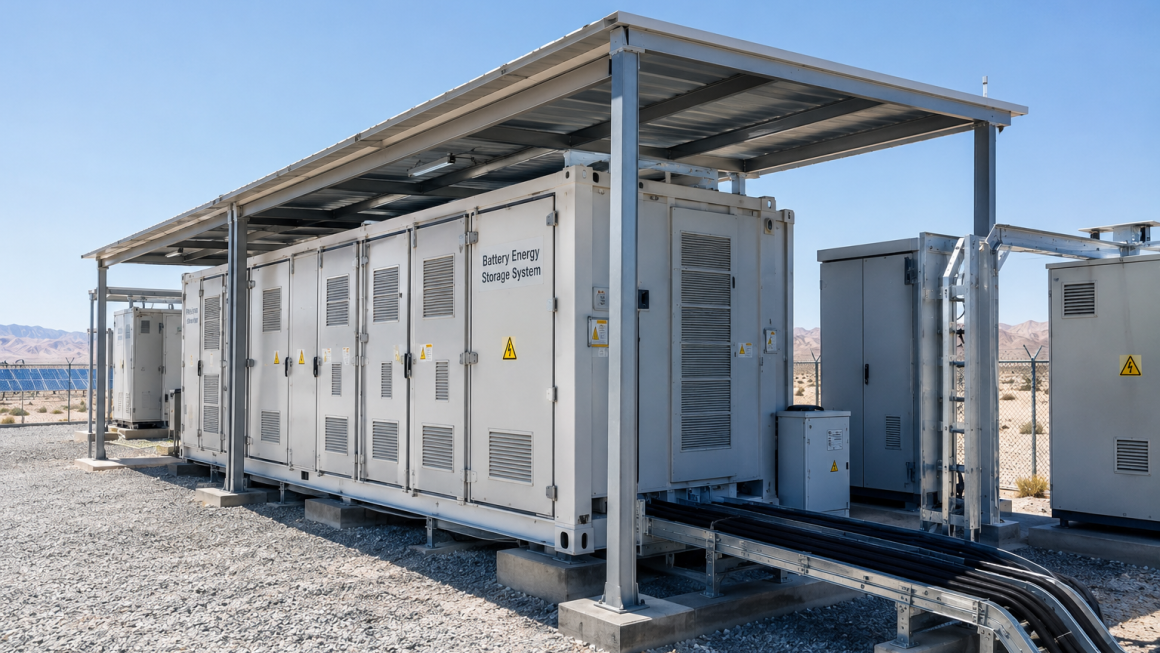
6. Raised Roof Covers Can Be Especially Effective
For outdoor BESS equipment, a raised roof or canopy structure can provide substantial environmental protection without surrounding the equipment completely.
It can reduce direct exposure to:
- Sunlight
- Rain
- Sand
- Dust
- Falling debris
At the same time, open sides can maintain natural airflow.
This type of structure can be useful for:
- PCS cabinets
- Distribution cabinets
- Control cabinets
- Auxiliary equipment
- Outdoor electrical panels
A raised roof also creates an air gap between the equipment and the protective structure.
This can reduce direct solar heat gain.
7. UV Protection Is Often Overlooked
Dusty energy storage sites are frequently located in areas with strong solar radiation.
UV exposure can gradually degrade polymeric materials.
Potentially affected components include:
- Cable jackets
- Protective sleeves
- Gaskets
- Seals
- Flexible covers
- Plastic enclosures
- Labels
- Protective coatings
An outdoor equipment cover should therefore have appropriate UV resistance if it will remain exposed for years.
Materials should be evaluated for:
- UV stability
- Temperature resistance
- Mechanical durability
- Weather resistance
- Flexibility
- Aging characteristics
A cover that performs well during its first year may not provide the same protection after prolonged outdoor exposure if the material is not designed for the environment.
8. Rain Protection Is Not the Same as Dust Protection
Dusty environments are not necessarily dry.
Desert and semi-arid sites can experience intense short-duration rainfall, while coastal and tropical environments may combine dust with high humidity.
This creates a challenging combination:
Dust + moisture = contamination and corrosion risk
When dust deposits become wet, they can form a layer that is much more difficult to remove.
Moisture can also increase the risk of:
- Corrosion
- Electrical leakage
- Connector degradation
- Seal deterioration
- Insulation contamination
Equipment covers should therefore manage both dry and wet conditions.
The design should prevent direct rain entry without creating areas where moisture becomes trapped.
9. Material Selection Matters
Outdoor equipment covers can be manufactured from different materials depending on the required protection level.
Common approaches include:
Coated fabric
Flexible coated fabrics can be useful when equipment needs temporary or semi-permanent protection.
Advantages include:
- Lightweight construction
- Easy installation
- Flexibility
- Relatively simple replacement
However, long-term UV and temperature resistance must be carefully evaluated.
Engineered polymer materials
Polymer-based covers can provide good resistance to weather and moisture.
They may be suitable for smaller electrical components or connection points.
Metal structures
Aluminum or coated steel structures can provide long-term mechanical protection.
They are particularly useful for permanent canopies and equipment shelters.
Important considerations include:
- Corrosion resistance
- Structural strength
- Weight
- Thermal expansion
- Installation method
- Maintenance
For permanent BESS installations, a hybrid structure may sometimes be appropriate.
10. Cable Connections Need Special Protection
One of the most vulnerable areas around outdoor energy storage equipment is often not the main cabinet itself but the cable interface.
Cable entries and external connections can be exposed to:
- Dust
- Water
- UV radiation
- Mechanical impact
- Vibration
- Temperature cycling
A cover can reduce direct environmental exposure, but it should work together with appropriate cable protection.
A complete protection system may include:
- Cable glands
- Sealing systems
- Protective conduits
- Cable sleeves
- Cable trays
- Junction boxes
- Weather shields
- Strain relief
This layered approach is more reliable than depending on a single protective component.
11. Covers Should Not Interfere with Maintenance
A protective cover is only useful if technicians can still access the equipment safely.
Poorly designed covers may make it difficult to:
- Open cabinet doors
- Replace filters
- Inspect connectors
- Read displays
- Access emergency stops
- Perform electrical testing
- Remove failed components
This can increase maintenance time and potentially create safety risks.
For this reason, equipment covers should incorporate practical access features such as:
- Hinged panels
- Removable sections
- Access doors
- Inspection windows
- Service openings
- Quick-release fasteners
The protection system should make maintenance easier rather than more complicated.
12. Design for Wind Loading
Outdoor equipment covers must withstand the same environment they are designed to protect against.
This becomes particularly important in desert locations.
Strong winds can create significant mechanical forces on:
- Canopies
- Roof structures
- Side panels
- Mounting brackets
- Fasteners
A poorly secured cover can become a safety hazard.
Permanent installations should therefore consider:
- Wind speed
- Wind direction
- Structural loads
- Mounting method
- Foundation conditions
- Fastener strength
- Vibration
- Repeated wind loading
The cover should remain stable under the expected environmental conditions.
13. Dust Protection Should Not Create a Maintenance Problem
There is an important difference between preventing dust from reaching equipment and completely eliminating dust exposure.
No outdoor protection system can realistically eliminate all environmental contamination.
Instead, the goal should be to reduce the rate of contamination and make cleaning easier.
For example:
Without protection
Heavy dust accumulation → frequent cleaning → increased maintenance labor
With appropriate protection
Reduced exposure → slower contamination → longer maintenance intervals
This can lower operating costs over the equipment lifecycle.
14. Covers Can Support Preventive Maintenance
Outdoor equipment covers can also make preventive maintenance more predictable.
Maintenance teams can establish inspection points for:
- Cover condition
- Fasteners
- Seals
- Ventilation openings
- Dust accumulation
- Cable entries
- Corrosion
- Drainage
- Structural integrity
Inspection frequency should depend on the site environment.
A location exposed to frequent sandstorms may require much more frequent inspection than a relatively clean industrial site.
This is why environmental conditions should be incorporated into the O&M strategy.
15. Modular Covers Can Simplify BESS Expansion
Energy storage systems are increasingly designed as modular platforms.
A project may initially deploy several battery containers and PCS units and later add additional capacity.
The same principle can apply to protective structures.
Modular covers can be designed to accommodate:
- Additional PCS units
- New battery containers
- Expanded cable routes
- Additional auxiliary equipment
- Future cooling systems
This can reduce the need to redesign the entire environmental protection system during expansion.
A modular approach can therefore support both:
System scalability
and
Maintenance flexibility
16. Temporary Covers vs. Permanent Structures
Not every application requires a permanent equipment shelter.
The appropriate solution depends on project conditions.
Temporary equipment covers
Useful for:
- Construction periods
- Temporary installations
- Maintenance activities
- Equipment waiting for permanent enclosure upgrades
They can provide rapid protection against dust and weather.
Permanent equipment covers
More appropriate for:
- Long-term BESS installations
- Desert energy projects
- Remote renewable energy sites
- Industrial microgrids
- Utility-scale infrastructure
Permanent structures can be engineered specifically around equipment airflow, access, wind loading, drainage, and maintenance requirements.
17. Equipment Covers Should Be Part of the Site Design
An important lesson is that outdoor equipment covers should not be treated as an accessory added after the BESS has already been installed.
The protection strategy should be considered during site planning.
Relevant questions include:
- Where does prevailing wind come from?
- Where will dust accumulate?
- Which equipment generates the most heat?
- Where are the air intakes?
- Where are the cable routes?
- Which components require frequent maintenance?
- How will technicians access the equipment?
- How will rainwater drain?
- What happens during a sandstorm?
The answers influence the optimal cover design.
18. A Layered Protection Strategy Is More Reliable
The most effective outdoor BESS environmental protection strategy is usually not based on one component.
Instead, it combines several layers.
Layer 1: Site layout
Reduce direct exposure through appropriate equipment positioning.
Layer 2: Equipment enclosure
Provide the primary environmental barrier.
Layer 3: Outdoor equipment cover
Reduce direct exposure to dust, rain, UV, and debris.
Layer 4: Cable protection
Protect cable routes, connections, and entry points.
Layer 5: Cooling protection
Maintain clean and unobstructed airflow.
Layer 6: O&M
Regular inspection and cleaning maintain the protection system over its operating life.
Together:
Site design + enclosure + cover + cable protection + cooling + O&M
creates a much stronger environmental protection strategy.
19. How to Select an Outdoor Equipment Cover
Before specifying a cover, project engineers should evaluate several parameters.
Environmental conditions
- Dust concentration
- Sandstorm frequency
- Temperature range
- UV exposure
- Rainfall
- Humidity
- Salt exposure
Equipment characteristics
- Heat generation
- Ventilation requirements
- Equipment dimensions
- Cable entry locations
- Maintenance frequency
Mechanical requirements
- Wind loading
- Impact resistance
- Structural stability
- Mounting requirements
Maintenance requirements
- Access doors
- Removable panels
- Inspection points
- Cleaning requirements
Lifecycle considerations
The lowest-cost cover is not necessarily the most economical solution.
A better comparison should consider:
Purchase cost + installation + maintenance + replacement + equipment protection + downtime risk
This provides a more realistic total cost of ownership.
20. The Future of Outdoor BESS Protection
As energy storage systems move into increasingly demanding environments, environmental protection will become a more integrated part of system design.
Future outdoor BESS installations are likely to combine:
- High-performance enclosures
- Advanced filtration
- Intelligent thermal management
- Modular protective structures
- UV-resistant materials
- Improved cable sealing
- Environmental sensors
- Predictive maintenance
- Remote monitoring
Sensors can also help operators identify changing environmental conditions.
For example:
Dust level increases → filter loading increases → airflow decreases → cooling performance changes → maintenance alert
This creates an opportunity to connect environmental protection with intelligent O&M.
Outdoor energy storage systems must operate reliably despite exposure to dust, sand, heat, UV radiation, rain, and changing environmental conditions.
Outdoor equipment covers for dusty energy storage sites provide an additional layer of protection for PCS cabinets, control equipment, cable interfaces, cooling components, and other vulnerable infrastructure.
However, effective protection requires more than simply covering the equipment.
The cover must be designed around:
- Dust exposure
- Airflow
- Heat dissipation
- UV resistance
- Rain management
- Wind loading
- Cable access
- Maintenance requirements
- Long-term material durability
The most effective strategy is a layered one:
Protect the equipment without preventing it from operating, cooling, and being maintained.
For BESS developers and operators, this approach can help reduce environmental contamination, improve equipment reliability, simplify maintenance, and support longer-term system performance in demanding outdoor environments.
Frequently Asked Questions
What are outdoor equipment covers used for in BESS?
They provide an additional layer of protection against dust, sand, rain, UV radiation, debris, and other environmental exposure around outdoor energy storage equipment.
Can an equipment cover cause overheating?
Yes. If a cover blocks ventilation or traps hot air around PCS or other power electronics, operating temperatures can increase. Cover design must therefore consider the equipment’s airflow and cooling requirements.
What equipment can be protected with outdoor covers?
Typical applications include PCS cabinets, electrical distribution equipment, control cabinets, junction boxes, cable connections, communication equipment, and auxiliary systems.
Are equipment covers suitable for desert BESS installations?
Yes, when properly engineered. Desert applications require particular attention to dust, sandstorms, UV exposure, high temperature, wind loading, and thermal management.
Should cable connections have additional protection?
Yes. Equipment covers should normally be combined with appropriate cable glands, sealing systems, conduits, sleeves, trays, and weather-resistant connection solutions.
What materials are suitable for outdoor equipment covers?
Depending on the application, suitable materials may include UV-resistant coated fabrics, engineered polymers, aluminum structures, coated steel, or hybrid constructions.
How should equipment covers be maintained?
Regular inspections should check for dust accumulation, material degradation, damaged fasteners, corrosion, blocked ventilation, water accumulation, and deterioration of seals or protective components.
Are permanent equipment covers better than temporary covers?
For long-term BESS installations, permanent engineered structures generally provide better durability and integration. Temporary covers can be useful during construction, maintenance, or temporary deployments.
What is the most important consideration when designing an outdoor BESS cover?
The most important consideration is balance: the cover must reduce environmental exposure without compromising cooling, ventilation, accessibility, safety, or maintenance.