


The rapid expansion of electric vehicles (EVs) is driving demand for faster and more powerful charging infrastructure.
While early EV charging systems could rely primarily on passive or air-based cooling, modern high-power charging systems are pushing thermal management requirements to a much higher level.
DC fast chargers operating at hundreds of kilowatts generate significant heat in power electronics, charging cables, connectors, and cooling components. As charging power continues to increase, liquid cooling is becoming an increasingly important technology for managing thermal loads.
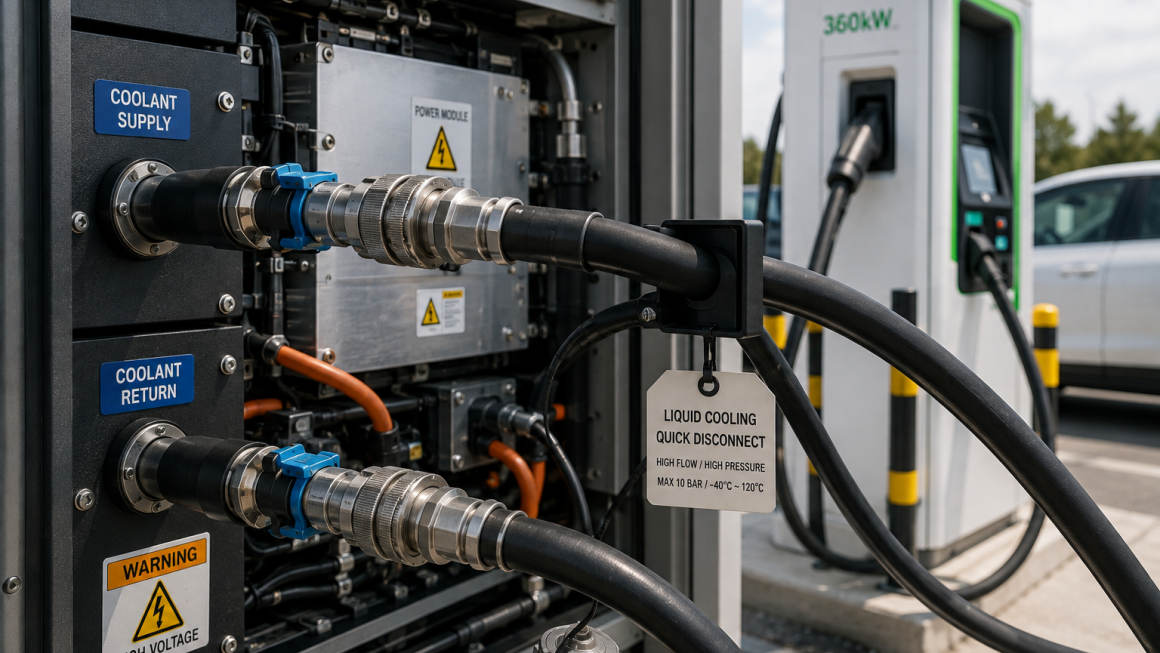
However, liquid cooling introduces another critical component into EV charging infrastructure: quick disconnect couplings, or QDs.
Heavy-duty quick disconnects provide a practical way to connect and disconnect coolant lines during manufacturing, installation, maintenance, and component replacement.
In high-power EV charging applications, these components must do much more than simply connect two hoses.
They must provide reliable fluid flow, leak resistance, mechanical durability, pressure capability, thermal cycling resistance, and long service life under demanding operating conditions.
Why EV Fast Charging Needs Better Thermal Management
The fundamental challenge is simple:
Higher charging power generates more heat.
An EV charging system converts electrical energy through power electronics before delivering energy to the vehicle battery.
During this process, some energy is inevitably converted into heat.
Heat can be generated by:
- Power semiconductor devices
- AC/DC converters
- DC/DC converters
- Charging connectors
- High-current cables
- Busbars
- Contactors
- Transformers
- Cooling equipment
As charging power increases, thermal management becomes increasingly important.
For example, a conventional charging system may operate at relatively moderate power levels, while modern high-power charging systems can reach several hundred kilowatts.
At these power levels, even relatively small electrical losses can translate into substantial heat generation.
The thermal management system must continuously remove this heat while keeping critical components within their required operating temperature ranges.
What Is Liquid Cooling in EV Charging Infrastructure?
Liquid cooling uses a circulating coolant to transfer heat away from high-temperature components.
A typical liquid cooling architecture may include:
Pump → Coolant Line → Cold Plate / Heat Exchanger → Charging Equipment → Heat Rejection → Pump
Depending on the system architecture, liquid cooling may be used for:
- Power electronics
- Charging cables
- Charging connectors
- Power modules
- Charging cabinets
- Energy storage components
- High-power charging dispensers
Compared with air cooling, liquid cooling can provide significantly higher heat-transfer capability within a compact system.
This makes it attractive for high-power charging infrastructure where space, weight, and thermal performance are important design constraints.
Why Charging Cables May Need Liquid Cooling
The charging cable is one of the most challenging thermal components in a high-power charging system.
Higher current produces resistive losses according to:
P = I²R
where:
- P is electrical power loss
- I is current
- R is electrical resistance
As current increases, resistive heating increases rapidly.
Simply increasing cable size can reduce resistance, but it also increases:
- Cable weight
- Cable diameter
- Material cost
- Bending difficulty
- Handling difficulty
For high-power EV charging, liquid-cooled charging cables can provide another solution.
A coolant channel integrated into or around the cable can remove heat generated during high-current operation.
This allows the charging system to achieve higher current capability without requiring an excessively large and heavy cable.
The Role of Quick Disconnects in Liquid-Cooled Charging
Once a liquid cooling loop is introduced, the system requires reliable fluid connections.
This is where quick disconnect couplings become important.
A quick disconnect allows two coolant lines to be connected or disconnected without requiring extensive disassembly.
A typical connection may consist of:
Coolant Hose → QD Coupling → Cooling Component
The coupling can be used between:
- Cooling unit and charging cabinet
- Cooling loop and charging cable
- Cooling loop and power electronics
- Cooling manifold and individual components
- Vehicle charging equipment and service equipment
For manufacturers and maintenance teams, this can significantly simplify assembly and servicing.
What Makes a Heavy-Duty QD Different?
Not every quick disconnect is suitable for high-power EV charging.
A heavy-duty QD must withstand the actual operating conditions of the cooling loop.
Important requirements can include:
- High flow capacity
- Low pressure drop
- Reliable sealing
- Pressure resistance
- Temperature resistance
- Thermal cycling
- Mechanical durability
- Vibration resistance
- Corrosion resistance
- Long connection life
- Compatibility with the selected coolant
The coupling becomes part of the thermal management system.
Its performance can directly influence coolant circulation and therefore the ability of the system to remove heat.
Flow Rate and Pressure Drop
One of the most important QD performance parameters is flow resistance.
Every component in a liquid cooling loop creates some pressure drop.
This includes:
- Hoses
- Tubes
- Valves
- Filters
- Heat exchangers
- Cold plates
- Quick disconnect couplings
If a QD has excessive internal restriction, the cooling system may require greater pump power to achieve the desired flow rate.
This creates a trade-off:
Higher Flow Rate → Better Heat Removal
but:
Higher Flow Resistance → Higher Pumping Energy
Therefore, QD selection should consider hydraulic performance rather than focusing only on nominal connection size.
Sealing and Leak Prevention
Leak prevention is one of the most important requirements for liquid-cooled EV charging systems.
Coolant leakage near electrical equipment can create significant reliability and safety concerns.
A QD therefore needs a reliable sealing architecture.
Common sealing considerations include:
- O-ring selection
- Seal material compatibility
- Compression
- Connection tolerance
- Surface finish
- Temperature range
- Pressure range
- Chemical compatibility
The sealing system must remain reliable over repeated connection and disconnection cycles.
This is particularly important for serviceable charging equipment where QDs may be disconnected during maintenance.
Dry-Break Quick Disconnects
In many applications, minimizing coolant leakage during connection and disconnection is important.
Dry-break or low-spill quick disconnect designs can help reduce fluid loss and contamination during maintenance.
When disconnected, internal valves can close to limit coolant leakage.
When connected, the valves open to establish the coolant flow path.
This can provide several practical benefits:
- Reduced coolant loss
- Cleaner maintenance
- Lower contamination risk
- Faster component replacement
- Improved serviceability
For high-power charging infrastructure, minimizing maintenance downtime can be an important consideration.
Thermal Cycling Is a Major Reliability Challenge
EV charging equipment does not necessarily operate at one constant temperature.
Charging loads can change rapidly.
The cooling system may therefore experience repeated thermal cycles.
For example:
Idle → High-Power Charging → Reduced Power → Idle
This can produce repeated expansion and contraction of:
- Hoses
- Couplings
- Seals
- Metal components
- Plastic components
- Cooling manifolds
Over thousands of operating cycles, thermal cycling can become an important reliability factor.
A QD designed only for static laboratory conditions may not provide the same performance under long-term dynamic operation.
Vibration and Mechanical Stress
Charging infrastructure is often installed in environments where mechanical vibration can occur.
Potential sources include:
- Vehicle movement
- Cable handling
- Charging connector insertion
- Cooling pumps
- Fans
- Compressors
- Outdoor equipment
- Roadside infrastructure
Heavy-duty QDs therefore need appropriate mechanical robustness.
The coupling should maintain secure engagement while minimizing stress on hoses and adjacent components.
Strain relief and proper hose routing can further reduce mechanical loading.
Coolant Compatibility
QD materials and seals must be compatible with the selected coolant.
Different systems may use different coolant formulations.
Potential compatibility considerations include:
- Chemical composition
- Temperature
- Additives
- Concentration
- Long-term exposure
- Material swelling
- Seal degradation
- Corrosion
A coupling that performs well with one coolant should not automatically be assumed to perform identically with another.
Material compatibility testing is therefore important during system development.
Corrosion Resistance in Outdoor Charging Infrastructure
Many EV charging stations are installed outdoors.
This exposes components to:
- Rain
- Humidity
- Salt spray
- Dust
- UV radiation
- Temperature changes
- Road contaminants
QD materials and surface treatments should therefore be selected according to the actual environmental conditions.
For coastal installations, for example, corrosion resistance may become particularly important.
For roadside charging infrastructure, protection against contamination and mechanical damage can also be significant.
QDs and Charging Cable Serviceability
One of the major advantages of QDs is serviceability.
A liquid-cooled charging cable can be a relatively complex assembly.
If a cable or cooling component needs replacement, permanently connected coolant lines can make the repair process more complicated.
A quick disconnect allows the affected component to be isolated and replaced more efficiently.
This creates a useful maintenance chain:
Fault Detection → Coolant Isolation → QD Disconnection → Component Replacement → Reconnection → Leak Check → System Recommissioning
Reducing the number of steps can help shorten maintenance downtime.
QDs in Modular Charging Infrastructure
The trend toward modular charging architecture further increases the value of quick disconnects.
A modular charging system may separate:
- Power conversion
- Cooling
- Charging dispensers
- Charging cables
- Control systems
- Electrical distribution
Standardized QD interfaces can allow cooling modules to be connected to different equipment configurations.
This can simplify:
- Manufacturing
- Assembly
- Installation
- Maintenance
- Retrofit
- System expansion
The QD becomes part of the modular interface between thermal components.
Heavy-Duty QDs and High-Power Charging
As charging power continues to increase, thermal management requirements will become more demanding.
Higher current means higher electrical losses.
Higher electrical losses mean greater heat generation.
Greater heat generation increases the need for effective cooling.
This creates a direct connection:
High-Power Charging → Liquid Cooling → Higher Coolant Flow → More Demanding QD Requirements
The QD therefore becomes an increasingly important component of high-power charging infrastructure.
QDs for Charging Cabinets and Power Electronics
Liquid cooling is not limited to charging cables.
Charging cabinets may contain high-density power electronics that require efficient heat removal.
Liquid cooling can be applied to:
- Power semiconductor modules
- Rectifiers
- Inverters
- DC/DC converters
- Cold plates
- Heat exchangers
Quick disconnects can connect these components to centralized or distributed cooling loops.
This modular approach allows individual thermal components to be serviced without completely rebuilding the cooling infrastructure.
Design Considerations for Heavy-Duty EV Charging QDs
When selecting a QD for EV charging infrastructure, engineers should evaluate several parameters.
1. Flow Rate
Does the coupling provide sufficient coolant flow for the required heat load?
2. Pressure Drop
How much additional pressure loss does the QD introduce into the cooling loop?
3. Working Pressure
Can the coupling safely operate at the required system pressure?
4. Temperature Range
Can the coupling and seals withstand the minimum and maximum operating temperatures?
5. Leak Performance
How much coolant leakage occurs during connection, disconnection, and normal operation?
6. Connection Cycles
How many connection and disconnection cycles can the QD withstand?
7. Coolant Compatibility
Are the body, seals, valves, and other wetted materials compatible with the coolant?
8. Environmental Resistance
Can the QD withstand outdoor conditions such as moisture, dust, salt, and temperature changes?
9. Mechanical Strength
Can it tolerate vibration, hose movement, and accidental mechanical loading?
10. Installation Space
Is the coupling suitable for the available equipment envelope?
These factors should be evaluated together rather than selecting a QD based only on nominal size.
The Importance of QD Size Optimization
A larger coupling does not automatically mean better performance.
Oversizing may increase:
- Cost
- Weight
- Installation space
- Material consumption
Undersizing may create:
- Excessive pressure drop
- Insufficient flow
- Higher pump requirements
- Reduced cooling capacity
The ideal QD should therefore match the actual hydraulic requirements of the cooling loop.
Reducing Total Cost of Ownership
A QD may represent only a small portion of the total charging infrastructure cost.
However, its lifecycle impact can be much larger.
A reliable QD can help reduce:
- Coolant leakage
- Maintenance time
- Component replacement time
- Unplanned downtime
- Service labor
- Fluid replacement
- Secondary equipment damage
This means QD selection should be evaluated based on total cost of ownership, rather than purchase price alone.
QDs and Preventive Maintenance
Preventive maintenance programs should include inspection of liquid cooling connections.
Maintenance teams can check:
- Signs of leakage
- Seal condition
- Coupling locking mechanism
- Hose connection
- Corrosion
- Physical damage
- Coolant residue
- Abnormal temperature
For high-utilization charging stations, connection components may experience frequent thermal and mechanical cycles.
Condition-based inspection can therefore become increasingly valuable.
The Future of Liquid-Cooled EV Charging
The future of EV charging is moving toward higher power density, faster charging, and more compact infrastructure.
This trend will increase demand for advanced thermal management.
Future charging systems may increasingly combine:
High-Power Electronics + Liquid-Cooled Cables + Advanced Cooling Loops + Intelligent Thermal Control + Heavy-Duty QDs
Thermal management will become an integrated part of charging system architecture rather than an auxiliary subsystem.
At the same time, modularity will continue to influence system design.
Serviceable thermal interfaces will allow charging equipment to be upgraded or repaired without replacing entire systems.
From Component to Thermal Interface Platform
The role of the quick disconnect may also evolve.
Rather than being viewed simply as a connector, the QD can be considered part of a complete thermal interface.
A high-performance interface may combine:
- QD coupling
- Hose
- Sealing system
- Strain relief
- Flow management
- Thermal insulation
- Mounting hardware
This integrated approach can improve reliability and simplify system engineering.
Liquid cooling is becoming increasingly important as EV charging systems move toward higher power levels.
High-current charging creates significant thermal loads, particularly in charging cables and power electronics. Liquid cooling provides an effective method for transferring this heat away from critical components while maintaining compact system dimensions.
However, liquid cooling also creates a need for reliable fluid connections.
Heavy-duty quick disconnect couplings play an important role by enabling secure coolant connections while supporting installation, maintenance, component replacement, and modular system design.
For high-power EV charging applications, QD selection should consider more than connection size.
Flow capacity, pressure drop, sealing reliability, thermal cycling, coolant compatibility, corrosion resistance, mechanical durability, connection cycles, and leak performance all influence long-term system reliability.
As EV charging infrastructure continues to move toward higher power density and faster charging, the demand for reliable thermal interfaces will grow.
The future charging system will not only need more electrical power.
It will also need better heat management, more reliable coolant connections, and more serviceable thermal architectures.
In this environment, heavy-duty quick disconnects are becoming an increasingly important component of the liquid cooling ecosystem for next-generation EV charging infrastructure.
Frequently Asked Questions
Why does EV fast charging require liquid cooling?
Higher charging currents generate more heat in cables, connectors, and power electronics. Liquid cooling can remove this heat more efficiently than conventional air cooling and can help enable higher charging power in a compact system.
What are QDs in liquid-cooled EV charging systems?
QDs, or quick disconnect couplings, are fluid connectors that allow coolant lines to be connected and disconnected efficiently. They are useful for assembly, maintenance, component replacement, and modular cooling system design.
Why are heavy-duty QDs important for high-power EV charging?
High-power charging systems can impose demanding requirements on coolant flow, pressure, temperature cycling, mechanical durability, and sealing. Heavy-duty QDs are designed to handle these requirements more reliably than basic fluid connectors.
What is a dry-break quick disconnect?
A dry-break QD incorporates internal valves that close when the coupling is disconnected, helping minimize coolant leakage and fluid loss during maintenance.
What should be considered when selecting an EV charging QD?
Key parameters include flow rate, pressure drop, working pressure, temperature range, sealing performance, connection cycles, coolant compatibility, corrosion resistance, mechanical durability, and installation space.
Can QDs be used for liquid-cooled charging cables?
Yes. QDs can connect liquid-cooled charging cables to cooling loops, allowing cables to be serviced or replaced more efficiently.
Does a QD affect cooling performance?
Yes. The internal geometry of a QD affects pressure drop and coolant flow. A poorly matched coupling can restrict flow and increase pump energy requirements.
How can QDs improve EV charging maintenance?
QDs can simplify coolant-line disconnection, reduce fluid loss, and allow components such as charging cables or cooling modules to be replaced without extensive disassembly.
Will QDs become more important as charging power increases?
Yes. As charging power increases, thermal loads and coolant-flow requirements also increase. This makes reliable, low-restriction, leak-resistant thermal interfaces increasingly important.