



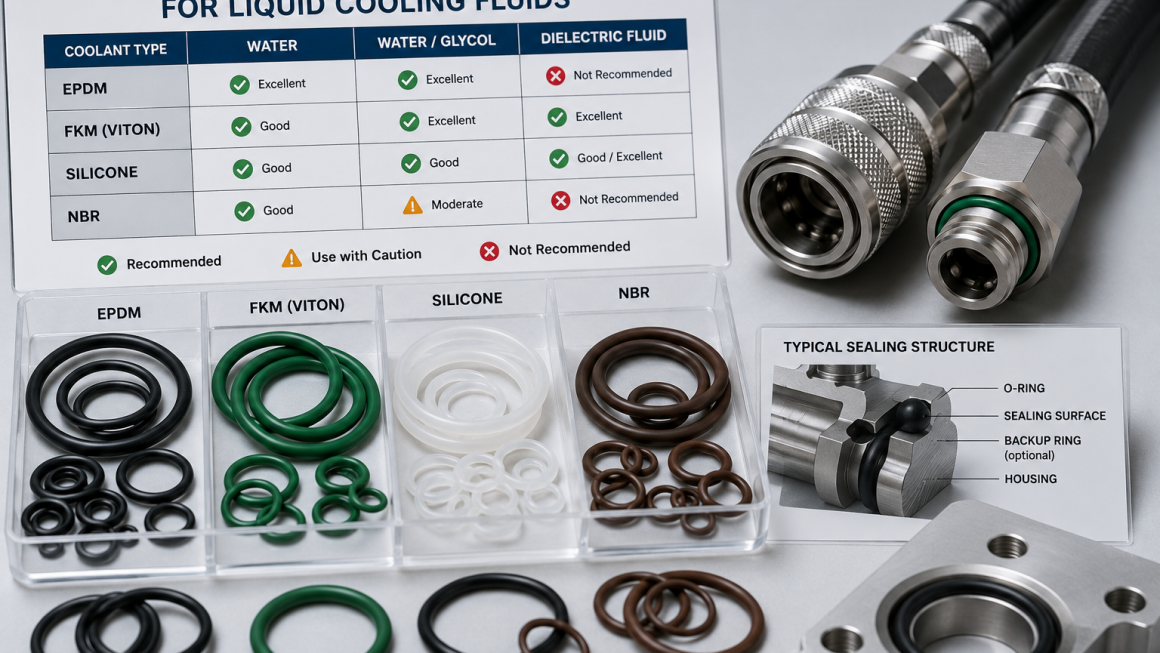
Why Seal Selection Is Critical in Liquid Cooling Systems
Liquid cooling has become a key thermal management technology for AI servers, high-performance computing (HPC), and Battery Energy Storage Systems (BESS).
A typical liquid cooling loop includes:
- Cold plates
- Quick disconnect couplings
- Pumps
- Manifolds
- Heat exchangers
- Hoses and fittings
Although these components are responsible for heat transfer and coolant circulation, the reliability of the entire system often depends on a small but critical component:
The O-ring and sealing system.
A failed seal can lead to:
- Coolant leakage
- Reduced cooling performance
- Equipment downtime
- Damage to sensitive electronics
Therefore, selecting the correct sealing material according to the coolant type and operating environment is essential.
The Role of O-Rings in Liquid Cooling Systems
O-rings provide a sealing interface between mechanical components.
They prevent fluid leakage by maintaining contact pressure between surfaces.
Common locations include:
- Quick disconnect couplings
- Cooling plate connections
- Manifold interfaces
- Valve assemblies
- Pump connections
A reliable O-ring must maintain performance under:
- Temperature changes
- Pressure fluctuations
- Chemical exposure
- Long operating periods
Main Factors Affecting Seal Performance
Temperature Range
Liquid cooling systems may operate under different temperature conditions.
High temperatures can cause:
- Seal hardening
- Loss of elasticity
- Cracking
Low temperatures may cause:
- Reduced flexibility
- Poor sealing performance
Chemical Compatibility
Different coolants interact differently with sealing materials.
A seal suitable for water may not perform well with dielectric fluids.
Material compatibility must be evaluated before system deployment.
Pressure and Mechanical Stress
Cooling loops experience:
- Pump pressure
- Connection cycles
- Mechanical vibration
The seal must maintain compression without excessive deformation.
O-Ring Selection for Water-Based Cooling Systems
Water-based cooling systems are common in:
- Data center liquid cooling
- Industrial cooling
- ESS thermal management
Water is often combined with additives such as:
- Glycol
- Corrosion inhibitors
- Biocides
EPDM O-Rings
EPDM is one of the most widely used sealing materials for water-based systems.
Advantages:
- Excellent water resistance
- Good temperature stability
- Good resistance to glycol mixtures
Typical applications:
- Cold plate systems
- Cooling loops
- Industrial fluid connectors
Advantages of EPDM
Suitable for:
- Water
- Water-glycol mixtures
- Cooling systems requiring long service life
Limitations:
- Poor compatibility with many oils and hydrocarbons
O-Ring Selection for Glycol-Based Coolants
Many BESS and industrial cooling systems use water-glycol mixtures.
Common glycol types include:
- Ethylene glycol
- Propylene glycol
Glycol provides:
- Freeze protection
- Improved temperature range
- Corrosion control
EPDM for Glycol Applications
EPDM is commonly selected because it provides:
- Good chemical resistance
- Long-term stability
- Reliable sealing performance
FKM (Viton) O-Rings
FKM provides:
- Higher temperature resistance
- Excellent chemical resistance
- Good durability
Applications include:
- Higher-temperature cooling systems
- Industrial environments
Limitations:
- Higher cost compared with EPDM
O-Ring Selection for Dielectric Cooling Fluids
Dielectric cooling fluids are increasingly used in advanced thermal management.
Applications include:
- Immersion cooling
- Specialized electronics cooling
- High-density computing
Unlike water-based systems, dielectric fluids require different sealing considerations.
FKM O-Rings
FKM is often preferred for dielectric applications.
Advantages:
- Excellent chemical resistance
- Good temperature stability
- Low fluid absorption
Silicone O-Rings
Silicone provides:
- Wide temperature range
- Excellent flexibility
Applications:
- Specialized cooling systems
- Extreme temperature environments
Limitations:
- Lower mechanical strength compared with some elastomers
Comparing Common O-Ring Materials
| Material | Water | Water-Glycol | Dielectric Fluid | Temperature Resistance |
|---|---|---|---|---|
| EPDM | Excellent | Excellent | Limited | Medium |
| FKM | Good | Excellent | Excellent | High |
| Silicone | Good | Good | Depends on fluid | Very High |
| NBR | Good | Moderate | Limited | Medium |
Common Seal Failure Modes
Chemical Swelling
Some fluids may cause the seal material to absorb chemicals.
Results include:
- Size change
- Reduced sealing force
- Leakage risk
Compression Set
Over time, elastomers may lose their ability to return to their original shape.
This can create:
- Reduced contact pressure
- Slow leakage
Temperature Aging
Continuous exposure to high temperatures may cause:
- Hardening
- Cracking
- Loss of elasticity
Incorrect Installation
Seal damage may occur due to:
- Improper lubrication
- Surface scratches
- Incorrect compression
- Misalignment
Seal Selection for Quick Disconnect Couplings
Quick disconnects are particularly demanding because they experience repeated connection cycles.
Important requirements include:
- Low friction
- High durability
- Reliable sealing
- Resistance to coolant chemistry
For example:
AI Data Center Liquid Cooling
Typical considerations:
- High connection cycles
- Clean coolant
- Low leakage requirement
Outdoor BESS Liquid Cooling
Additional requirements:
- Temperature fluctuation resistance
- Humidity resistance
- Long service life
- Corrosion compatibility
Engineering Recommendations
A reliable seal design should consider:
Match Seal Material with Coolant
Do not select O-rings based only on temperature.
Chemical compatibility is equally important.
Consider Total System Conditions
Evaluate:
- Temperature
- Pressure
- Fluid chemistry
- Connection frequency
- Operating environment
Validate Through Testing
Recommended testing includes:
- Immersion testing
- Pressure cycling
- Temperature cycling
- Leakage testing
- Long-term aging evaluation
Future Trends in Liquid Cooling Sealing Technology
As AI infrastructure and ESS systems continue to increase in power density, sealing technology is evolving toward:
- Advanced elastomer materials
- Low-leakage connector designs
- Longer lifecycle seals
- Environment-specific sealing solutions
- Smart leakage monitoring systems
Reliable sealing will become increasingly important as liquid cooling systems move toward higher performance levels.
O-ring and seal selection is a critical factor in liquid cooling system reliability.
Different cooling fluids require different sealing materials:
- EPDM is widely used for water and glycol systems.
- FKM provides higher chemical and temperature resistance.
- Silicone supports extreme temperature applications.
By selecting the correct sealing material according to coolant type, operating conditions, and system requirements, engineers can significantly reduce leakage risks and improve the long-term reliability of liquid cooling systems.
In AI data centers, HPC platforms, and Battery Energy Storage Systems, a small sealing component can have a major impact on overall system performance.