
As electric vehicles (EVs) rapidly scale across global markets, the demand for fast, reliable, and grid-friendly charging infrastructure is becoming a critical bottleneck. Ultra-fast charging—often defined as 150 kW to 350 kW and beyond—places significant stress not only on the grid but also on the underlying energy systems that support it.
At the center of this challenge lies a key enabling technology: high-power battery modules.
These modules are no longer just energy storage units. They are evolving into dynamic power buffers, grid stabilizers, and core building blocks of next-generation fast-charging infrastructure.
For companies operating in energy storage, materials, and system integration, understanding the role of high-power battery modules is essential to unlocking scalable EV charging solutions.
The Challenge of Fast-Charging Infrastructure
Fast charging introduces a fundamentally different load profile compared to traditional electricity consumption.
Instead of gradual, predictable demand, fast charging creates:
- Sudden high-power spikes (150 kW–350 kW per vehicle)
- Simultaneous multi-vehicle demand
- Highly intermittent usage patterns
For example:
- A single EV charging session at 250 kW can equal the peak demand of a small commercial building
- A charging station with 6–10 fast chargers can reach megawatt-level loads
This creates several challenges:
1. Grid Constraints
Many urban and semi-urban grids are not designed for such high instantaneous loads.
2. Infrastructure Cost
Upgrading transformers, cabling, and substations is capital-intensive and time-consuming.
3. Load Instability
Unmanaged charging demand can lead to voltage fluctuations and grid stress.
4. Energy Inefficiency
Peak demand charges significantly increase operational costs.
These challenges are driving the adoption of battery-integrated fast-charging systems.
Why High-Power Battery Modules Matter
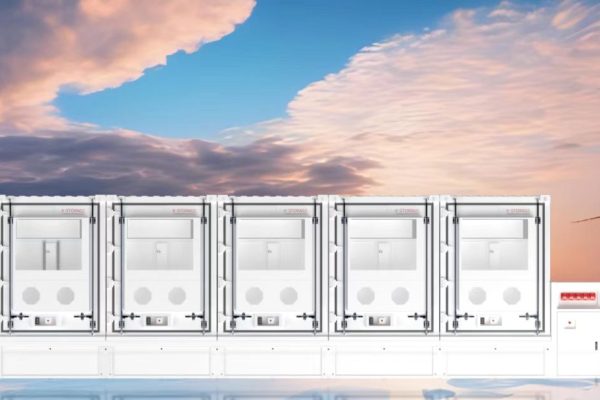
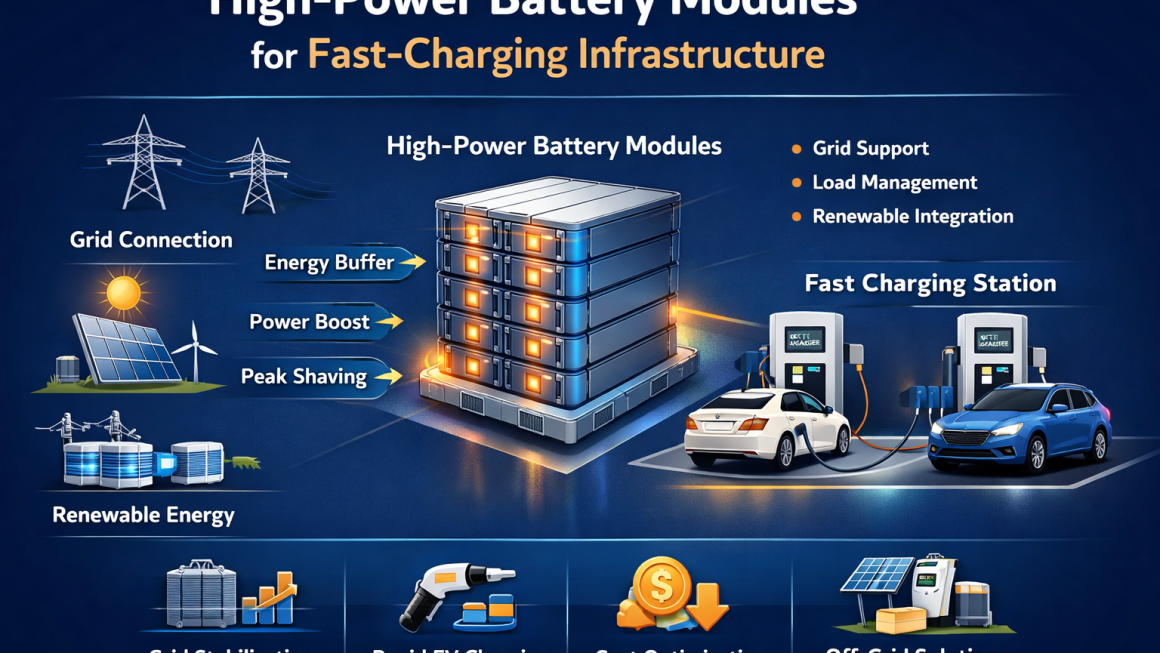
High-power battery modules act as an intermediate energy layer between the grid and EV chargers.
Instead of drawing all power directly from the grid, charging stations can:
- Store energy in battery modules during low-demand periods
- Deliver high-power output during charging events
This approach provides several key advantages:
Peak Shaving
Battery modules reduce the maximum power drawn from the grid by supplying part of the charging energy.
Grid Decoupling
Charging speed becomes less dependent on grid capacity, enabling deployment in grid-limited locations.
Energy Cost Optimization
Energy can be stored when electricity prices are low and used during peak periods.
Improved Charging Experience
Stable and consistent power delivery ensures faster and more reliable charging sessions.
Defining High-Power Battery Modules
Not all battery modules are suitable for fast-charging infrastructure. High-power modules are specifically designed to handle:
- High discharge rates (high C-rate performance)
- Rapid charge/discharge cycling
- Thermal stability under high load
- Low internal resistance
Key characteristics include:
High C-Rate Capability
High-power modules can discharge at multiple times their nominal capacity, enabling rapid energy delivery.
Low Impedance Design
Reduced internal resistance minimizes energy loss and heat generation.
Fast Thermal Response
Efficient heat dissipation is critical to maintaining performance and safety.
Long Cycle Life Under High Load
Modules must withstand frequent high-power cycling without rapid degradation.
System Architecture: Battery-Buffered Fast Charging
Modern fast-charging infrastructure increasingly adopts a battery-buffered architecture.
Typical System Components:
- Grid connection
- Power conversion system (PCS)
- High-power battery modules
- DC fast chargers
- Energy management system (EMS)
How It Works:
- The grid supplies steady, moderate power
- Battery modules store this energy
- During charging events, batteries discharge rapidly
- The PCS regulates power flow to EV chargers
- EMS optimizes energy allocation in real time
This architecture transforms the charging station from a passive load into an active energy system.
Materials and Design Behind High-Power Performance
High-power battery modules are not defined only by cell chemistry—they are the result of integrated material and engineering design.
1. Electrode Materials
High-rate performance depends heavily on electrode design:
- Optimized particle size distribution
- Conductive additives (e.g., carbon-based materials)
- Advanced coating techniques
These factors improve electron and ion transport, enabling fast charge/discharge.
2. Thermal Interface Materials (TIMs)
Thermal management is one of the most critical aspects of high-power modules.
At high discharge rates:
- Heat generation increases significantly
- Temperature gradients can cause uneven aging
Advanced thermal interface materials help:
- Transfer heat efficiently from cells to cooling systems
- Maintain uniform temperature distribution
- Improve safety and lifespan
3. Busbars and Conductive Pathways
High currents require optimized electrical pathways:
- Low-resistance busbar design
- High-conductivity materials
- Compact and robust interconnections
Poor electrical design leads to energy loss and localized heating.
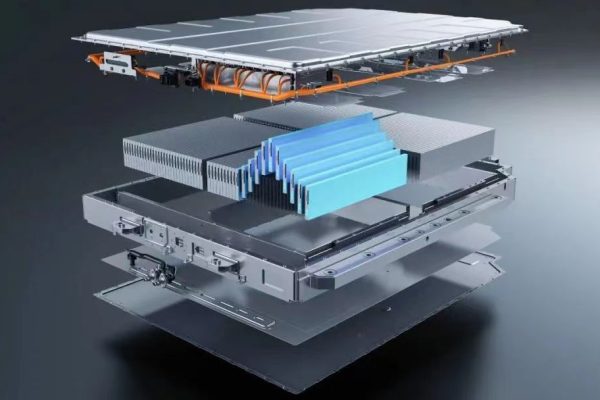
4. Module-Level Engineering
Beyond materials, module architecture plays a key role:
- Cell arrangement for uniform current distribution
- Mechanical stability under thermal expansion
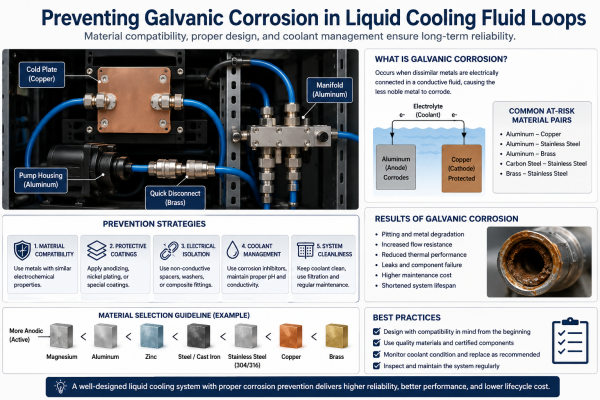
- Integration with cooling systems (air or liquid)
This is where materials meet system engineering.
Integration with Renewable Energy
High-power battery modules also enable renewable-powered fast charging.
In such systems:
- Solar PV generates electricity during the day
- Battery modules store excess energy
- EVs are charged using stored renewable energy
This reduces:
- Grid dependency
- Carbon footprint
- Operating costs
In off-grid or weak-grid regions, this approach can enable standalone charging stations.
Application Scenarios
High-power battery modules are being deployed across multiple fast-charging scenarios:
Highway Charging Hubs
- High vehicle throughput
- Peak demand management
- Reduced grid upgrade requirements
Urban Charging Stations
- Limited grid capacity
- High demand variability
- Need for compact systems
Fleet Charging Depots
- Predictable but high-power demand
- Opportunity for energy optimization
Remote and Off-Grid Locations
- Integration with solar + storage
- Reduced reliance on grid infrastructure
Challenges and Considerations
Despite their advantages, high-power battery modules introduce new challenges:
Thermal Stress
High power density increases heat generation, requiring advanced cooling solutions.
Degradation Under High C-Rates
Frequent fast cycling can accelerate battery aging if not properly managed.
System Cost
Battery integration adds upfront cost, though it reduces long-term operational expenses.
Control Complexity
Coordinating grid, battery, and charging loads requires advanced EMS strategies.
The Future of Fast-Charging Infrastructure
As EV adoption continues to grow, fast-charging infrastructure will evolve toward:
- Ultra-high power charging (500 kW+)
- AI-driven energy management
- Integration with distributed energy systems
- Second-life battery applications
High-power battery modules will become:
Not just support components, but central energy nodes in intelligent charging ecosystems
How gr-newenergy.com Supports This Evolution
At gr-newenergy.com, we focus on enabling next-generation energy systems through a material-to-application approach:
- Conductive and thermal materials for high-power battery modules
- Intermediate solutions supporting module and system design
- Integration support for energy storage and charging applications
Rather than focusing solely on large-scale deployment, we support:
- Component-level optimization
- Module-level performance improvement
- System-level integration pathways
This approach is particularly relevant for fast-charging infrastructure, where performance depends on the seamless interaction between materials, modules, and systems.
Fast-charging infrastructure is one of the most critical enablers of the EV transition—but it also presents significant technical and economic challenges.
High-power battery modules provide a powerful solution by:
- Decoupling charging demand from grid constraints
- Enabling stable, high-speed charging
- Supporting renewable integration
- Improving overall system efficiency
As charging networks become more complex and demanding, the role of battery modules will continue to expand—from energy storage units to core infrastructure components.
For companies building the future of energy, the question is not whether to integrate battery modules—but how to optimize them for power, performance, and system-level impact.