Understanding the Differences, Efficiency, Costs, and Installation Considerations
As residential solar energy systems become more common, homeowners are increasingly considering battery storage to improve energy independence, reduce electricity costs, and maintain power during grid interruptions.
However, choosing a home battery is not the only important decision. One of the first technical questions is how the battery should be connected to the solar photovoltaic (PV) system.
Two common configurations are AC-coupled and DC-coupled home energy storage systems.
Both approaches allow homeowners to store excess solar energy and use it later. However, they differ in electrical architecture, conversion processes, equipment requirements, installation complexity, and compatibility with existing solar installations.
So, which one is better?
The answer depends largely on whether you are installing a new solar-plus-storage system or adding a battery to an existing PV installation.
This guide explains how AC-coupled and DC-coupled home storage systems work, compares their advantages and limitations, and highlights the practical factors that should be considered before installation.
1. What Is AC-Coupled Home Storage?
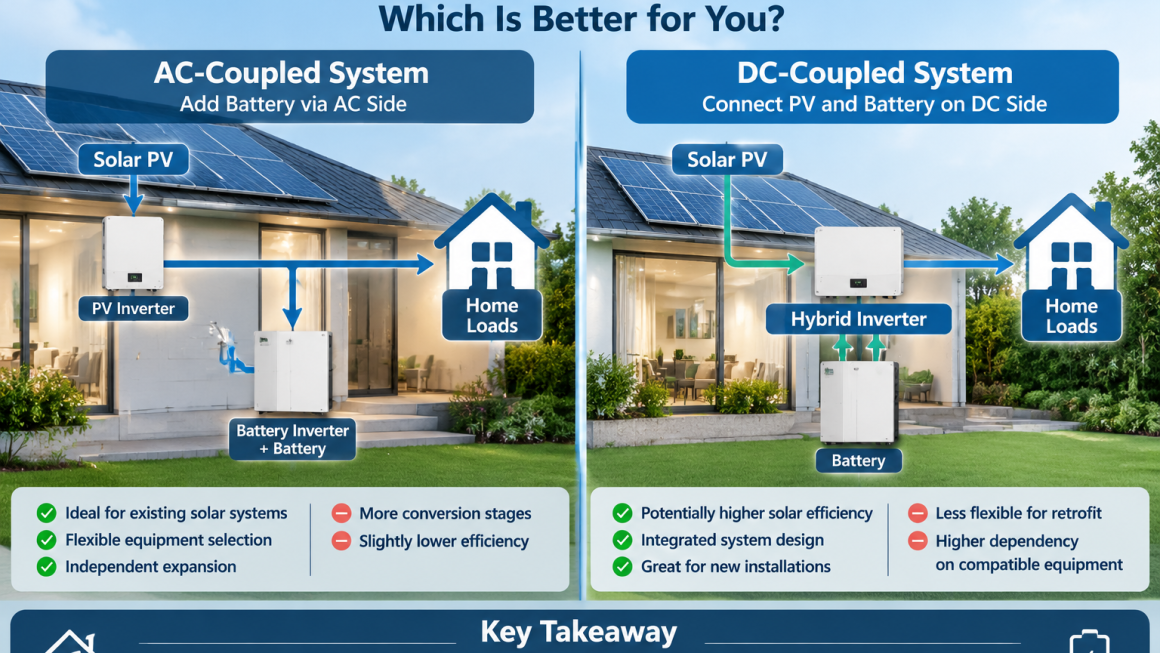
In an AC-coupled system, the solar PV system and battery storage system typically have separate inverters.
Solar panels generate direct current (DC) electricity. A solar inverter converts this electricity into alternating current (AC) for household use.
The battery system has its own battery inverter, which manages charging and discharging.
When excess solar electricity is available, the energy can flow through the AC electrical system and be converted into DC before being stored in the battery.
When the battery supplies electricity to the home, the battery inverter converts the stored DC energy back into AC.
How an AC-Coupled System Works
A typical energy flow is:
- Solar panels generate DC electricity.
- The PV inverter converts DC into AC.
- Household loads consume the available AC electricity.
- Excess electricity is directed through the battery inverter.
- The battery inverter converts AC into DC for battery charging.
- When required, the battery converts stored DC energy back into AC for household consumption.
Key characteristic: The PV inverter and battery inverter operate as separate conversion systems connected through the AC side.
<figure>
AC-coupled system architecture:
Solar PV → PV Inverter → AC Distribution → Household Loads
AC Distribution ↔ Battery Inverter ↔ Battery Storage
</figure>
Advantages of AC-Coupled Storage
1. Suitable for existing solar installations
AC coupling is often convenient when homeowners already have a functioning grid-connected solar system and want to add battery storage without replacing the existing PV inverter.
2. Greater flexibility in equipment selection
Because the PV and battery systems have separate inverters, they can sometimes be selected or upgraded independently, subject to system compatibility.
3. Easier integration with some existing systems
AC-coupled storage can be practical for retrofit projects, especially when the existing solar installation is already operating reliably.
4. Independent system expansion
Depending on the equipment architecture, battery capacity or storage functionality can be expanded without redesigning the entire PV generation system.
Limitations of AC-Coupled Storage
The main consideration is the additional energy conversion process.
Solar electricity may pass through several conversion stages before it is stored and later used.
This can result in higher conversion losses compared with some DC-coupled configurations.
AC coupling also requires coordination between the PV inverter, battery inverter, energy management system, and electrical protection devices.
The actual complexity depends on the selected equipment and system design.
2. What Is DC-Coupled Home Storage?
In a DC-coupled system, the solar PV array and battery storage system are connected on the DC side, typically through a hybrid inverter or a coordinated DC power conversion architecture.
Solar panels generate DC electricity, which can be used to charge the battery without first converting it into AC and then back into DC.
When electricity is needed by household appliances, the inverter converts the available DC power into AC.
How a DC-Coupled System Works
A typical energy flow is:
- Solar panels generate DC electricity.
- The DC power is managed through the hybrid inverter or DC conversion system.
- Excess solar energy charges the battery directly through the DC-side architecture.
- Stored battery energy is converted into AC when household loads require electricity.
Key characteristic: Solar generation and battery charging are coordinated on the DC side, reducing the need for repeated AC/DC conversion during solar charging.
<figure>
DC-coupled system architecture:
Solar PV → DC Power Management / Hybrid Inverter ↔ Battery Storage
Hybrid Inverter → AC Distribution → Household Loads
</figure>
Advantages of DC-Coupled Storage
1. Potentially higher solar-to-battery efficiency
Because solar electricity can charge the battery without an intermediate conversion to AC and back to DC, DC coupling can reduce conversion losses.
However, actual efficiency depends on inverter topology, battery voltage, operating conditions, and system design.
2. Integrated equipment architecture
A hybrid inverter can coordinate PV generation, battery charging, battery discharging, and grid interaction within one system architecture.
3. Suitable for new solar-plus-storage installations
When PV and battery storage are installed together, DC coupling can provide a well-coordinated solution without requiring a separate battery inverter.
4. Potentially simpler energy conversion pathways
For solar charging, fewer conversion stages can improve overall energy utilization.
Limitations of DC-Coupled Storage
1. Greater dependence on equipment compatibility
The battery voltage range, communication protocol, charging limits, and inverter specifications must be compatible.
2. Retrofit limitations
Adding a DC-coupled battery to an existing solar installation may require replacing the existing inverter or making substantial system modifications.
3. Centralized equipment considerations
When PV and battery functions depend on a hybrid inverter, equipment failure or replacement may affect multiple system functions, depending on the architecture.
4. Expansion constraints
Future battery expansion must comply with the hybrid inverter’s voltage, current, power, and battery compatibility limits.
3. AC vs. DC-Coupled Home Storage: Key Differences
The following table summarizes the main technical differences.
| Comparison | AC-Coupled | DC-Coupled |
|---|---|---|
| Connection architecture | Battery connected on AC side | Battery connected on DC side |
| PV inverter | Usually separate | Often integrated into hybrid inverter |
| Battery inverter | Typically separate | Often integrated into hybrid inverter |
| Solar-to-battery conversion | Usually includes DC-to-AC and AC-to-DC stages | Can charge through DC-side power conversion |
| Retrofit suitability | Often better for existing PV systems | Depends on existing inverter architecture |
| New installation | Suitable | Often attractive |
| Equipment flexibility | Potentially higher | More dependent on inverter compatibility |
| System coordination | Requires coordination between separate devices | Often coordinated through hybrid inverter |
| Installation complexity | Depends on existing AC distribution and equipment | Depends on DC design and equipment integration |
| Expansion | Depends on inverter and system limits | Depends on hybrid inverter and battery limits |
It is important to distinguish between conversion efficiency and overall system efficiency.
A DC-coupled system may have an advantage in certain solar charging scenarios, but this does not automatically mean every DC-coupled system will outperform every AC-coupled system.
4. Which System Is More Efficient?
Efficiency is one of the most frequently discussed differences between AC and DC coupling.
However, comparing only the number of conversion stages can be misleading.
A complete assessment should consider:
- PV inverter efficiency.
- Battery inverter or hybrid inverter efficiency.
- Battery charging and discharging efficiency.
- Standby power consumption.
- Cable and connection losses.
- Operating power levels.
- Battery temperature and operating conditions.
- Energy management and control strategies.
Example: Storing Excess Solar Energy
Consider a household with excess solar generation during the day.
In an AC-coupled system:
PV DC → PV Inverter → AC → Battery Inverter → Battery DC
In a DC-coupled system:
PV DC → DC Power Management → Battery DC
The DC-coupled architecture may avoid an additional DC-to-AC-to-DC conversion sequence during solar charging.
However, when the battery later supplies household AC loads, conversion is still required.
Therefore, the actual efficiency difference should be evaluated using complete system efficiency data under comparable operating conditions.
Homeowners should request round-trip efficiency specifications and clarify the testing conditions, measurement boundaries, and whether auxiliary consumption is included.
5. Which System Is Better for Existing Solar Homes?
For homeowners who already have rooftop solar panels, the most important question is whether the existing PV system can be retained.
AC Coupling: Often Practical for Retrofit Projects
AC-coupled storage is frequently suitable when:
- The existing PV inverter is functioning properly.
- The homeowner wants to retain the current solar installation.
- The battery system can be installed as an additional AC-connected unit.
- The existing electrical distribution system can accommodate the additional equipment.
This approach may reduce the need for major modifications.
DC Coupling: Worth Evaluating When Equipment Is Being Replaced
DC coupling may be worth considering when:
- The existing PV inverter is approaching replacement.
- The homeowner plans a major solar system upgrade.
- A compatible hybrid inverter is available.
- Battery storage and PV generation can be redesigned together.
The final choice should compare total installed cost, expected energy performance, equipment compatibility, and future maintenance requirements.
6. Which System Is Better for New Home Solar Installations?
For a new residential solar-plus-storage installation, DC coupling is often an attractive option because the PV and battery architecture can be designed together from the beginning.
A hybrid inverter can coordinate solar generation, battery charging, and household energy consumption.
However, AC coupling should not be dismissed.
It may be appropriate when:
- Different equipment brands or architectures are required.
- The project prioritizes independent inverter selection.
- The installation needs a modular configuration.
- The system integrator has a preferred AC-coupled architecture.
- Future equipment replacement flexibility is important.
The better choice depends on the homeowner’s energy usage, equipment preferences, backup requirements, and long-term service strategy.
7. Backup Power: An Important Design Consideration
Many homeowners choose battery storage not only to increase solar self-consumption but also to maintain electricity during grid outages.
However, neither AC coupling nor DC coupling automatically guarantees backup power.
A complete backup design may require:
- Grid-forming inverter capability.
- Backup or essential-load distribution panel.
- Automatic transfer or isolation equipment.
- Appropriate protection and grounding arrangements.
- Battery reserve capacity.
- Load prioritization and energy management.
- Safe disconnection from the utility grid during an outage.
The ability to provide backup power depends on the inverter’s operating modes and the complete system architecture.
For example, some grid-following PV inverters stop operating when the grid fails. A compatible battery inverter or hybrid inverter must be able to establish and maintain the required local electrical supply before other generation sources can operate.
Homeowners should confirm which loads can be supported, the maximum backup power, and the expected operating duration.
8. Installation and O&M Considerations for Both Architectures
Regardless of whether a home storage system uses AC or DC coupling, installation quality plays an important role in long-term reliability.
The system includes more than solar panels, inverters, and batteries. It also requires properly designed electrical connections, cable routing, mechanical protection, sealing, and maintenance access.
8.1 Cable Protection and Routing
Residential energy storage installations may involve DC PV cables, battery cables, AC power cables, and communication cables.
Different cable types may require different routing and protection arrangements.
Important considerations include:
- Appropriate cable sizing and current ratings.
- Correct separation of power and communication cables where required.
- Suitable bending radius.
- Mechanical protection against abrasion and impact.
- UV resistance for exposed outdoor sections.
- Temperature suitability.
- Secure cable support and identification.
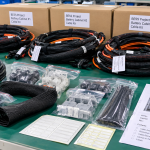
Protective sleeves, conduits, and cable management accessories can help organize and protect cables when correctly selected for the application.
8.2 Electrical Connections and Sealing
Outdoor inverters and battery installations may be exposed to rain, dust, humidity, and temperature changes.
Cable glands, grommets, and sealing accessories should be selected according to the equipment manufacturer’s requirements and the required enclosure protection rating.
Incorrect cable entry or sealing arrangements may compromise enclosure protection.
8.3 Maintenance Accessibility
A well-designed system should allow technicians to inspect and service equipment without unnecessary dismantling.
Consider:
- Accessible cable connections.
- Clear cable identification.
- Adequate equipment ventilation.
- Replaceable protective sleeves and accessories.
- Organized cable routing.
- Sufficient working clearance around equipment.
These details can improve maintenance efficiency throughout the system’s operating life.
9. A Practical Decision Framework
The following framework can help homeowners and installers identify the more suitable architecture.
| Project situation | Architecture worth evaluating |
|---|---|
| Existing PV system with a working inverter | AC-coupled |
| New solar-plus-storage installation | DC-coupled or AC-coupled |
| Existing inverter needs replacement | DC-coupled hybrid system |
| Independent inverter selection is important | AC-coupled |
| Integrated PV and battery control is preferred | DC-coupled hybrid system |
| Future battery expansion is expected | Evaluate both against expansion limits |
| Backup power is a priority | Evaluate complete backup architecture |
Questions to Ask Before Making a Decision
Before selecting a system, homeowners and installers should confirm:
- Is the solar PV system already installed?
- Can the existing inverter support battery integration?
- What is the expected battery capacity?
- What are the household’s daily electricity consumption patterns?
- Is backup power required during grid outages?
- Which loads must remain operational?
- What are the available installation spaces and environmental conditions?
- What are the equipment warranties and maintenance requirements?
- Can the system be expanded in the future?
- What is the total installed cost over the expected operating period?
A technically suitable system should balance performance, compatibility, cost, safety, and long-term serviceability.
10. Conclusion: AC or DC Coupling — Which Is Better?
There is no universal winner between AC-coupled and DC-coupled home storage.
AC coupling is often a practical option for homeowners who already have an operational solar PV system and want to add battery storage while retaining their existing inverter.
DC coupling is often attractive for new solar-plus-storage installations because it can provide a more integrated architecture and reduce conversion stages during solar battery charging.
However, the final decision should be based on the complete system design rather than a single efficiency figure.
In addition to battery and inverter selection, installation quality, cable protection, electrical connections, environmental suitability, and maintenance accessibility all contribute to reliable long-term operation.
At GR-NEWenergy, our focus is on supporting energy storage installation and O&M requirements through cable protection sleeves, routing accessories, sealing components, and related protective solutions.
Whether a project uses AC or DC coupling, properly selected installation accessories can help support organized wiring, equipment protection, and practical maintenance.
Frequently Asked Questions
1. Is AC-coupled or DC-coupled home storage more efficient?
DC-coupled systems can reduce conversion stages when storing solar electricity, potentially improving solar-to-battery efficiency. Actual performance depends on the inverter architecture, battery characteristics, and operating conditions.
2. Can I add a battery to my existing solar PV system?
Yes. AC-coupled storage is often used for retrofitting existing solar systems because it can operate alongside the existing PV inverter. DC-coupled integration may also be possible, depending on inverter compatibility and system design.
3. Is DC coupling always cheaper?
No. DC coupling may reduce certain equipment requirements in a new installation, but total cost depends on inverter selection, battery compatibility, installation work, system modifications, and local market conditions.
4. Which system is better for backup power?
Neither architecture automatically provides backup power. The inverter must support the required backup operating mode, and the system must include suitable isolation, transfer, protection, and load management arrangements.
5. Can AC-coupled and DC-coupled systems be expanded?
Both can be expanded in some configurations. However, expansion depends on inverter capacity, battery compatibility, electrical limits, control communication, and manufacturer requirements.
6. What should installers consider when selecting cable protection for home storage systems?
Installers should consider cable type, dimensions, current and temperature requirements, UV exposure, mechanical abrasion, routing conditions, enclosure entry, and maintenance accessibility.
7. Does AC or DC coupling affect battery lifespan?
The coupling architecture alone does not determine battery lifespan. Battery chemistry, temperature management, charging and discharging rates, depth of discharge, and battery management controls are more directly relevant.
Q1: What is the main difference between AC-coupled and DC-coupled home storage?
AC-coupled systems connect battery storage through a separate battery inverter on the AC side, while DC-coupled systems connect solar generation and battery storage through a shared DC-side architecture, commonly using a hybrid inverter.
Q2: Is AC coupling better for adding batteries to an existing solar system?
AC coupling is often a practical retrofit option because it can retain the existing PV inverter. However, compatibility, electrical capacity, backup requirements, and installation costs should be evaluated.
Q3: Is DC coupling better for new residential solar installations?
DC coupling is often attractive for new installations because PV and battery storage can be designed together, potentially reducing conversion losses during solar charging. AC coupling can still be appropriate where equipment flexibility is a priority.
Q4: Does AC or DC coupling provide better backup power?
Backup capability depends primarily on inverter functions, grid isolation, transfer arrangements, battery capacity, and system configuration rather than the coupling architecture alone.
Q5: What installation accessories are important for home battery storage systems?
Depending on the design, important accessories include cable protection sleeves, conduits, cable glands, grommets, sealing components, cable supports, and identification accessories.