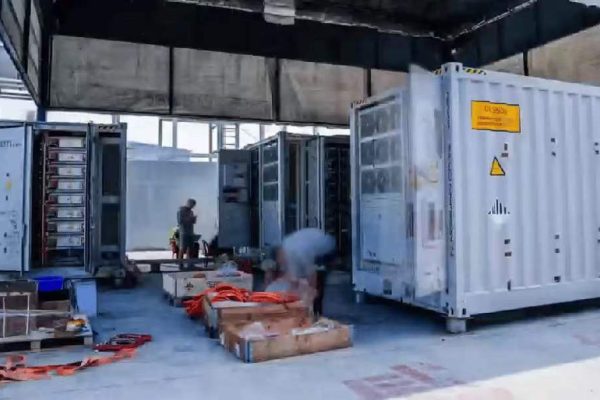



Energy storage projects often involve multiple cable types, connection points, protective accessories, and installation procedures. Even when the main equipment is supplied as a complete package, contractors and end clients may still need to perform significant cable preparation and accessory installation on site.
This creates several challenges:
- Different installers may prepare cables in different ways.
- Cable lengths and routing arrangements may vary between installations.
- Incorrect labeling can slow down commissioning and troubleshooting.
- Field cutting, stripping, and termination increase the possibility of installation errors.
- Missing accessories can delay project completion.
- Repeated manual preparation makes quality control more difficult.
One practical way to improve installation consistency is to provide pre-wired kits.
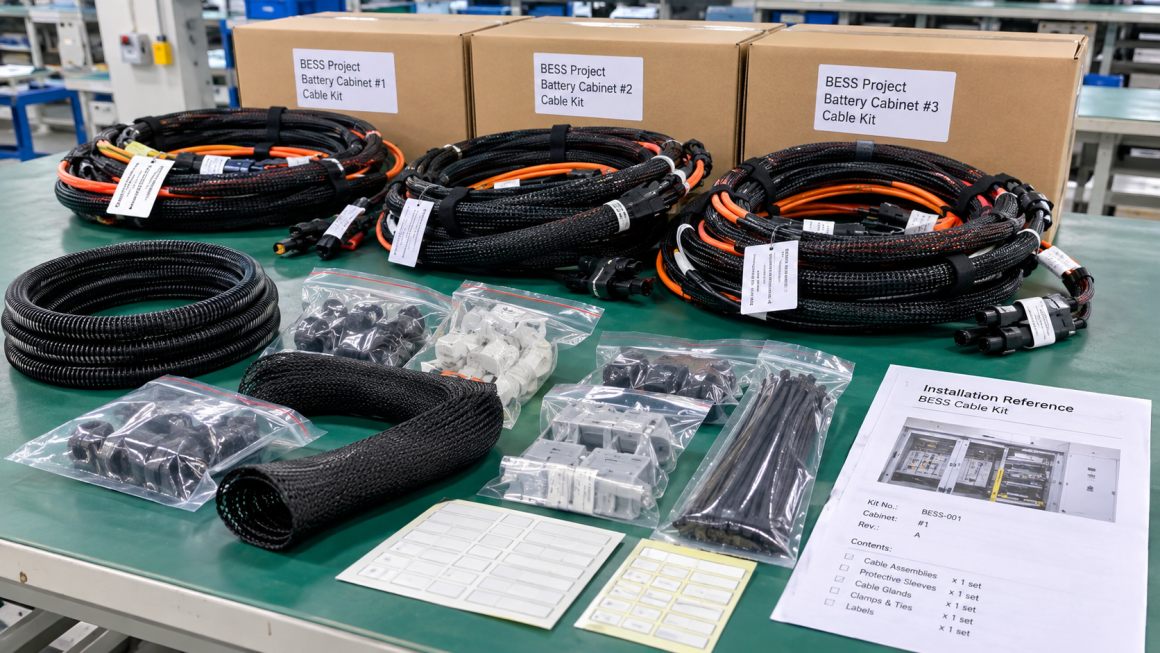
A pre-wired kit is a prepared package of cables, cable assemblies, protective components, connectors, labels, and installation accessories designed for a specific application or installation requirement.
For energy storage projects, properly specified pre-wired kits can reduce repetitive field work, improve cable management, and make installation and maintenance more predictable.
This article explains how suppliers can develop, prepare, and deliver pre-wired kits to end clients while maintaining clear technical and commercial boundaries.
1. What Is a Pre-Wired Kit?
A pre-wired kit is a group of prepared electrical or cable-related components supplied together according to an agreed installation configuration.
Depending on the project, a kit may include:
- Pre-cut cables with specified lengths
- Cable assemblies with approved connectors
- Cable protection sleeves and conduits
- Cable glands and sealing accessories
- Cable ties, clamps, and fastening components
- Identification labels and markers
- Installation drawings and connection references
- Protective covers and routing accessories
The exact contents depend on the application.
For example, a battery energy storage installation may require different kits for battery cabinet connections, auxiliary power cables, communication wiring, grounding connections, or external cable routing.
A pre-wired kit does not necessarily mean a complete electrical system. It may simply be a standardized package of prepared cable assemblies and related installation accessories.
The scope should be clearly defined before production.
2. Why End Clients May Prefer Pre-Wired Kits
The main commercial value of pre-wired kits is not simply convenience. It is the reduction of repeated preparation work and the improvement of installation consistency.
2.1 Reduced on-site preparation
Without pre-prepared components, installers may need to measure, cut, strip, label, protect, and organize cables individually.
A pre-wired kit can move suitable preparation work to a controlled production environment.
This can reduce repetitive field activities and help contractors concentrate on equipment positioning, routing, final connections, and commissioning.
2.2 More consistent cable lengths and identification
In projects with repeated cabinet layouts or standardized equipment configurations, cable lengths and identification requirements are often similar.
Preparing cable assemblies in batches can improve consistency.
Each cable can be supplied with an agreed identification label, making it easier for installation teams to identify its intended connection point.
2.3 Better material and accessory coordination
A common installation problem is that cable assemblies and protective accessories are purchased separately.
The cable may arrive before the sleeve, gland, clamp, or fastening accessory. Installers then need to source missing components or make substitutions.
A pre-wired kit can group compatible items together, reducing the risk of missing installation materials.
2.4 Easier maintenance and replacement
When cable assemblies and accessories are identified and documented consistently, maintenance teams can more easily understand the installation arrangement.
For replaceable cable assemblies, standardized kits may also simplify future procurement and replacement.
However, replacement must still follow the equipment manufacturer’s procedures and applicable electrical safety requirements.
3. What Should Be Included in an Energy Storage Pre-Wired Kit?
There is no universal kit configuration. The contents should be determined by the installation environment, electrical requirements, equipment interface, and customer responsibilities.
The following categories provide a practical starting point.
| Component category | Possible kit contents | Main purpose |
|---|---|---|
| Cable assemblies | Pre-cut cables, approved connector assemblies | Reduce field preparation |
| Cable protection | Braided sleeves, self-wrapping sleeves, conduits | Protect cable surfaces |
| Thermal protection | Fiberglass sleeves, aluminum foil protection | Address specified heat exposure |
| Cable entry protection | Cable glands, grommets, sealing accessories | Organize and protect cable entries |
| Fastening accessories | Clamps, cable ties, mounting clips | Secure cable routing |
| Identification | Cable markers, labels, identification tags | Improve traceability |
| Documentation | Cable list, layout drawing, installation instructions | Support installation and inspection |
Example: Battery Cabinet Cable Protection Kit
A kit designed for a battery cabinet installation might include:
- Pre-cut cable protection sleeves
- Split braided sleeves for existing or retrofit cable bundles
- Cable entry grommets
- Suitable fastening clips
- Identification labels
- A packing list and installation reference drawing
If the customer also requires pre-terminated electrical cables, those assemblies should be treated as a separately defined technical scope.
Cable conductor size, insulation rating, voltage rating, current capacity, connector compatibility, and termination quality must be confirmed by qualified electrical personnel.
4. Start with the Customer’s Installation Configuration
A pre-wired kit should never be developed simply by selecting commonly used cables and accessories.
The first step is understanding the actual installation configuration.
4.1 Collect equipment information
Request the relevant equipment details, such as:
- Equipment manufacturer and model
- Cabinet or rack dimensions
- Cable entry and exit locations
- Connection interface specifications
- Available installation space
- Required cable routing paths
- Operating environment
Where possible, obtain equipment drawings, photographs, and existing cable schedules.
4.2 Identify the cable requirements
For electrical cable assemblies, the technical team should confirm:
- Cable type and conductor material
- Conductor cross-sectional area
- Rated voltage and current requirements
- Insulation and temperature ratings
- Required cable length and tolerance
- Connector and terminal specifications
- Grounding requirements
- Applicable standards and customer specifications
For cable protection accessories, additional factors include:
- Outer cable diameter
- Bundle diameter
- Required sleeve size
- Temperature exposure
- Abrasion and mechanical protection needs
- UV, dust, moisture, or chemical exposure
- Required installation and maintenance access
These details determine whether the proposed components are suitable.
4.3 Confirm the installation responsibility
This is particularly important for pre-wired kits.
The customer should confirm which activities will be completed by the supplier and which will remain the responsibility of the installer or electrical contractor.
For example:
| Activity | Possible responsibility |
|---|---|
| Cable cutting and preparation | Supplier, subject to approved specifications |
| Connector assembly | Qualified cable assembly supplier |
| Sleeve cutting and preparation | Supplier |
| Accessory packaging | Supplier |
| Final cable routing | Site installation team |
| Electrical connection to equipment | Qualified installer |
| Commissioning and electrical verification | Authorized commissioning personnel |
Clear responsibility boundaries reduce misunderstandings and prevent the kit supplier from unintentionally assuming responsibility for the complete electrical installation.
5. Design the Kit Around Standardized Modules
For customers with repeated installations, modular kit design can improve efficiency.
Instead of preparing every order as a completely new package, suppliers can establish several standard kit categories.
5.1 Cabinet connection kits
These may contain prepared cable assemblies, identification materials, and suitable cable protection accessories for defined cabinet interfaces.
5.2 Cable routing and protection kits
These focus on cable management rather than electrical termination.
Possible contents include:
- Split braided sleeves
- Self-wrapping sleeves
- Corrugated conduits
- Cable clamps
- Grommets
- Mounting clips
- Identification labels
They are particularly useful when the end client wants a consistent protection arrangement across multiple cabinets.
5.3 Auxiliary wiring kits
These may be used for specified auxiliary power, monitoring, or control wiring applications.
The cable type, connector, pinout, shielding, and communication requirements must be confirmed against the equipment documentation.
5.4 Retrofit and maintenance kits
Existing installations may need replacement protection components without removing the original cable.
A retrofit kit may include:
- Openable braided sleeves
- Split conduits
- Reusable fastening accessories
- Replacement grommets
- Cable identification materials
- Installation instructions
The modular approach makes it easier to repeat orders and maintain a consistent bill of materials.
6. Create a Clear Bill of Materials (BOM)
A properly prepared bill of materials is essential for every pre-wired kit.
It should identify each component and its relevant specifications.
A practical BOM may include:
| Item | Description | Specification | Quantity | Remarks |
|---|---|---|---|---|
| 1 | Cable assembly | Customer-approved cable and connector specification | As required | Electrical scope |
| 2 | Protective sleeve | Split braided sleeve, specified diameter | As required | Cable protection |
| 3 | Cable gland | Approved thread and cable range | As required | Entry protection |
| 4 | Cable clamp | Compatible with cable or bundle diameter | As required | Cable securing |
| 5 | Identification label | Customer-approved numbering | As required | Traceability |
| 6 | Installation document | Drawing and component list | 1 set | Documentation |
The BOM should include part numbers, revisions, and approved substitutions where applicable.
If the customer changes the cable routing, equipment interface, or connector specification, the BOM should be reviewed before production.
This avoids the common problem of supplying a technically correct component that does not match the final installation configuration.
7. Quality Control Before Delivery
Pre-wired kits are intended to reduce work at the installation site. Therefore, quality control should take place before shipment.
The inspection process depends on the agreed scope.
For cable assemblies
Where the supplier is responsible for manufacturing electrical cable assemblies, quality checks may include:
- Cable type and specification verification
- Length measurement
- Connector and terminal verification
- Crimping or termination inspection
- Polarity and pinout verification where applicable
- Continuity testing
- Insulation resistance or other electrical testing where required
- Label and identification verification
The specific tests and acceptance criteria must be agreed in advance and performed using appropriate procedures and equipment.
For cable protection kits
Inspection may include:
- Sleeve material and size verification
- Length and quantity checks
- Surface condition inspection
- Accessory compatibility checks
- Fastening component verification
- Packaging and labeling inspection
For complete kits
Before packing, check:
- All BOM items are included.
- Component quantities match the approved order.
- Cable identification matches the drawings.
- Components are grouped by cabinet, section, or installation location.
- Documentation is included.
- Packaging protects components during transportation.
A final inspection checklist can help ensure that each kit is complete before dispatch.
8. Packaging and Identification: Make Installation Easier
A well-designed pre-wired kit should be easy to identify and distribute at the project site.
Packaging is therefore part of the solution.
8.1 Package by installation location
Instead of placing all components in one large carton, consider packaging by:
- Battery cabinet number
- Rack number
- Installation zone
- Electrical interface
- Maintenance task
For example, a project with 20 identical battery cabinets could receive 20 separately identified protection kits.
This reduces the need for installers to sort components manually.
8.2 Use consistent labeling
Labels should be clear, durable, and consistent with the customer’s documentation.
Possible identification information includes:
- Project reference
- Cabinet or rack number
- Kit number
- Component description
- Cable identification
- Drawing revision
- Quantity
For electrical cable assemblies, identification should match the approved cable schedule.
8.3 Include a simple installation reference
Each kit can include a short document showing:
- Kit identification
- Component list
- Intended installation location
- Relevant drawing reference
- Installation notes
- Inspection requirements
This does not replace the customer’s approved electrical drawings or formal installation procedures. It provides a convenient reference for the supplied components.
9. Common Mistakes When Supplying Pre-Wired Kits
Several problems can undermine the value of a pre-wired kit.
| Common mistake | Potential consequence | Recommended approach |
|---|---|---|
| Using estimated cable lengths | Cables may be too short or unnecessarily long | Confirm routing and measurement references |
| Ignoring connector interfaces | Assemblies may not fit the equipment | Verify approved connector specifications |
| Mixing different kit revisions | Installation inconsistency | Apply revision control |
| Providing unclear labels | Connection identification becomes difficult | Follow the customer cable schedule |
| Separating accessories from cable assemblies | Missing or incompatible components | Package according to the BOM |
| Over-customizing every order | Higher cost and longer lead time | Establish standard modules where possible |
| Unclear testing responsibility | Disputes over acceptance | Define inspection and test scope in advance |
| Claiming complete system readiness | Incorrect expectations about installation responsibility | State exactly what has been prepared and tested |
The most important principle is simple: a pre-wired kit should be designed around a confirmed installation configuration, not assumptions.
10. A Practical Workflow for Providing Pre-Wired Kits
A structured workflow helps suppliers manage customer requirements and production more effectively.
Step 1: Receive the inquiry
Collect the customer’s application, equipment details, quantities, project location, and expected delivery schedule.
Step 2: Review the technical information
Check drawings, cable schedules, interface specifications, photographs, and environmental requirements.
Identify missing information before preparing a quotation.
Step 3: Define the kit scope
Confirm whether the customer requires:
- Cable assemblies
- Cable protection accessories
- Complete accessory packages
- Installation documentation
- Inspection and testing
- Customized packaging
Step 4: Prepare the BOM and technical proposal
Provide a component list, specifications, quantities, assumptions, and exclusions.
Any unresolved technical details should be listed clearly.
Step 5: Obtain customer approval
Confirm the final drawings, cable schedule, BOM, labeling requirements, and kit configuration.
Production should not proceed on the basis of an unapproved preliminary layout.
Step 6: Manufacture and prepare the kits
Carry out the agreed cable preparation, assembly, accessory preparation, identification, and packaging.
Step 7: Inspect and document
Complete the agreed inspection and testing activities. Record relevant results and maintain revision traceability.
Step 8: Pack and deliver
Package kits by installation location or project section and provide the corresponding documentation.
Step 9: Collect installation feedback
After delivery, collect feedback from installers and project managers.
Identify recurring problems and improve future kit configurations.
11. Commercial Considerations: How to Quote Pre-Wired Kits
A pre-wired kit should not be quoted as a simple collection of individual components if it involves customization and preparation work.
The quotation may include several cost categories:
| Cost category | Description |
|---|---|
| Cable and connectors | Raw materials and approved electrical components |
| Protection accessories | Sleeves, conduits, glands, clamps, and related products |
| Processing | Cutting, stripping, crimping, termination, and assembly where included |
| Identification | Labels, markers, and documentation |
| Packaging | Individual kit packaging and transport protection |
| Quality control | Inspection, testing, and reporting |
| Engineering preparation | Drawing review, BOM preparation, and configuration work |
| Logistics | Freight, export packaging, and delivery |
For customized projects, it may also be useful to define a minimum order quantity or a one-time engineering preparation fee.
Start with a pilot batch
For a new customer, a pilot batch is often a sensible approach.
A small batch can help verify:
- Whether the kit configuration matches the actual installation
- Whether cable lengths and accessory sizes are correct
- Whether the labeling system is understandable
- Whether packaging is suitable for site distribution
- Whether the installation team can use the kit efficiently
After the pilot installation is reviewed, the configuration can be adjusted before larger-scale production.
This reduces the risk of repeating an incorrect configuration across an entire project.
12. How GR-NEWenergy Can Support Pre-Wired Kit Projects
GR-NEWenergy focuses on energy storage installation and O&M-related products, particularly cable protection, thermal protection, routing, fastening, and related accessories.
For customers developing pre-wired or pre-assembled installation kits, GR-NEWenergy can support the preparation of suitable cable protection and accessory packages according to confirmed project requirements.
Potential support areas include:
- Split braided sleeves for cable bundles
- Self-wrapping sleeves for accessible cable protection
- High-temperature fiberglass sleeves
- Aluminum foil and thermal protection materials
- Corrugated conduits and cable routing accessories
- Cable glands, grommets, and sealing components
- Cable clamps and fastening accessories
- Customized cutting, grouping, labeling, and packaging where available
The exact supply scope depends on the project and confirmed manufacturing capabilities.
Where customers require fully terminated electrical cable assemblies, connector integration, or electrical testing, these activities should be separately specified and assigned to qualified cable assembly partners.
Our objective is to help customers organize the relevant protection and installation accessories into practical, clearly identified packages that are easier to manage during installation and maintenance.
We believe that a good installation kit should do more than deliver components. It should help reduce unnecessary site preparation, improve consistency, and support long-term maintainability.
13.
Pre-wired kits can bring practical value to energy storage projects by moving suitable preparation activities from the installation site to a more controlled supply process.
The most effective approach begins with accurate technical information, a clearly defined scope, an approved bill of materials, appropriate quality checks, and installation-oriented packaging.
For end clients, the benefits can include reduced preparation work, improved component coordination, clearer identification, and easier maintenance.
For suppliers, standardized kit configurations can create repeatable products, improve order management, and support longer-term cooperation with system integrators, EPC contractors, installers, and O&M service providers.
The key is to provide exactly what the project requires, with clear specifications and clearly defined responsibilities.
Questions
1. What is a pre-wired kit in an energy storage project?
A pre-wired kit is a prepared package of cables, cable assemblies, connectors, protection accessories, identification materials, and related components designed for a specific installation configuration. Its contents depend on the project scope.
2. Can pre-wired kits reduce installation time?
They can reduce certain on-site preparation activities, such as cable cutting, labeling, accessory sorting, and some assembly work. Actual time savings depend on the kit scope, installation conditions, and the contractor’s workflow.
3. What information is needed to prepare a pre-wired kit?
Typical requirements include equipment drawings, cable schedules, cable specifications, connection interfaces, routing information, quantities, environmental conditions, labeling requirements, and delivery details.
4. Can cable protection accessories be included in pre-wired kits?
Yes. Suitable products may include braided sleeves, self-wrapping sleeves, corrugated conduits, fiberglass sleeves, cable glands, grommets, clamps, and other cable management accessories.
5. Are pre-wired kits ready for direct connection?
Not necessarily. The term does not automatically mean that every cable has been terminated, electrically tested, or approved for direct connection. The supplier and customer must define the exact preparation and testing scope.
6. Can pre-wired kits be customized for different battery cabinets?
Yes. Kits can be configured according to cabinet dimensions, cable routing, interface requirements, and installation quantities. Standardized configurations can also be developed for repeated cabinet models.
7. How should pre-wired kits be packaged?
For easier installation, kits can be grouped by cabinet, rack, installation zone, or project section. Each package should have clear identification and a corresponding component list.
8. Can pre-wired kits support maintenance and retrofit projects?
Yes. Maintenance kits can include replacement sleeves, openable conduits, fastening accessories, grommets, and identification materials. They can be designed to support specific retrofit tasks without necessarily removing existing cables.
Q&A
Q: What should a supplier include in a pre-wired kit for a BESS project?
A: Depending on the approved project scope, a BESS pre-wired kit may include prepared cable assemblies, connectors, cable protection sleeves, conduits, glands, clamps, identification labels, and installation documentation.
Q: How can pre-wired kits improve energy storage installation efficiency?
A: Pre-wired kits can move suitable preparation work away from the installation site, reduce repetitive component sorting, improve cable identification, and help installers receive the materials required for each installation section.
Q: What information is required before manufacturing customized pre-wired kits?
A: Suppliers typically need equipment drawings, cable schedules, connection specifications, routing information, cable lengths, accessory requirements, quantities, and packaging instructions.
Q: Can cable protection suppliers provide pre-wired kits?
A: Cable protection suppliers can provide customized protection and accessory kits, including sleeves, conduits, glands, clamps, and labels. Fully terminated electrical cable assemblies may require cooperation with qualified cable assembly manufacturers.
Q: What is the difference between a pre-wired kit and a cable protection kit?
A: A pre-wired kit may include prepared electrical cable assemblies and related accessories, while a cable protection kit focuses on protective and cable management components. The two can be combined when the project scope requires it.