Off-grid microgrids provide electricity to remote communities, industrial sites, agricultural facilities, telecommunications infrastructure, mining operations, and other locations where reliable grid access is unavailable or impractical.
Unlike grid-connected systems, an off-grid microgrid must balance electricity generation and consumption locally. Solar photovoltaic (PV) systems, battery energy storage, diesel or gas generators, and controllable loads may need to work together to maintain voltage, frequency, power quality, and an acceptable energy reserve.
For remote operations, the challenge extends beyond generating enough electricity. The system must also respond to changing weather, unexpected load variations, equipment faults, communication interruptions, and limited access to maintenance personnel.
Effective microgrid control strategies help coordinate these resources, reduce unnecessary fuel consumption, manage battery operation, and maintain service continuity within the capabilities of the installed equipment.
This article explains the main control strategies for off-grid microgrids, how energy storage supports system stability, and what operators should consider when designing systems for remote and difficult-to-access environments.
1. Why Off-Grid Microgrids Need Coordinated Control
An off-grid microgrid operates without relying on a utility grid to continuously balance electricity supply and demand. Its local energy resources must collectively meet the load while respecting the operating limits of each component.
Several factors make control particularly important.
1.1 Variable Renewable Energy Generation
Solar generation changes with sunlight, cloud cover, season, shading, and panel temperature. Wind generation, where installed, varies with local wind conditions.
When renewable generation decreases suddenly, the microgrid must obtain the missing power from available batteries, dispatchable generators, or other controllable resources.
When generation exceeds demand, the controller must decide whether to charge the battery, supply flexible loads, curtail generation, or use another permitted operating strategy.
1.2 Changing Electricity Demand
Remote sites may have highly variable loads. A mining facility may start heavy machinery, a telecommunications site may maintain relatively steady consumption, and an agricultural facility may operate irrigation pumps for limited periods.
Large load changes can affect system frequency and voltage, particularly when generation capacity or stored energy is limited.
The control strategy must therefore consider not only total energy consumption but also instantaneous power demand, load-starting characteristics, and the availability of reserve capacity.
1.3 Limited Access to Maintenance
A fault at a remote site may take hours or days to inspect and repair. Spare parts may be difficult to deliver, and specialist technicians may not be available locally.
Monitoring, alarms, remote diagnostics, fault isolation, and clear operating procedures are consequently important parts of microgrid reliability.
Remote monitoring, however, does not eliminate the need for physical inspections or qualified on-site maintenance.
1.4 Fuel and Logistics Constraints
Where diesel generators provide backup or dispatchable power, fuel transportation can represent a significant operating expense.
Coordinated storage and renewable generation can reduce generator operating hours under suitable conditions. The actual benefit depends on renewable resources, load patterns, fuel consumption, battery losses, maintenance costs, and system design.
2. The Main Components of an Off-Grid Microgrid
A typical off-grid microgrid may include several interconnected resources and control layers.
Solar PV System
PV modules provide electricity when solar energy is available. Depending on the architecture, PV inverters may operate under commands from a microgrid controller or follow the voltage and frequency established by another grid-forming source.
Battery Energy Storage System
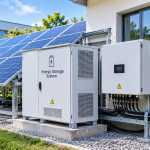
The battery stores energy for later use and can respond to changes in supply and demand. Its capabilities depend on the battery technology, BMS limits, inverter power rating, available state of charge, temperature, and operating strategy.
Dispatchable Generators
Diesel, gas, or other suitable generators may supply electricity when renewable generation and available battery energy are insufficient.
The controller may start or stop generators according to demand, battery reserve, forecast conditions, minimum loading requirements, and manufacturer restrictions.
Power Conversion Systems
Inverters and power conversion systems manage electrical energy transfer between resources and loads. Their grid-forming, grid-following, voltage-regulation, and frequency-response capabilities depend on the equipment and control configuration.
Microgrid Controller or Energy Management System
The controller coordinates generation, storage, and load management according to operating objectives and equipment constraints.
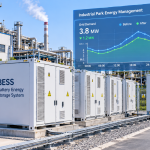
Some functions run locally in real time, while higher-level energy scheduling and reporting may be handled by an EMS or supervisory controller.
Loads and Protection Equipment
Loads may include essential services, industrial machinery, pumps, communications equipment, and noncritical consumption.
Switchgear, protective devices, grounding, isolation, and appropriate electrical distribution are necessary to support safe operation and fault management.
The exact configuration varies by site. Not every off-grid microgrid uses the same equipment or control hierarchy.
3. Understanding the Main Microgrid Control Strategies
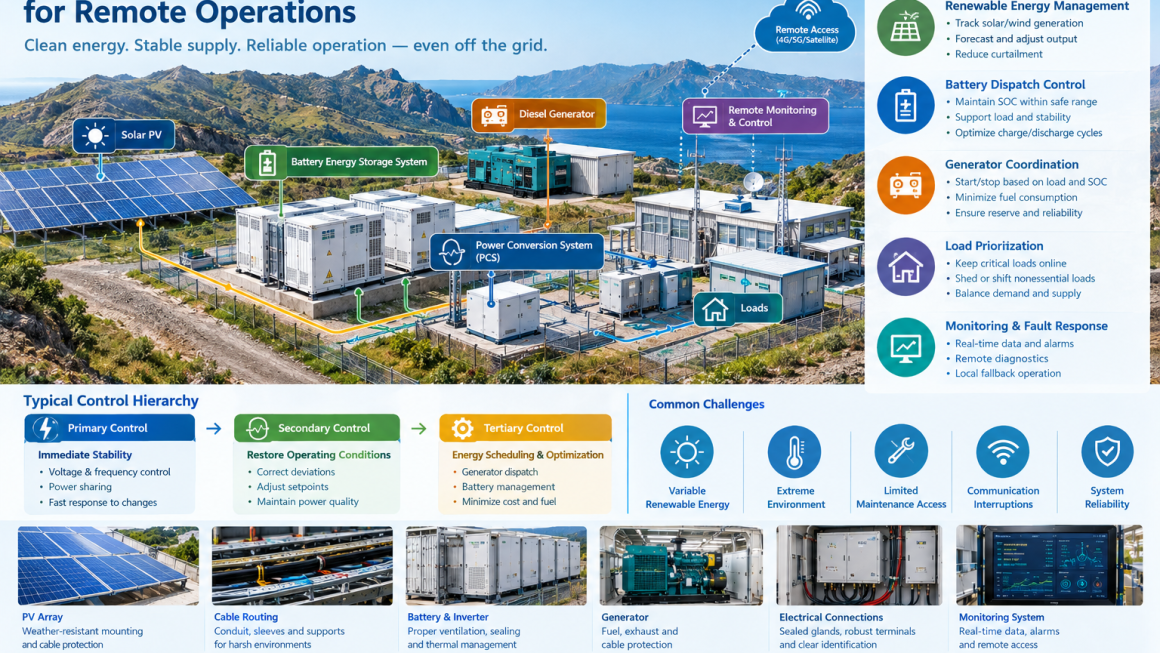
Microgrid control is often organized into primary, secondary, and tertiary levels. These levels address different time scales and operating objectives, although actual implementations may combine functions in different ways.
3.1 Primary Control: Immediate Electrical Stability
Primary control responds to rapid changes in electrical conditions.
Its functions may include:
- Maintaining voltage and frequency within permitted limits
- Sharing power between compatible parallel sources
- Responding to sudden load changes
- Limiting electrical output according to equipment capability
- Supporting stable operation during disturbances
In some systems, droop control allows parallel grid-forming sources to share active and reactive power without requiring continuous high-speed communication.
Battery inverters capable of grid-forming operation may establish the local voltage and frequency reference. In other configurations, a generator or another source may perform that role.
The appropriate strategy depends on system architecture, equipment capabilities, protection coordination, and the expected operating conditions.
3.2 Secondary Control: Restoring Operating Conditions
Secondary control corrects deviations that remain after the immediate response.
For example, primary control may allow a temporary frequency deviation while balancing a sudden change in load. Secondary control can then adjust operating references to bring frequency and voltage closer to their intended values.
This coordination may be implemented locally or through a microgrid controller, depending on communication requirements and system design.
3.3 Tertiary Control: Energy Scheduling and Optimization
Tertiary control operates at a slower time scale and focuses on resource scheduling.
Typical decisions include:
- When to charge or discharge the battery
- When to start or stop a generator
- How much battery reserve to maintain
- How to use forecast solar or wind generation
- When to schedule flexible loads
- How to minimize operating cost while meeting reliability requirements
The control objective should not be limited to reducing fuel consumption. It must also account for battery degradation, generator operating limits, reserve requirements, expected load changes, and the consequences of service interruption.
4. Battery Energy Storage Control Strategies
Battery storage is often a key resource in off-grid microgrids because it can respond quickly to changes in generation and demand.
However, the controller must distinguish between power available now and energy available over a longer period.
4.1 State-of-Charge-Based Control
The battery management system monitors battery conditions and provides relevant operating limits. The controller uses available state-of-charge information to determine whether charging or discharging is appropriate.
A typical strategy establishes operating thresholds:
- High state of charge: Reduce or stop charging when the permitted upper limit is reached.
- Normal operating range: Charge or discharge according to system demand and scheduling priorities.
- Low state of charge: Reduce discretionary discharge and prepare additional generation or load-management measures.
- Critical reserve condition: Protect essential loads and initiate the predefined backup or emergency operating strategy.
The thresholds should be established according to battery specifications, expected autonomy, reserve requirements, and the site’s risk profile.
The EMS should not override BMS protection limits.
4.2 Power Reserve Management
A battery can have substantial stored energy while still being unable to meet a sudden high-power demand if its inverter or battery power limit is too low.
For this reason, the controller should monitor both available energy and available power.
A remote industrial site may need to reserve enough inverter capacity to support motor starting or other transient loads, subject to the equipment’s actual capabilities.
Power reserve and energy reserve should therefore be evaluated separately.
4.3 Forecast-Based Charging
When solar generation forecasts are available, the controller can adjust charging and generator schedules in advance.
For example, if high solar generation is expected during the following day, the system may preserve some charging headroom. If poor weather is expected, it may prioritize maintaining a higher battery reserve or scheduling additional generator operation.
Forecasts are uncertain, so the strategy should include safeguards for forecast errors and unexpected load changes.
4.4 Battery Protection and Lifecycle Management
Repeated deep cycling, unsuitable temperatures, excessive charging or discharging power, and prolonged operation outside recommended conditions can affect battery performance and service life.
A practical control strategy should follow manufacturer limits and consider the trade-off between immediate energy availability and long-term battery degradation.
The lowest possible state of charge is not automatically the most economical operating target.
5. Coordinating Solar PV, Batteries, and Backup Generators
For many remote sites, a hybrid microgrid combines renewable generation, battery storage, and a dispatchable generator.
The controller must decide how these resources work together under changing conditions.
Scenario A: High Solar Generation and Low Demand
Solar generation exceeds the current load.
The controller may prioritize supplying the load directly, charging the battery within its permitted limits, and using flexible loads where practical.
If the battery is full and demand remains low, renewable generation may need to be curtailed if there is no other permitted destination for the surplus energy.
Scenario B: Solar Generation Falls Rapidly
Cloud cover reduces PV output while the load remains relatively constant.
The battery may respond quickly to compensate for the shortfall. The controller then evaluates whether the remaining battery reserve is sufficient or whether a generator should be started.
Generator start-up delays and minimum operating requirements must be considered in advance.
Scenario C: Prolonged Low Renewable Generation
Several days of poor solar or wind conditions may reduce available stored energy.
The controller may need to schedule more generator operation, restrict noncritical loads, or apply an approved emergency energy-management strategy.
Battery capacity should not be treated as an unlimited source of backup power.
Scenario D: Sudden Increase in Load
A large motor or production process starts, creating a temporary power demand.
The controller and power electronics must respond within their available capabilities. Depending on the system, this may involve battery discharge, generator support, load sequencing, or a combination of measures.
If the transient exceeds the system’s capability, a control strategy alone cannot compensate for inadequate equipment sizing.
6. Rule-Based Control vs. Optimization-Based Control
Two broad approaches are commonly used to manage microgrid resources.
Rule-Based Control
Rule-based control follows predefined conditions and thresholds.
For example:
- Start the generator when battery state of charge falls below a specified threshold and forecast or load conditions require it.
- Charge the battery when renewable generation exceeds a defined level.
- Limit discretionary loads when available reserve becomes insufficient.
- Stop the generator only when reserve, load, and minimum run-time conditions permit.
Advantages: Relatively straightforward to understand, test, and maintain. It can be suitable for smaller sites with predictable operating patterns.
Limitations: Fixed thresholds may not adapt well to rapidly changing weather, variable fuel prices, or complex load patterns.
Optimization-Based Control
Optimization-based control uses forecasts, system models, and operating constraints to select a preferred schedule.
Possible objectives include minimizing fuel consumption, reducing operating cost, managing battery degradation, or maintaining reserve for critical loads.
Methods may include model predictive control, mathematical optimization, or other supervisory scheduling approaches.
Advantages: Can coordinate several resources and operating objectives more systematically.
Limitations: Requires reliable input data, appropriate models, validation, and a fallback strategy when forecasts, communication, or optimization functions become unavailable.
For remote operations, the most sophisticated algorithm is not always the best choice. Maintainability, local technical capability, and predictable failure behavior are equally important.
7. Load Prioritization and Demand Management
When local generation and storage cannot meet all demand, the system needs a predefined approach to load prioritization.
Loads can be classified according to their operational importance.
| Load category | Typical examples | Possible control approach |
|---|---|---|
| Critical loads | Essential communications, safety-related equipment, critical monitoring | Maintain supply wherever the system can safely support it |
| Important operational loads | Selected production equipment, water pumping, refrigeration | Maintain according to available reserve and operating priorities |
| Flexible loads | Deferrable pumping, scheduled processing, some charging activities | Shift operation to periods with greater energy availability |
| Nonessential loads | Selected convenience or discretionary loads | Reduce or disconnect according to an approved load-shedding plan |
The classification must reflect actual site requirements. Equipment that appears nonessential in one facility may be critical in another.
Load shedding should follow a documented sequence and use appropriate switching and protection equipment. It should not depend on informal operator judgment during an emergency.
Where processes have minimum operating or restart requirements, these must also be incorporated into the control logic.
8. Remote Monitoring and Fault Management
Remote operation is most effective when the system provides meaningful information and a clear response procedure.
A monitoring platform may collect:
- PV generation and inverter operating status
- Battery state of charge and relevant temperature readings
- Charge and discharge power
- Generator status, operating hours, and fuel-related information where available
- Electrical measurements and system alarms
- Communication status
- Historical energy flows and maintenance events
Not all measurements are available on every system. Monitoring should be designed around the actual equipment and the decisions operators need to make.
Alarm Prioritization
Alarms should distinguish between informational events, warnings requiring attention, and faults that require immediate action.
Excessive or poorly configured alarms can overwhelm operators and cause important events to be missed.
Communication Failure
A remote site may lose its internet connection or supervisory communication link.
The local control system should be designed to maintain safe operation within its permitted capabilities without depending on continuous cloud connectivity.
If remote commands are unavailable, the system should follow a defined local fallback strategy.
Remote Reset and Restart
Remote reset functions should only be used where supported by the equipment and permitted by the manufacturer’s procedures.
A reset should not be used to bypass an unresolved fault or repeatedly restart equipment that may be operating under unsafe conditions.
Cybersecurity and Access Control
Remote access should use appropriate authentication, access permissions, secure communications, and controlled software updates.
Critical control functions should remain protected against unauthorized commands and communication failures.
Remote monitoring is a support mechanism—not a replacement for local electrical protection or safe maintenance procedures.
9. Reliability Challenges in Remote Microgrid Installations
Remote sites often face environmental and logistical conditions that differ from those of conventional urban installations.
9.1 Heat, Dust, and Moisture
High ambient temperatures can affect battery performance and power electronics. Dust may accumulate in equipment or ventilation paths, while moisture and condensation can contribute to corrosion or electrical problems.
Equipment enclosures, filters, seals, and thermal-management systems should be suitable for the site’s actual environmental conditions.
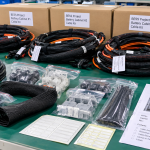
9.2 Cable Routing and Mechanical Protection
Cable routes may be exposed to vibration, abrasion, sunlight, rodents, accidental impact, or maintenance traffic.
Suitable cable supports, protective sleeves, conduits, glands, and mechanical barriers can help address specific risks when correctly selected and installed.
However, cable accessories must not obstruct ventilation, interfere with required electrical clearances, or conceal damage that needs to be inspected.
9.3 Limited Spare Parts and Technical Support
A minor component failure can cause an extended outage when replacement parts are unavailable.
Operators should identify critical spare parts, establish practical inspection intervals, maintain equipment documentation, and define escalation procedures for faults that cannot be resolved remotely.
9.4 Maintenance Accessibility
Remote sites may have limited access to equipment installed in compact enclosures or exposed outdoor locations.
Cable routing, component identification, service clearances, and replaceable protective accessories should be considered during the initial design and later retrofit work.
A maintainable installation can make routine inspections and repairs more manageable over the system’s operating life.
10. Illustrative Case Study: A Remote Solar-Battery-Diesel Microgrid
Consider a remote industrial facility that requires continuous electricity for essential equipment and scheduled operation of several production loads.
The site uses solar PV, a battery energy storage system, and a diesel generator. Fuel deliveries are costly, and maintenance personnel visit the facility periodically rather than remaining on-site full time.
The operator wants to reduce unnecessary generator operation without compromising essential loads.
Initial Assessment
The engineering team collects interval-load data, PV generation records, generator operating history, battery specifications, and the site’s critical-load requirements.
The assessment identifies three main opportunities:
- Improve coordination between solar generation and battery charging.
- Establish clearer generator start and stop criteria.
- Improve remote visibility of alarms and equipment status.
Control Strategy
The local controller prioritizes supplying available solar generation to the active load and charges the battery when conditions permit.
The battery supports short-term imbalances and selected load peaks. Generator operation is scheduled according to available reserve, load requirements, start-up delays, and equipment constraints.
When prolonged poor weather or high demand reduces the reserve, the controller can initiate the approved backup strategy. If necessary, discretionary loads are curtailed according to the site’s predefined priorities.
Operational Improvements
The team also reviews cable routing, enclosure condition, ventilation, equipment access, and the availability of critical spare parts.
The monitoring system is configured to report relevant operating conditions and communication failures. Maintenance personnel receive documented instructions for investigating alarms and verifying equipment condition.
Performance Evaluation
The operator compares generator runtime, fuel consumption, renewable energy utilization, battery cycling, load interruptions, and maintenance events before and after the changes.
The comparison accounts for differences in weather, production levels, and load demand.
This is an illustrative control-planning example, not a verified project result. Actual fuel savings and reliability improvements require site-specific measurements.
11. How to Select the Right Control Strategy
A practical selection process begins with the operating requirements rather than a preference for a particular algorithm.
Step 1: Define Reliability Requirements
Identify which loads must remain energized, the consequences of interruption, and the required autonomy or reserve.
The system design must determine what can be maintained under realistic worst-case conditions.
Step 2: Characterize the Load
Collect load profiles, peak demand, motor-starting requirements, seasonal changes, and opportunities for flexible operation.
Both instantaneous power and total daily energy consumption matter.
Step 3: Assess Renewable Resources
Evaluate solar or wind availability, seasonal variation, forecast uncertainty, and the relationship between generation and load.
Step 4: Define Battery Operating Limits
Confirm usable energy, power capability, temperature limits, state-of-charge restrictions, and manufacturer requirements.
Step 5: Establish Generator Dispatch Logic
Define start and stop thresholds, minimum run time, minimum loading requirements, reserve conditions, and the response to failed starts.
Step 6: Design Local and Remote Control Layers
Determine which functions require immediate local response and which can be handled through supervisory scheduling or remote monitoring.
Step 7: Test Abnormal Conditions
Evaluate loss of communication, generator unavailability, sudden load changes, low battery reserve, and unexpected renewable generation shortfalls.
Step 8: Validate Through Commissioning and Monitoring
Test control sequences, alarms, transitions between operating modes, and the behavior of protective systems.
Review operating data after commissioning and adjust approved control settings as the site’s needs evolve.
12. Practical Checklist for Remote Microgrid Operations
Before deploying or upgrading an off-grid microgrid, consider the following:
- Critical, important, and flexible loads have been identified.
- Load profiles and peak power requirements have been assessed.
- Grid-forming and grid-following capabilities are understood.
- Battery energy and power limits are reflected in the control strategy.
- Generator start, stop, and reserve policies are documented.
- Renewable energy forecasts and forecast errors are considered.
- Local control can operate safely when remote communications fail.
- Alarm priorities and fault-response procedures are defined.
- Electrical protection and load-shedding arrangements are verified.
- Cable routing, mechanical protection, and environmental ratings are suitable.
- Ventilation and thermal-management requirements are maintained.
- Critical spare parts and maintenance procedures are available.
- Commissioning includes relevant abnormal-condition tests.
- Operating performance is reviewed using measured data.
This checklist supports project planning but does not replace detailed electrical engineering, site-specific safety procedures, applicable standards, or manufacturer instructions.
Frequently Asked Questions
What is the best control strategy for an off-grid microgrid?
There is no single best strategy for every site. Rule-based control may suit smaller, predictable systems, while optimization-based control can help coordinate complex generation and storage resources. The choice depends on load variability, equipment capabilities, maintenance resources, and reliability requirements.
How does battery storage improve off-grid microgrid stability?
A suitably configured battery and power conversion system can respond to changes in supply and demand, support energy balancing, and help maintain voltage and frequency when designed for those functions. Its effectiveness depends on inverter capability, available power and energy, control settings, and the overall system architecture.
How can remote microgrids reduce diesel consumption?
They can prioritize renewable generation, schedule battery charging and discharging, optimize generator dispatch, and shift flexible loads. Actual savings depend on renewable availability, load patterns, fuel consumption, storage losses, and operating constraints.
Can an off-grid microgrid operate without an internet connection?
Yes, if its local control and protection architecture is designed to operate independently of continuous internet connectivity. Remote monitoring and supervisory optimization may become unavailable during a communication outage, so local fallback behavior must be defined and tested.
Why is load prioritization important in remote microgrids?
When available generation and stored energy cannot meet total demand, load prioritization helps preserve electricity for the most important services. The load-shedding sequence should be defined in advance and implemented through suitable control and switching equipment.
What are the main maintenance challenges for remote microgrids?
Common challenges include limited technician access, delayed spare-parts delivery, environmental exposure, communication interruptions, and difficulty diagnosing faults. Monitoring, documented procedures, appropriate spare parts, and maintainable equipment layouts can help address these issues.
What role do cable protection accessories play in remote microgrids?
Suitable cable protection, supports, glands, and routing accessories can reduce specific mechanical and environmental risks. They complement, but do not replace, correct electrical design, circuit protection, thermal management, or qualified maintenance.
Off-grid microgrid reliability depends on the coordinated operation of renewable generation, battery storage, dispatchable generators, and local loads. Effective control strategies must balance immediate electrical stability with longer-term energy scheduling, reserve management, and operating cost.
For remote facilities, control logic must also account for limited maintenance access, communication failures, environmental exposure, and the consequences of unexpected equipment outages.
A practical approach combines suitable primary control, coordinated energy management, clear load priorities, tested fallback modes, and reliable monitoring. Equally important are the physical installation details that support long-term operation, including cable routing, mechanical protection, environmental suitability, thermal management, and maintenance accessibility.
GR-NEWenergy focuses on energy storage integration and O&M-related solutions, including cable protection, installation accessories, and practical protection measures for energy infrastructure. For remote microgrid projects, these supporting solutions can contribute to installation reliability and maintainability as part of a properly engineered system.
- What are the main control strategies for off-grid microgrids? Primary control supports immediate electrical stability, secondary control restores operating conditions, and tertiary control coordinates energy scheduling and resource optimization.
- How does battery storage support remote microgrid operation? Battery storage can balance short-term supply and demand, shift renewable energy to later periods, and support selected reserve and stability functions when properly configured.
- How can an off-grid microgrid reduce diesel generator runtime? It can coordinate renewable generation, battery dispatch, generator scheduling, and flexible loads while maintaining the required operating reserve.
- Can remote microgrids operate when communications fail? They can if local controls and protection are designed and tested to maintain safe operation without continuous remote connectivity.
- What makes remote microgrid maintenance difficult? Limited site access, environmental exposure, spare-parts logistics, and communication interruptions can delay fault diagnosis and repair.
- How do cable protection products support remote energy systems? Appropriate sleeves, conduits, supports, and cable-entry accessories can reduce specific mechanical and environmental risks and improve maintainability.