Industrial electricity consumption is often shaped by production schedules, equipment startup cycles, HVAC demand, compressed air systems, and other energy-intensive processes. When several high-power loads operate simultaneously, a facility may experience significant electricity demand peaks, higher energy costs, or increased pressure on its electrical infrastructure.
Energy storage can help industrial facilities shift electricity consumption from high-cost periods to lower-cost periods. By charging batteries when electricity is less expensive or when site demand is relatively low, and discharging them during selected peak periods, businesses can improve energy cost management without necessarily changing their core production processes.
However, successful industrial load shifting requires more than installing a battery system. It depends on understanding the facility’s load profile, electricity tariff, production schedule, available grid capacity, and operational requirements.
This guide explains practical industrial load shifting strategies, how energy storage supports them, and what businesses should evaluate before implementing a project.
1. What Is Industrial Load Shifting?
Industrial load shifting is the practice of moving electricity consumption from one period to another to reduce energy costs, manage demand peaks, or improve the utilization of available electrical capacity.
Load shifting does not always mean reducing total electricity consumption. Instead, it changes when electricity is purchased from the grid or supplied by on-site resources.
For example, a factory may charge its battery energy storage system during off-peak hours and discharge it during the afternoon when electricity prices or facility demand are higher.
Three related concepts are important:
- Load shifting: Moving electricity consumption or energy supply between different time periods.
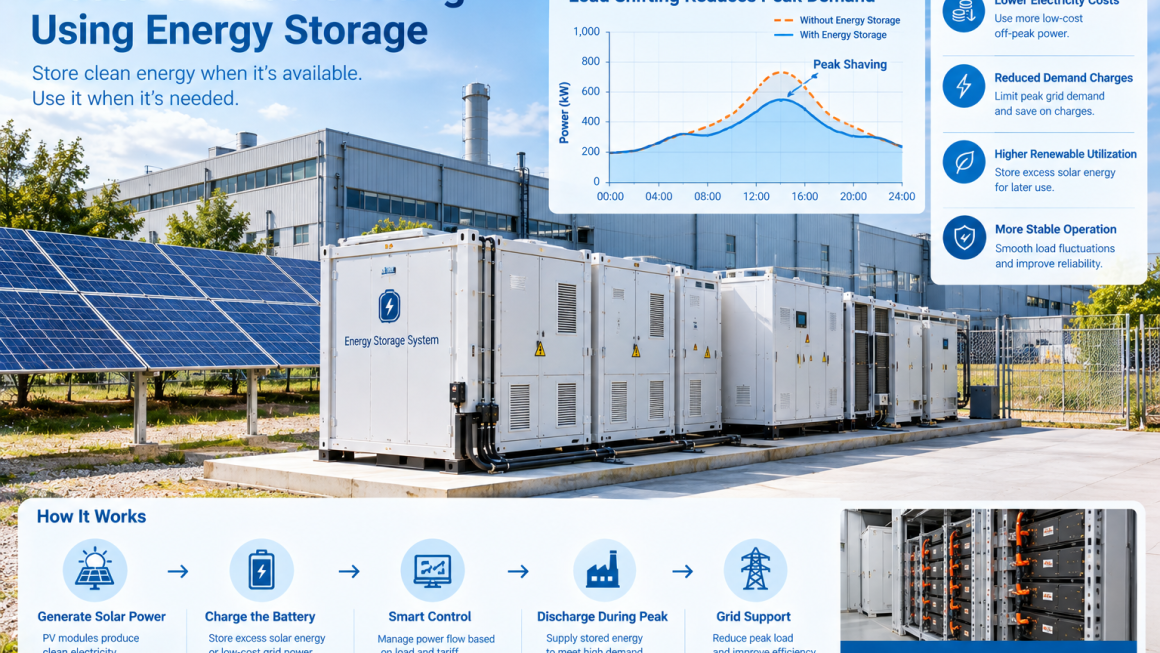
- Peak shaving: Reducing the highest grid power demand during selected intervals, often by discharging an energy storage system.
- Demand response: Adjusting electricity consumption or on-site generation in response to grid conditions, utility signals, or electricity prices.
These strategies can work together, but they are not identical. A facility may shift energy to avoid expensive tariff periods, shave a monthly demand peak, or participate in a demand-response program depending on local market rules.
2. Why Industrial Facilities Use Energy Storage for Load Shifting
Industrial load shifting is particularly relevant for facilities with predictable operating schedules, significant peak-period consumption, or electricity tariffs that vary by time of use.
2.1 Reducing Time-of-Use Electricity Costs
Some utilities apply different electricity prices during peak, shoulder, and off-peak periods. The difference between these rates creates an opportunity for energy storage.
A facility can charge its battery during lower-cost periods and discharge it when grid electricity is more expensive.
The financial benefit depends on the price difference, storage efficiency, battery degradation, demand charges, and the number of usable operating cycles.
2.2 Managing Peak Demand Charges
In some electricity markets, industrial customers pay charges based partly on their maximum measured demand in kilowatts. A short period of high consumption can therefore influence the electricity bill beyond the cost of the energy consumed during that interval.
An appropriately controlled battery system can discharge when facility demand approaches a predefined threshold.
This strategy requires careful coordination with the billing interval and the utility’s demand-charge calculation method. Reducing one brief spike may not be sufficient if another interval sets a higher monthly peak.
2.3 Supporting Production Without Major Schedule Changes
Not every factory can move production to nighttime or off-peak hours. Continuous-process industries, cold storage facilities, automated manufacturing lines, and operations with strict delivery schedules may have limited flexibility.
Energy storage can provide some of the flexibility that production schedules cannot. Instead of shifting the entire production process, a facility may shift part of its electricity supply.
2.4 Improving the Use of On-Site Renewable Energy
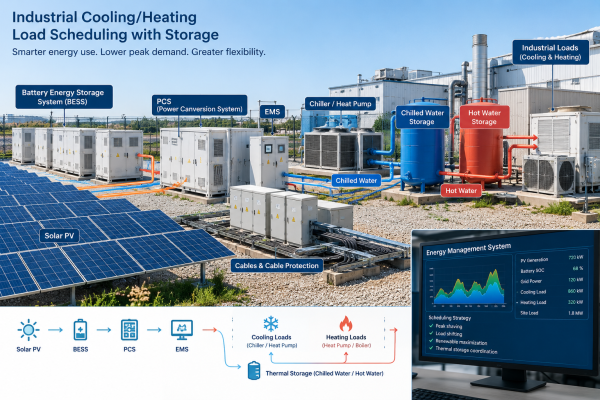
Industrial facilities with rooftop solar or other on-site renewable generation can use batteries to store surplus electricity and discharge it when production demand remains high but renewable output falls.
This can increase on-site energy utilization, depending on the site’s generation profile, load pattern, storage capacity, and applicable export tariffs.
3. Key Industrial Load Shifting Strategies
There is no single load shifting strategy suitable for every factory. The right approach depends on the relationship between electricity prices, demand peaks, production requirements, and available storage capacity.
Strategy 1: Off-Peak Charging and Peak-Period Discharging
This is the most direct form of battery-based load shifting.
The system charges during lower-price periods and discharges during selected high-price periods. An energy management system (EMS) can schedule these operations based on tariff data, state of charge, demand forecasts, and operational limits.
Suitable applications:
- Manufacturing plants with predictable daily load profiles
- Industrial facilities operating across multiple shifts
- Warehouses and distribution centers with substantial electrical loads
- Commercial-industrial sites with time-of-use tariffs
Key considerations:
The battery must have enough usable energy to cover the intended discharge period. The charging window must also be long enough to replenish the battery before the next peak.
Round-trip efficiency matters because some electricity is lost during charging and discharging. A wide tariff spread does not automatically guarantee a profitable project.
Strategy 2: Demand Peak Shaving
Peak shaving focuses on limiting the amount of power drawn from the grid during selected intervals.
For example, if several production lines, chillers, compressors, and auxiliary systems start simultaneously, facility demand may temporarily rise above its normal operating level. A battery can discharge to reduce the grid-supplied portion of that peak.
The control system may use a demand threshold, a forecasted peak, or a combination of both.
Peak shaving is most effective when high-demand events are identifiable and the storage system can respond quickly enough to influence the relevant metering interval.
Strategy 3: Production-Aware Load Shifting
Some industrial facilities have flexible operations, but their flexibility is limited by labor schedules, equipment availability, product quality requirements, or production deadlines.
A production-aware strategy coordinates energy storage with the manufacturing schedule.
For example, the system may prioritize battery discharge during a planned high-load production phase while preserving sufficient reserve for critical equipment or an upcoming demand peak.
The control strategy should distinguish between loads that can be delayed and loads that must remain continuously powered. Production safety and process stability take priority over electricity savings.
Strategy 4: Solar-Plus-Storage Load Shifting
For factories with on-site solar photovoltaic systems, energy storage can move some solar-generated electricity from midday into later operating periods.
A typical operating sequence is:
- Solar generation supplies active facility loads.
- Surplus solar electricity charges the battery, subject to operating limits.
- The battery discharges when solar output decreases and electricity demand remains high.
- Grid electricity supplies any remaining demand.
The optimal strategy depends on whether the facility benefits more from maximizing self-consumption, reducing peak demand, avoiding high-price imports, or limiting electricity exports.
These objectives may conflict. A battery reserved for the evening peak, for example, may not be available for an unexpected demand spike earlier in the day.
Strategy 5: Hybrid Load Shifting With Operational Flexibility
Battery storage can be combined with selected operational changes, such as staggering equipment startup, rescheduling noncritical processes, optimizing compressed-air systems, or adjusting thermal loads within safe process limits.
This combined approach may reduce the required battery power or energy capacity. Operational changes should be assessed first where they are practical, measurable, and compatible with production requirements.
The goal is not to replace energy storage with operational changes in every case, but to avoid oversizing the battery to solve a problem that can be partially addressed through better scheduling.
4. How to Analyze an Industrial Load Profile
A load profile shows how a facility’s electrical demand changes over time. It is one of the most important inputs for designing a load shifting strategy.
Before selecting storage equipment, industrial operators should collect interval-meter data, ideally covering representative production days and seasonal conditions.
Important data includes:
- Average and maximum demand in kilowatts (kW)
- Electricity consumption in kilowatt-hours (kWh)
- Peak-demand timing and duration
- Production shifts and equipment operating schedules
- Weekday, weekend, and seasonal variations
- Time-of-use electricity prices and demand-charge rules
- Existing solar generation or other on-site power sources
- Critical loads and minimum reserve requirements
A short monitoring period may miss infrequent production peaks or seasonal operating conditions. Where possible, the analysis should use a sufficiently representative historical dataset.
Example: A Factory With an Afternoon Demand Peak
Assume a factory experiences an afternoon grid-demand peak of 500 kW for two hours. The facility wants to reduce grid demand by approximately 100 kW during that period.
The idealized discharge requirement is:
100 kW × 2 hours = 200 kWh of delivered energy.
This is a simplified estimate. The actual battery system may need a higher rated energy capacity because of conversion losses, operating reserve, battery degradation, temperature effects, and limits on usable state of charge.
The battery inverter must also support the required discharge power. A system with adequate energy capacity but insufficient power capacity may not achieve the intended peak reduction.
5. How to Size an Energy Storage System for Load Shifting
Industrial battery storage has two key sizing dimensions: power and energy.
Power capacity (kW) determines how much load the system can support or offset at a given moment.
Energy capacity (kWh) determines how much energy it can deliver over time.
A preliminary estimate can be developed using the target grid-demand reduction and the intended discharge duration.
Step 1: Define the Target
Determine how much grid demand should be reduced and for how long. The target should reflect the facility’s actual tariff and operating constraints rather than an arbitrary percentage reduction.
Step 2: Estimate Delivered Energy
Multiply the required discharge power by the discharge duration.
For a constant 100 kW reduction over two hours, the target delivered energy is 200 kWh.
Step 3: Account for System Losses and Operating Limits
The installed battery capacity will generally need to exceed the required delivered energy. The calculation should account for usable state-of-charge range, conversion efficiency, auxiliary consumption, degradation allowance, and reserve requirements.
Step 4: Check Inverter Power and Connection Limits
Verify that the power conversion system, switchgear, cables, protection devices, and point of connection can support the planned charging and discharging rates.
Step 5: Validate the Strategy With Operating Data
Simulate the strategy against historical load and tariff data. Test different battery sizes, dispatch schedules, and reserve settings before finalizing the design.
Oversizing may increase upfront cost without providing equivalent savings. Undersizing may prevent the facility from achieving its intended peak reduction.
6. Evaluating the Financial Value of Load Shifting
A load shifting project should be assessed using the facility’s actual electricity tariff and operating data.
A simplified energy-arbitrage calculation is:
Gross energy cost benefit per cycle
= Discharge energy × High-period electricity price
− Charging energy × Low-period electricity price
Charging energy must be higher than delivered discharge energy when losses occur.
For example, suppose a battery delivers 200 kWh during a high-price period, with an assumed round-trip efficiency of 90%. The required charging energy is approximately 222 kWh.
If the high-period electricity price is $0.25/kWh and the low-period price is $0.10/kWh:
- Value of 200 kWh discharged: $50.00
- Cost of approximately 222 kWh charged: $22.22
- Simplified gross energy-arbitrage benefit: approximately $27.78 per cycle
This illustration excludes demand-charge savings, degradation, maintenance, financing, taxes, and other operating costs. Actual savings may be lower or higher depending on tariff structure and system operation.
A complete project assessment should consider:
- Capital cost and installation cost
- Energy price differences and tariff changes
- Demand-charge reductions, where applicable
- Round-trip efficiency and auxiliary loads
- Battery degradation and replacement assumptions
- Operations and maintenance costs
- Interconnection and utility requirements
- Financing, incentives, and applicable taxes
- Potential revenue from approved grid services
Avoid counting the same benefit twice. For example, a dispatch strategy that prioritizes peak shaving may not simultaneously maximize energy arbitrage during every interval.
7. Control Strategies: Rule-Based, Forecast-Based, and Optimization-Based
The energy management system determines when the battery charges, discharges, or holds its reserve.
Rule-Based Control
Rule-based control uses predefined conditions, such as charging below a selected electricity price or discharging when grid demand exceeds a threshold.
It is relatively straightforward to implement and can be appropriate for facilities with stable load patterns.
Forecast-Based Control
Forecast-based control uses predicted facility demand, production schedules, renewable generation, or electricity prices to plan battery operation.
It can help preserve sufficient charge for an upcoming peak instead of using the battery too early.
Forecast quality and the ability to respond to unexpected operating changes affect performance.
Optimization-Based Control
Optimization-based control evaluates multiple objectives and constraints, such as electricity cost, demand limits, battery wear, and reserve requirements.
It may be useful for facilities with complex tariffs or multiple competing objectives. However, it depends on reliable data, a suitable control model, and integration with site operating systems.
Whatever approach is used, the system should define safe operating limits, communication-loss behavior, alarms, and a clear method for switching to a safe operating mode.
8. Industrial Applications for Energy Storage Load Shifting
Manufacturing and Assembly
Manufacturing facilities may have predictable shift changes, high-power equipment startup events, and periods of intensive production. Storage can help manage selected peaks without requiring every production activity to be rescheduled.
Cold Storage and Refrigeration
Cold storage facilities often have significant refrigeration loads. Thermal inertia may offer some scheduling flexibility, but any adjustment must remain within product-temperature, food-safety, and equipment limits.
Battery dispatch should be coordinated with refrigeration controls rather than assumed to replace them.
Warehousing and Logistics
Warehouses may experience overlapping demand from charging equipment, conveyors, HVAC, lighting, and automation. Storage can reduce grid demand during concentrated operating periods, particularly where fleet charging schedules are predictable.
Metal Processing and Other Energy-Intensive Operations
Metal processing, machining, and related operations may experience high demand during equipment startup or specific production stages. A detailed load study is essential because process loads can be variable and some equipment has strict power-quality requirements.
Data Centers and Digital Infrastructure
Data centers prioritize uptime, power quality, and resilience. Energy storage may support demand management as part of a properly engineered electrical architecture, but load shifting must not compromise backup-power readiness or critical-load protection.
Battery energy reserved for backup service should not be assumed to be fully available for routine tariff optimization.
9. Installation and Operational Considerations
Load shifting performance depends not only on battery capacity and control logic, but also on the reliability of the complete installation.
Industrial environments may expose electrical equipment to heat, dust, vibration, moisture, chemical contaminants, and mechanical damage. These conditions should be considered during equipment placement, cable routing, enclosure selection, and maintenance planning.
Electrical Connection and Cable Protection
Power cables and control cables should be routed according to applicable electrical standards and the project design. Cable sizing, overcurrent protection, grounding, isolation, and connection methods must be selected by qualified electrical professionals.
Depending on the environment, suitable cable protection and routing accessories may help reduce mechanical abrasion, dust exposure, UV exposure, and other environmental risks. The appropriate protection level must be verified against actual site conditions.
Thermal Management
Battery systems, power conversion equipment, and associated electrical components operate within specified temperature ranges. Installation planning should account for ventilation, heat rejection, ambient temperature, and manufacturer-required clearances.
Cable sleeves or protective covers are not substitutes for engineered cooling, electrical insulation, fire protection, or thermal monitoring.
Environmental and Mechanical Protection
For outdoor or demanding industrial installations, the design should consider enclosure ratings, water ingress, corrosion, vibration, cable strain relief, and maintenance access.
Protective accessories should be selected based on verified material compatibility and environmental requirements. No single sleeve, coating, or sealing accessory should be assumed to provide universal protection.
Maintenance and Inspection
A practical maintenance plan may include:
- Visual inspection of cable routes and protective accessories
- Inspection for abrasion, cracking, deformation, or loose fittings
- Verification of alarms and monitoring communications
- Review of temperature trends and system operating records
- Inspection of ventilation paths and enclosure seals
- Replacement of damaged accessories according to site procedures
Inspection intervals should reflect manufacturer guidance, site risk, operating conditions, and applicable regulations.
10. Common Mistakes in Industrial Load Shifting Projects
Sizing storage from monthly electricity consumption alone. Monthly kWh figures do not reveal the timing or duration of demand peaks. Interval data is essential.
Ignoring the demand-charge calculation interval. The required discharge duration depends on how the utility measures and bills demand.
Assuming every battery cycle is profitable. Price differences must cover losses, degradation, and operating costs.
Discharging too early. A battery that empties before the facility’s actual peak may fail to reduce the billed maximum demand.
Ignoring production constraints. Energy optimization must not interrupt critical processes or compromise product quality.
Overlooking installation conditions. Poor cable routing, inadequate environmental protection, or restricted maintenance access can undermine long-term reliability.
Using backup energy for routine optimization without safeguards. Where the battery also serves as backup power, reserve requirements and dispatch priorities must be clearly defined.
11. A Practical Implementation Roadmap
A structured approach can reduce technical and financial uncertainty.
- Collect energy data. Obtain interval demand, electricity bills, tariff schedules, and production records.
- Identify the primary objective. Decide whether the project targets energy arbitrage, peak shaving, renewable self-consumption, or a combination.
- Define operating constraints. Document critical loads, production windows, backup requirements, and minimum state of charge.
- Model alternative system sizes. Compare power capacity, energy capacity, discharge duration, and dispatch strategies.
- Evaluate financial performance. Include energy losses, degradation, installation, maintenance, and applicable tariff rules.
- Review electrical and site design. Assess interconnection, protection, thermal management, cable routing, environmental exposure, and access for maintenance.
- Commission and verify. Confirm control settings, safety functions, monitoring, and actual demand reduction.
- Review operating results. Compare measured performance with the original model and refine the dispatch strategy as needed.
12. Frequently Asked Questions
What is the main purpose of industrial load shifting?
The main purpose is to move electricity consumption or supply between time periods to reduce electricity costs, manage peak demand, or improve the use of on-site energy resources.
Can battery storage reduce industrial demand charges?
It can, where demand charges are based on grid demand that the battery can reliably reduce during the relevant measurement interval. Results depend on tariff rules, dispatch accuracy, battery power, and available energy.
How much battery capacity does a factory need for load shifting?
There is no universal capacity. The requirement depends on the target power reduction, duration, load profile, tariff, usable state-of-charge range, efficiency, reserve needs, and operating conditions.
Is load shifting the same as peak shaving?
No. Load shifting moves energy consumption or supply between periods. Peak shaving specifically targets reductions in maximum power demand. A battery can support both, but the dispatch strategy may need to prioritize one objective over the other.
Can solar panels and battery storage work together for industrial load shifting?
Yes. Solar-plus-storage systems can store surplus solar generation for later use, subject to generation patterns, facility demand, storage limits, and electricity tariffs.
Does load shifting always reduce total electricity consumption?
No. It primarily changes the timing of electricity use or supply. Total consumption may remain similar, and storage losses can increase the amount of electricity needed to deliver the same useful energy.
What should industrial operators check before installing an energy storage system?
They should review load profiles, tariff structures, production constraints, required power and energy capacity, system efficiency, interconnection requirements, safety controls, installation conditions, and lifecycle costs.
Industrial load shifting using energy storage can help manufacturers and other energy-intensive facilities manage electricity costs and demand peaks while maintaining essential production operations. The strongest projects begin with reliable interval data, a clearly defined financial objective, and a control strategy that reflects real operating conditions.
Battery capacity alone does not determine project success. Tariff design, dispatch timing, system efficiency, electrical integration, environmental conditions, and long-term maintenance all influence performance.
For industrial energy storage projects, installation quality and maintainability should be considered alongside system sizing and control. Appropriate cable protection, routing accessories, environmental safeguards, and inspection procedures can support reliable operation when selected for the actual site conditions.
GR-NEWenergy focuses on energy storage integration and O&M-related solutions, including cable protection, installation accessories, and practical protection measures for industrial and energy infrastructure. For project-specific recommendations, the operating environment, cable requirements, and maintenance objectives should be assessed before selecting products.
- How does energy storage help industrial facilities shift electrical loads? It stores electricity during lower-cost or lower-demand periods and discharges it during selected peak periods, subject to system limits and operating requirements.
- What is the difference between load shifting and peak shaving? Load shifting changes when energy is consumed or supplied, while peak shaving specifically reduces maximum grid demand.
- How is a battery energy storage system sized for industrial peak shaving? Sizing starts with the required power reduction and duration, then accounts for efficiency, usable capacity, reserve requirements, and degradation.
- What affects the return on investment of industrial load shifting? Electricity tariffs, demand charges, dispatch frequency, efficiency, battery degradation, installation costs, and maintenance all affect project economics.
- What installation factors matter for industrial energy storage? Electrical protection, cable routing, thermal management, environmental exposure, enclosure requirements, monitoring, and maintenance access should all be evaluated.