As energy storage systems push toward higher energy density—driven by EVs, grid storage, and compact applications—safety design becomes increasingly critical. Higher energy concentration amplifies the consequences of failure, making proactive safety engineering essential across materials, structure, thermal management, and system control.
Why Safety Design Is More Critical in High-Density Systems
High-density energy storage systems pack more energy into smaller volumes, which introduces:
- Increased thermal load and hotspot risk
- Greater sensitivity to mechanical stress and defects
- Higher likelihood of thermal runaway propagation
- Reduced tolerance for design or manufacturing inconsistencies
A single-point failure can escalate rapidly without proper safety design.
Core Safety Design Principles
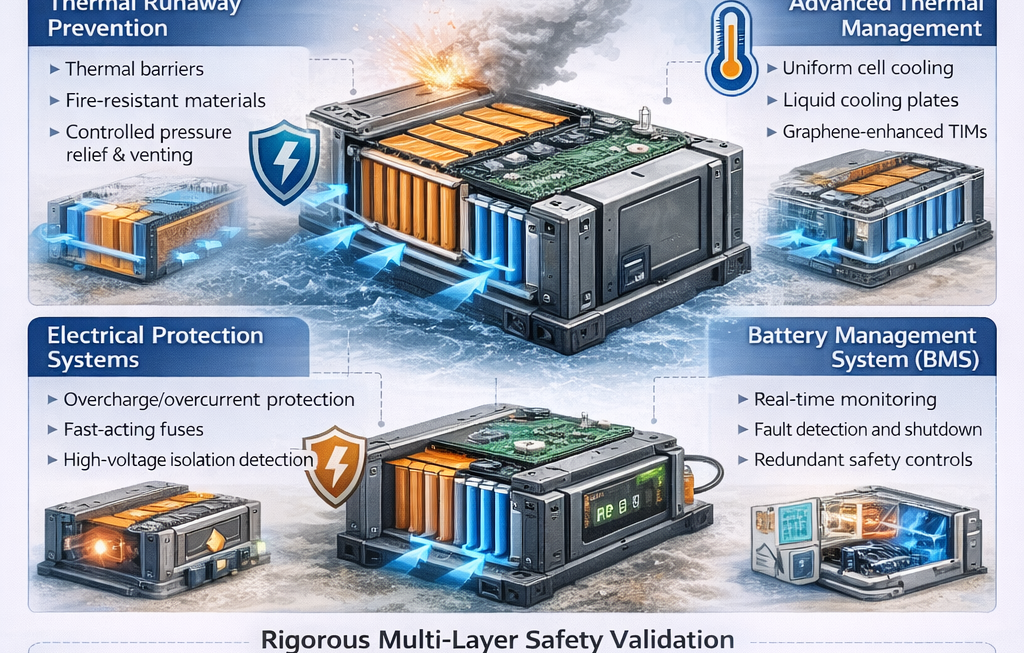
1. Thermal Runaway Prevention and Mitigation
Thermal runaway is the most critical risk in high-density systems.
Prevention strategies:
- Stable cell chemistry selection (e.g., LFP for improved thermal stability)
- Precise charge/discharge control
- High-quality cell manufacturing and screening
Mitigation strategies:
- Thermal barriers between cells
- Heat-resistant insulation materials
- Controlled venting paths to release pressure and gases
2. Advanced Thermal Management
Effective thermal control reduces risk at the source:
- Uniform temperature distribution across cells (<5°C gradient)
- Liquid cooling or hybrid cooling systems
- High-performance thermal interface materials (TIMs)
- Real-time thermal monitoring
3. Electrical Protection Systems
High-density systems require robust electrical safeguards:
- Overvoltage and undervoltage protection
- Overcurrent and short-circuit protection
- Isolation monitoring in high-voltage systems
- Fast-acting disconnect mechanisms (contactors, fuses)
4. Structural Safety Design
Mechanical integrity directly impacts safety:
- Reinforced module structures to prevent deformation
- Controlled cell compression to avoid internal damage
- Shock and vibration resistance
- Fire-resistant and pressure-resistant enclosures
5. Battery Management System (BMS)
The BMS is the central safety control unit:
- Continuous monitoring of voltage, current, and temperature
- Cell balancing to prevent overcharging
- Fault detection and emergency shutdown
- Data logging for predictive safety analysis
Safety Design at Different Levels
Cell Level
- Internal safety features (CID, shutdown separators)
- High manufacturing consistency
Module Level
- Thermal barriers and spacing
- Structural reinforcement
- Integrated sensing
Pack/System Level
- Fire suppression systems
- Venting and gas management
- Redundant safety controls
Key Technologies Enhancing Safety
1. Thermal Barriers and Fire-Resistant Materials
Prevent propagation between cells and modules.
2. Gas Detection and Venting Systems
Detect and safely release hazardous gases.
3. Carbon-Based Thermal Materials
Improve heat dissipation, reducing hotspot formation.
4. Smart Monitoring and AI Integration
Predict failures before they occur using data-driven models.
Design Challenges
- Balancing energy density with safety margins
- Managing heat in compact, high-power systems
- Ensuring reliability under long-term cycling
- Meeting increasingly strict regulatory standards
Industry Standards and Testing
High-density systems must comply with rigorous standards:
- IEC, UL, and UN transportation regulations
- Thermal runaway propagation testing
- Mechanical abuse testing (shock, crush, penetration)
- Environmental testing (temperature, humidity, corrosion)
Emerging Trends
1. Cell-to-Pack (CTP) and Cell-to-Chassis (CTC) Designs
Higher integration increases density but requires advanced safety strategies.
2. Solid-State Batteries
Potentially safer due to non-flammable electrolytes, but still under development.
3. Integrated Fire Suppression Systems
Built directly into modules and packs.
4. Digital Twins for Safety Simulation
Real-time modeling of system behavior under fault conditions.
Best Practices
- Design safety from the earliest concept stage
- Use multi-layered safety architecture (cell → module → system)
- Validate through extensive testing and pilot production
- Incorporate redundancy in critical safety systems
- Continuously monitor and update safety strategies based on field data
Safety design in high-density energy storage systems is not a single feature but a comprehensive, multi-layered engineering approach. As systems become more compact and powerful, integrating thermal, electrical, structural, and intelligent safety mechanisms is essential to ensure reliable and secure operation.
Future advancements will increasingly rely on material innovation, system integration, and intelligent monitoring—making safety a defining factor in next-generation energy storage technologies.