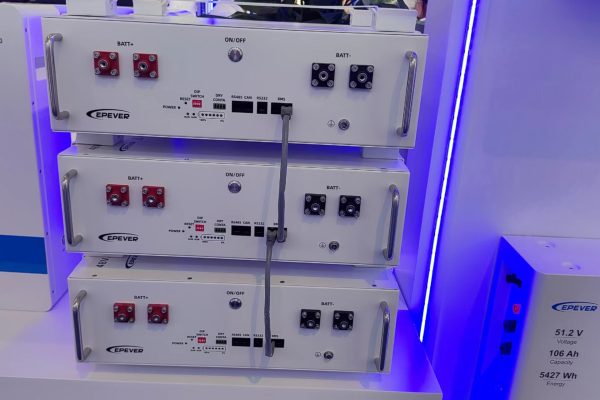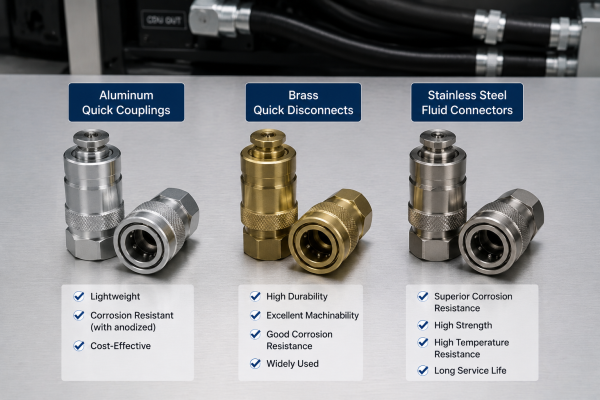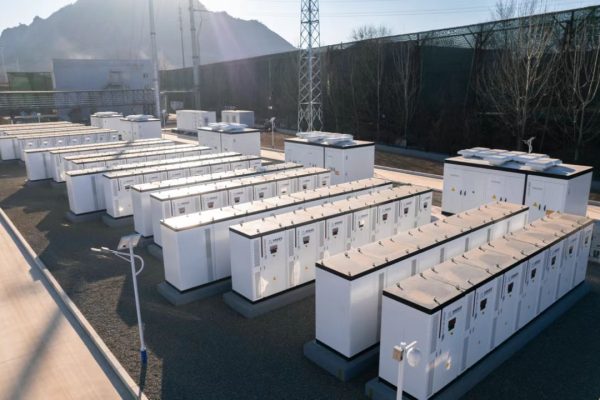
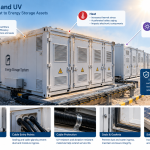
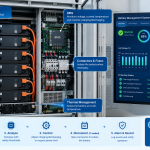

As battery modules move toward higher energy density, higher voltage, and more demanding applications, protection systems must evolve beyond basic safeguards. Advanced protection systems integrate electrical, thermal, mechanical, and intelligent controls to ensure safe operation under both normal and fault conditions.
Why Advanced Protection Systems Are Essential
Modern battery modules operate in complex environments where risks include:
- Overcharge and overdischarge
- Short circuits and overcurrent events
- Thermal runaway and heat accumulation
- Mechanical damage and vibration
- System-level integration faults
A single failure can cascade quickly—making layered, fast-response protection systems critical.
Multi-Layer Protection Architecture
1. Cell-Level Protection
Built-in safety features at the cell level form the first line of defense:
- Current Interrupt Devices (CID) to stop current under abnormal pressure
- Shutdown separators that block ion flow at high temperatures
- Vent mechanisms to release internal gas safely
These features prevent localized failures from escalating.
2. Module-Level Protection
At the module level, protection focuses on managing interactions between cells:
- Thermal barriers to prevent propagation
- Fuses and busbar protection for localized fault isolation
- Voltage and temperature sensors distributed across the module
- Mechanical reinforcement to prevent deformation-related failures
3. Pack/System-Level Protection
System-level controls ensure overall operational safety:
- High-voltage interlock loops (HVIL)
- Contactors and pre-charge circuits
- Isolation monitoring systems
- Emergency shutdown mechanisms
These systems protect both the battery and connected equipment.
Key Protection Technologies
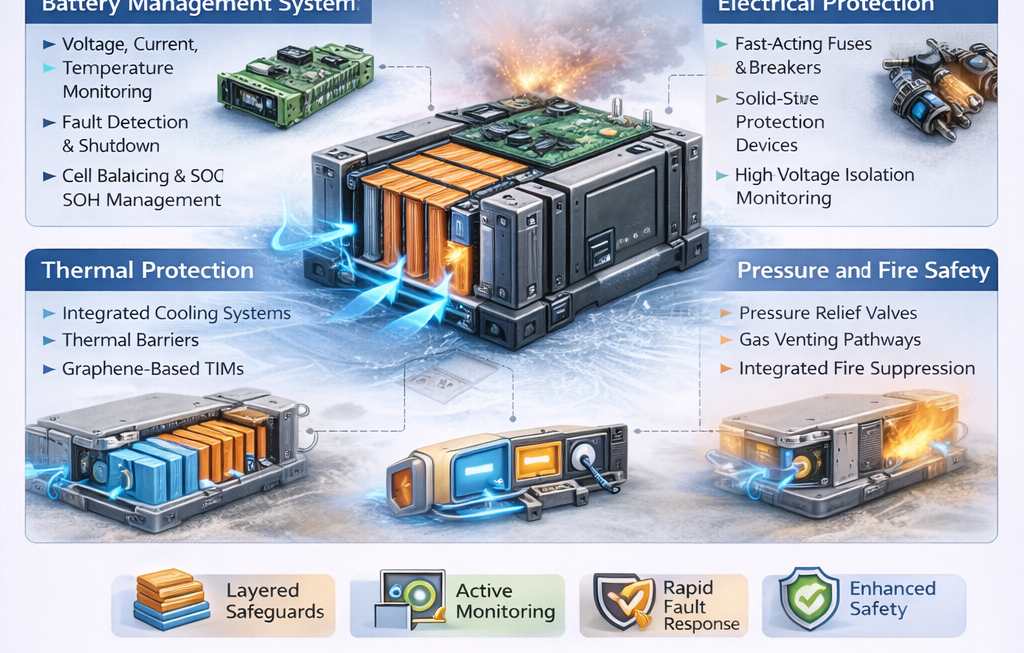
1. Battery Management System (BMS)
The BMS is the core intelligence layer:
- Real-time monitoring of voltage, current, temperature
- State-of-charge (SOC) and state-of-health (SOH) estimation
- Cell balancing to prevent uneven stress
- Fault detection and response logic
2. Thermal Protection Systems
- Active cooling (liquid or air)
- Passive materials (PCM, thermal insulation)
- Thermal runaway detection and early warning
- Heat spreading using graphite or graphene materials
3. Electrical Protection Components
- Fast-acting fuses and circuit breakers
- Solid-state protection devices
- Surge and transient voltage suppression
- Redundant current sensing systems
4. Gas and Pressure Management
- Pressure relief valves
- Directed venting pathways
- Gas detection sensors for early fault identification
5. Fire Protection and Suppression
- Fire-resistant materials
- Integrated fire suppression systems (aerosol, gas-based)
- Module-level containment strategies
Design Considerations
Response Time
Protection systems must react within milliseconds to prevent escalation.
Redundancy
Critical systems often include backup protection layers to ensure reliability.
Integration with Thermal and Structural Design
Protection is not standalone—it must align with cooling systems and mechanical architecture.
Scalability
Systems should adapt to different module sizes and configurations.
Challenges in Advanced Protection Design
- Balancing protection with system cost and complexity
- Avoiding false positives while maintaining sensitivity
- Managing protection in high-voltage (>800V) systems
- Ensuring long-term reliability of sensors and components
Emerging Trends
1. Smart Protection with AI
Predictive fault detection using real-time data and machine learning.
2. Solid-State Protection Devices
Faster and more reliable than traditional mechanical components.
3. Integrated Protection Modules
Combining sensing, control, and actuation into compact units.
4. Cybersecurity for Battery Systems
Protecting BMS and control systems from digital threats.
Best Practices
- Implement layered protection (cell → module → system)
- Combine active and passive safety mechanisms
- Validate protection strategies through abuse testing
- Design for fail-safe operation under worst-case scenarios
- Continuously update protection logic based on field data
Advanced protection systems in battery modules are essential for enabling safe, high-performance energy storage in increasingly demanding applications. By combining intelligent monitoring, rapid response mechanisms, and robust physical design, these systems ensure reliability, safety, and longevity.
As battery technologies continue to evolve, protection systems will become even more integrated, intelligent, and critical—serving as the backbone of safe energy deployment.