
As energy storage systems become increasingly central to modern power infrastructure, reliability has emerged as a defining requirement. Whether deployed in renewable integration, industrial backup, or EV charging infrastructure, energy storage systems must operate safely, consistently, and efficiently over long periods of time.
However, reliability is not achieved at a single level. It is the result of multi-layer design, spanning from material selection and component engineering to module integration and full system architecture.
Understanding how these layers interact is essential for designing energy storage solutions that perform not just in theory, but in real-world conditions.
What Does “Reliability” Mean in Energy Storage?
Reliability in energy storage systems refers to the ability to:
- Maintain stable performance over time
- Operate safely under varying conditions
- Deliver predictable output under dynamic loads
- Resist degradation and failure
This includes several dimensions:
Electrical Reliability
Consistent voltage, current, and power delivery under different load profiles.
Thermal Reliability
Stable temperature management to prevent overheating or uneven aging.
Mechanical Reliability
Structural integrity under vibration, expansion, and environmental stress.
System Reliability
Coordinated operation across components, modules, and control systems.
Reliability is therefore not a feature—it is a system-level outcome.
The Multi-Layer Design Approach
Designing reliable energy storage systems requires a structured, bottom-up approach:
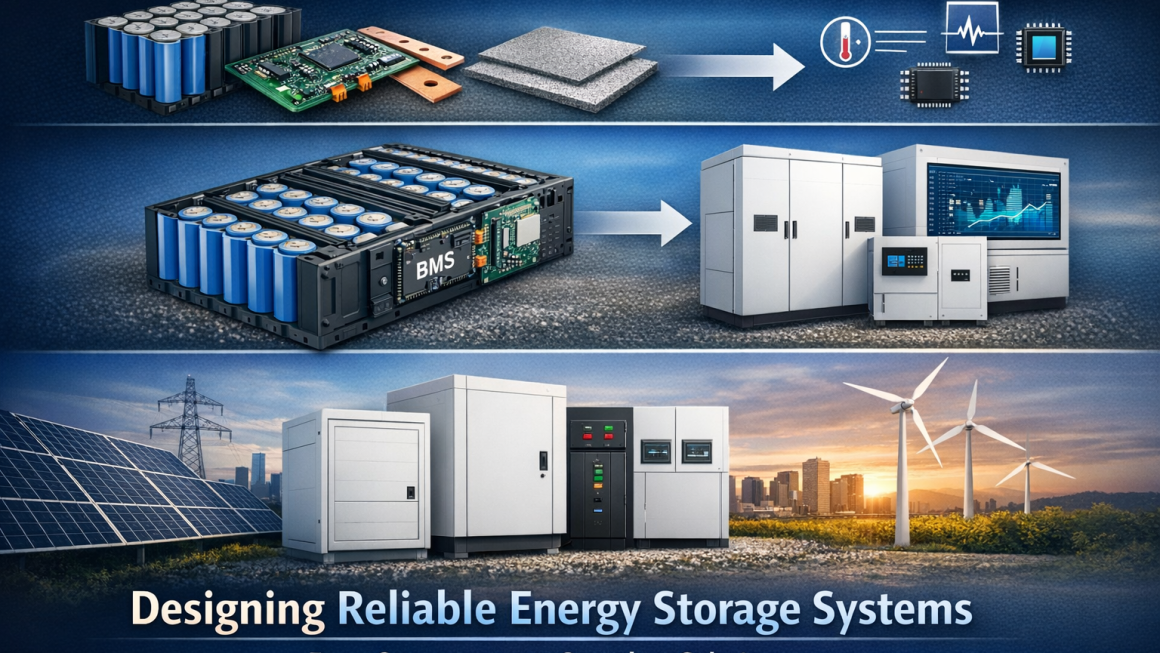
Materials → Components → Modules → Systems → Integration
Each layer contributes to overall system performance and must be optimized in coordination with others.
1. Material-Level Foundations
At the lowest level, materials determine the fundamental behavior of the system.
Conductive Materials
Efficient electron transport reduces internal resistance and energy loss. Conductive additives and coatings play a key role in:
- Enhancing electrode performance
- Improving current distribution
- Reducing heat generation
Thermal Materials
Thermal interface materials (TIMs) and heat spreaders are essential for:
- Managing heat dissipation
- Maintaining temperature uniformity
- Preventing thermal hotspots
Poor thermal design is one of the most common causes of system failure.
Structural Materials
Mechanical stability ensures durability during:
- Charge/discharge cycling
- Temperature fluctuations
- Physical stress
Material selection at this level directly affects lifespan and safety.
2. Component-Level Engineering
Components form the building blocks of energy storage systems.
Battery Cells
Cells define:
- Energy density
- Power capability
- Cycle life
Cell selection must align with application requirements, such as high energy vs high power.
Busbars and Electrical Connections
Reliable electrical pathways are critical for:
- Minimizing resistive losses
- Ensuring uniform current distribution
- Preventing localized heating
Design considerations include material conductivity, geometry, and contact quality.
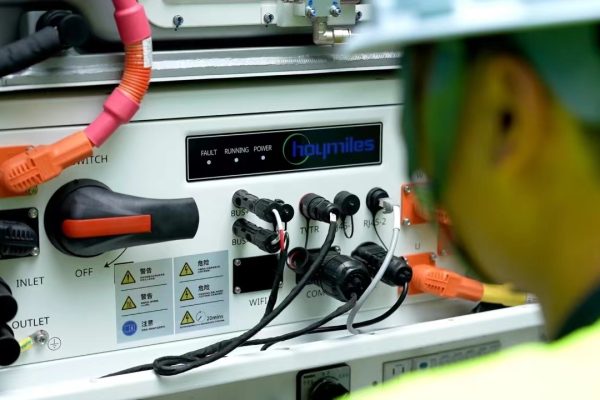
Sensors and Monitoring
Reliable systems require real-time visibility into:
- Voltage
- Temperature
- Current
These inputs enable proactive system management and fault detection.
3. Module-Level Integration
Modules group cells and components into functional units.
Key Objectives at the Module Level:
- Electrical balance between cells
- Thermal uniformity
- Mechanical stability
- Safety containment
Battery Management System (BMS)
The BMS is central to module reliability. It performs:
- State of charge (SoC) estimation
- State of health (SoH) monitoring
- Cell balancing
- Fault detection and protection
A well-designed BMS ensures that no individual cell becomes a weak point.
Thermal Design
Module-level thermal design includes:
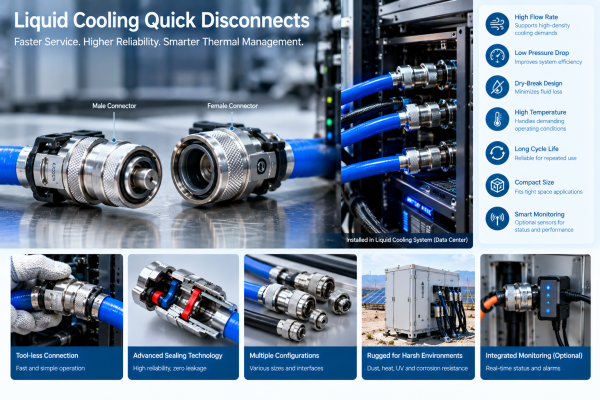
- Cooling strategies (air or liquid)
- Heat spreading materials
- Temperature monitoring
Uniform temperature distribution is essential for preventing uneven aging.
4. System-Level Architecture
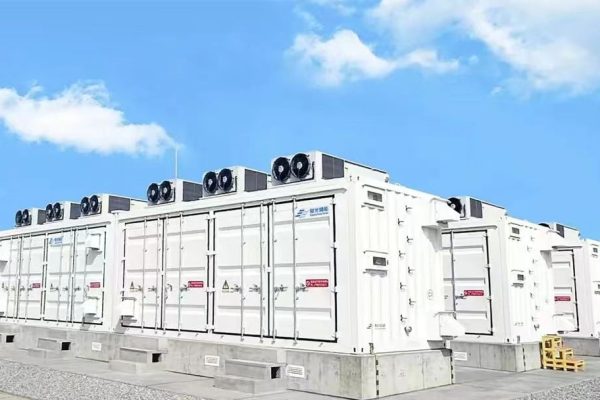
At the system level, modules are integrated into complete energy storage solutions.
Key System Components:
- Power Conversion System (PCS)
- Energy Management System (EMS)
- Protection and control systems
- Enclosures and mechanical structures
Energy Management System (EMS)
The EMS coordinates energy flow between:
- Grid
- Storage system
- Loads
It enables:
- Load balancing
- Peak shaving
- Renewable integration
- Real-time optimization
Power Electronics
Reliable power conversion ensures:
- Efficient energy transfer
- Stable voltage and frequency
- Compatibility with grid or off-grid systems
5. Integration and Real-World Deployment
Even well-designed components can fail if integration is not properly managed.
Environmental Considerations
Systems must operate reliably under:
- Temperature variations
- Humidity
- Dust and contamination
Installation Constraints
Real-world deployments often involve:
- Limited space
- Complex layouts
- Existing infrastructure integration
Design must accommodate these constraints without compromising performance.
Redundancy and Fault Tolerance
Reliable systems incorporate:
- Redundant modules
- Fault isolation mechanisms
- Fail-safe operation modes
This ensures that a single failure does not lead to system-wide issues.
Reliability Through Thermal and Electrical Balance
One of the most critical aspects of system reliability is maintaining balance:
Electrical Balance
- Uniform current distribution
- Avoidance of overloading specific cells or modules
Thermal Balance
- Even heat distribution
- Prevention of hotspots
Imbalance in either domain can lead to:
- Accelerated degradation
- Reduced efficiency
- Safety risks
The Role of Modularity in Reliability
Modular design enhances reliability in several ways:
- Scalability: Systems can grow without redesign
- Maintainability: Faulty modules can be replaced individually
- Redundancy: Multiple modules provide backup capacity
Modularity transforms reliability from a static feature into a dynamic capability.
Common Failure Points and Mitigation Strategies
Understanding potential failure points is essential for improving reliability.
Thermal Runaway
Mitigation:
- Advanced thermal management
- Early detection via sensors
- Proper cell spacing and materials
Electrical Faults
Mitigation:
- Robust insulation
- Reliable connections
- Protection circuits
Degradation and Aging
Mitigation:
- Balanced operation
- Controlled charge/discharge rates
- Accurate monitoring systems
From Components to Complete Solutions
Reliable energy storage systems are not built by optimizing individual parts in isolation. Instead, they require:
- Cross-layer coordination
- Integrated design thinking
- Continuous monitoring and adaptation
This approach transforms separate components into a cohesive, high-performance system.
The Role of Materials and Intermediate Layers
Between raw materials and full systems lies a critical but often overlooked layer:
The intermediate layer — where materials meet engineering
This includes:
- Conductive networks
- Thermal pathways
- Interface engineering
Optimizing this layer can significantly improve:
- Efficiency
- Stability
- System lifespan
How gr-newenergy.com Approaches Reliability
At gr-newenergy.com, we focus on enabling reliable energy storage systems through a material-to-system perspective:
- Advanced conductive and thermal materials
- Support for component and module-level optimization
- Exploration of integration pathways across system layers
Our approach emphasizes:
- Understanding mechanisms before scaling
- Supporting intermediate solutions rather than end-product claims
- Bridging material science with real-world system design
This aligns with the increasing complexity of modern energy storage systems.
Designing reliable energy storage systems requires more than selecting high-performance components. It demands a holistic approach that integrates materials, components, modules, and systems into a unified architecture.
Reliability emerges from:
- Balanced electrical and thermal design
- Robust module integration
- Intelligent system management
- Careful consideration of real-world conditions
As energy systems continue to evolve, the ability to design reliable, scalable, and efficient storage solutions will become a defining capability.
And in this process, the connection between materials and systems will play a central role in shaping the future of energy storage.