
As energy storage systems (ESS) evolve toward higher power density, faster charge–discharge capability, and longer operational life, one challenge becomes increasingly critical: heat and electrical management at the material level. While battery chemistry often receives the spotlight, thermal and conductive materials play a decisive role in determining system efficiency, safety, and real-world performance.
From cell to module and from module to system, advanced materials serve as the invisible bridge connecting electrochemical potential with reliable power delivery.
1. The Hidden Bottleneck: Heat and Resistance
Modern lithium-ion and high-power battery systems generate significant heat during operation—especially in applications such as:
- Commercial & industrial ESS
- Data center backup systems
- Hybrid microgrids
- High-frequency cycling environments
Without effective thermal control, excess heat can lead to:
- Accelerated cell degradation
- Capacity loss
- Reduced round-trip efficiency
- Increased safety risks
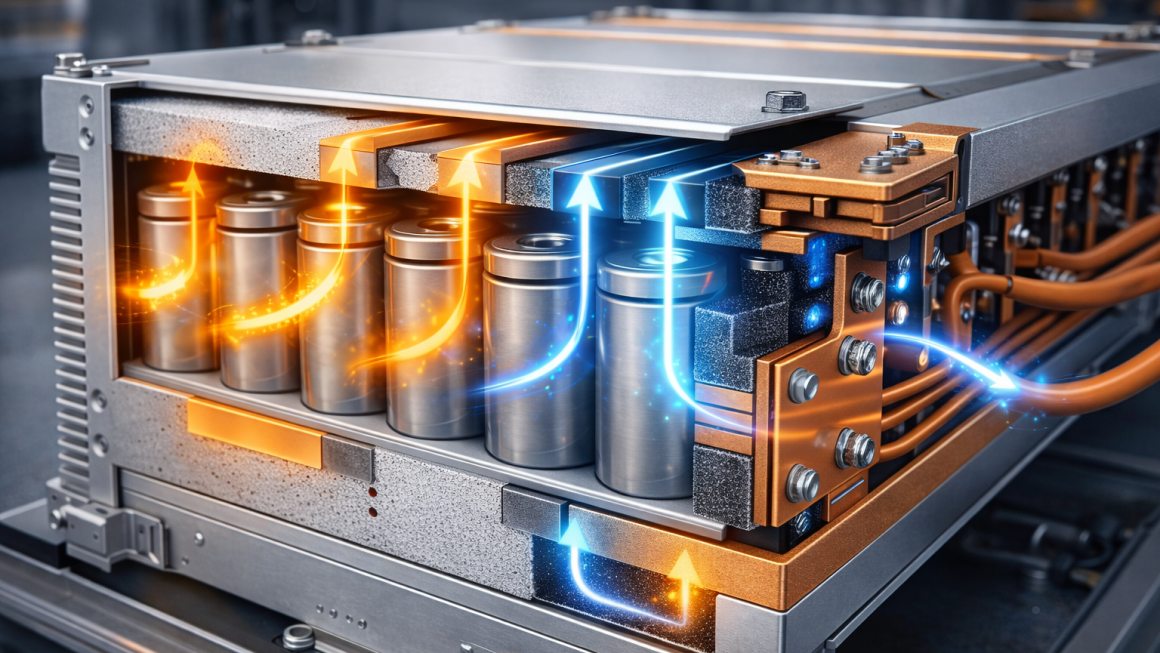
At the same time, internal electrical resistance—across busbars, connectors, interfaces, and coatings—creates energy loss in the form of heat. This means thermal and conductive performance are tightly interconnected.
The solution lies not only in system architecture but in material engineering.
2. Thermal Interface Materials (TIMs): Managing Heat at the Source
Thermal Interface Materials fill microscopic gaps between components, improving heat transfer from battery cells to cooling structures.
Key functions include:
- Lowering thermal contact resistance
- Enhancing heat dissipation uniformity
- Reducing temperature gradients across modules
Advanced TIMs now integrate:
- High thermal conductivity fillers
- Electrically insulating matrices
- Flame-retardant properties
The result is improved thermal stability without compromising electrical isolation—an essential requirement in high-voltage ESS modules.
3. Conductive Materials: Reducing Loss, Improving Efficiency
Electrical conductivity directly impacts system efficiency. Even small improvements in resistance reduction can lead to measurable gains in large-scale or high-power systems.
Applications include:
- Conductive coatings on current collectors
- Enhanced busbar materials
- Conductive adhesives and structural components
- Surface treatments to reduce oxidation and interface resistance
Materials such as advanced carbon-based additives, hybrid composites, and engineered metal structures help:
- Increase current carrying capacity
- Improve fast-charge performance
- Lower internal energy loss
- Enhance cycle stability
In modular ESS design, these improvements accumulate—contributing to better overall system ROI.
4. Thermal–Electrical Synergy: Integrated Material Design
The next generation of energy storage does not treat thermal and electrical properties separately. Instead, it integrates them into multifunctional materials that provide:
- High thermal conductivity
- Optimized electrical pathways
- Mechanical stability
- Fire resistance
- Long-term reliability
By bridging these properties, manufacturers can:
- Increase power density without overheating
- Extend battery lifespan
- Reduce cooling system burden
- Improve safety margins
This approach is especially important in mid-layer products—modules and packs—where performance optimization must align with manufacturability and cost control.
5. Enabling High-Performance ESS Applications
In applications such as commercial storage, data centers, and distributed energy systems, performance requirements are becoming stricter:
- Higher C-rates
- Faster response times
- Compact installation spaces
- Stricter safety standards
Thermal and conductive materials are no longer optional enhancements—they are foundational enablers of next-generation ESS performance.
By optimizing materials at the interface level, companies can unlock measurable system improvements without radically changing battery chemistry.
Energy storage innovation does not depend solely on new chemistries. It increasingly depends on how well materials manage heat and electricity across the entire system architecture.
Thermal and conductive materials bridge the gap between theoretical energy capacity and practical, reliable power delivery.
As ESS solutions continue to scale and diversify, material engineering will remain a decisive factor in achieving the balance between performance, efficiency, and safety.