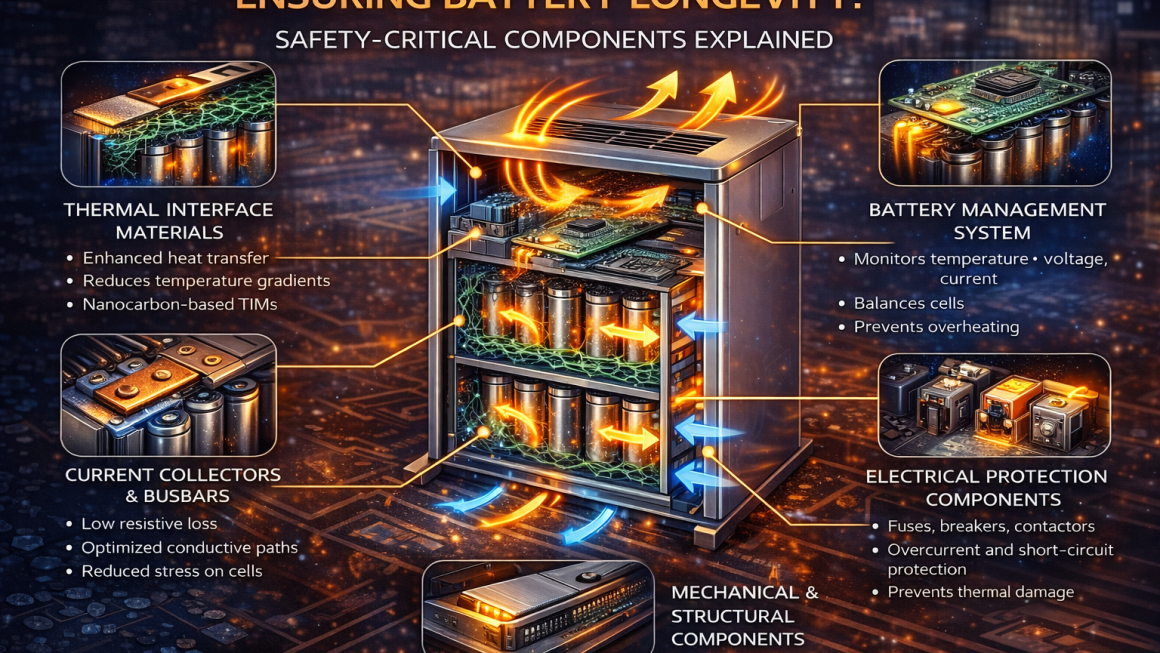
Safety-Critical Components Explained
Battery longevity is not determined by cell chemistry alone. In modern energy storage systems—especially residential and commercial ESS—long service life is the result of carefully designed safety-critical components working together.
From thermal interfaces and current collectors to protection electronics and enclosure design, these components quietly ensure that batteries operate within safe limits, day after day, year after year.
This article explains the key safety-critical components that directly impact battery lifespan, and why system-level thinking is essential for long-term reliability.
1. Why Battery Longevity Is a Safety Issue
Battery aging is not just a performance problem—it is a safety concern.
As batteries degrade:
- Internal resistance increases
- Heat generation rises during operation
- Temperature uniformity worsens
- The risk of localized overheating grows
Without proper safeguards, accelerated aging can lead to capacity loss, unexpected shutdowns, or in extreme cases, thermal incidents.
Designing for longevity means designing for controlled, predictable operation under real-world conditions.
2. Thermal Interface Materials (TIMs)
Thermal interface materials are among the most overlooked yet critical components affecting battery life.
Their role:
- Transfer heat from cells to cooling structures
- Minimize contact thermal resistance
- Maintain performance under compression and aging
High-quality TIMs—often enhanced with graphene or nanocarbon fillers—help ensure:
- Lower average cell temperature
- Reduced temperature gradients between cells
- Slower electrochemical degradation
Poor or aging TIMs, by contrast, can create hidden hotspots that shorten battery life long before failure is visible.
3. Current Collectors and Busbars
Electrical pathways also influence longevity.
Key factors:
- Electrical conductivity
- Contact resistance
- Thermal conductivity
Advanced current collectors and busbars—especially those using carbon-enhanced coatings or optimized surface treatments—reduce resistive heating during charge and discharge.
Lower electrical losses mean:
- Less internal heat generation
- Higher energy efficiency
- Reduced mechanical and thermal stress on cells
4. Battery Management System (BMS)
The BMS is the brain of battery safety and longevity.
Critical BMS functions include:
- Voltage and current monitoring
- Temperature sensing across modules
- State of charge (SOC) and state of health (SOH) estimation
- Cell balancing
Accurate temperature data allows the system to:
- Limit charge/discharge rates when needed
- Prevent operation outside safe thermal windows
- Extend usable cycle life
Hardware design and sensor placement are just as important as software algorithms.
5. Structural and Mechanical Components
Mechanical design directly affects thermal and electrical stability.
Important considerations:
- Controlled compression of cells
- Vibration resistance
- Thermal expansion compatibility
Materials such as thermally conductive composite plates or coated aluminum structures help maintain uniform pressure and efficient heat transfer over long service periods.
Mechanical instability often leads to rising contact resistance, accelerating both electrical and thermal aging.
6. Enclosures and Environmental Protection
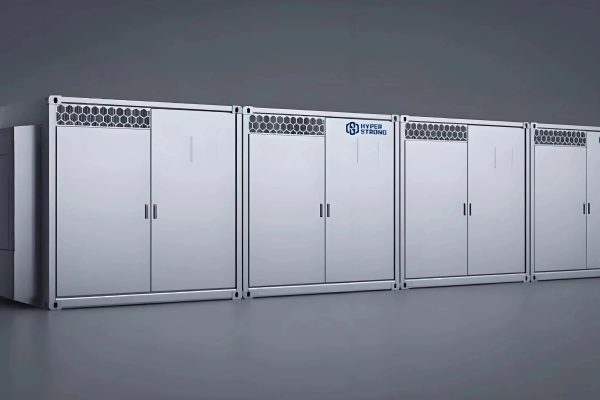
Battery enclosures are more than protective shells.
They influence:
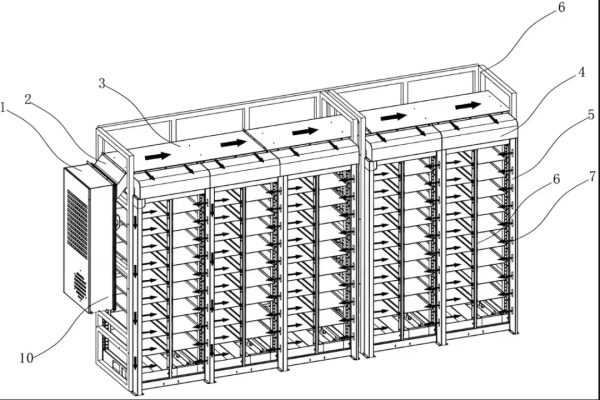
- Heat dissipation
- Airflow paths
- Moisture and dust resistance
- Fire containment strategies
Well-designed enclosures support passive thermal management, reduce environmental stress, and improve overall system reliability—especially in residential installations with limited maintenance.
7. Electrical Protection Components
Safety-critical protection elements include:
- Fuses and circuit breakers
- Contactors and relays
- Insulation and isolation barriers
These components prevent abnormal conditions—such as overcurrent or short circuits—from cascading into thermal or mechanical damage that shortens battery life.
8. System-Level Integration: The Real Differentiator
No single component guarantees longevity.
Battery lifespan depends on:
- Material compatibility
- Thermal pathways
- Electrical design
- Control strategies
Systems designed with isolated optimizations often underperform compared to those engineered as integrated thermal–electrical–mechanical ecosystems.
This is where material-level improvements—such as graphene-enhanced thermal components—deliver the greatest value.
Ensuring battery longevity is not about adding more protection—it is about designing smarter, more balanced systems.
Safety-critical components—from thermal interfaces and current collectors to BMS and enclosures—work together to control heat, reduce stress, and maintain stable operation over time.
For modern energy storage systems, longevity is engineered, not assumed—and thoughtful component selection is the foundation of long-term safety and performance.