



As battery energy density continues to increase, heat management has become one of the most critical bottlenecks in modern battery design. Whether in electric vehicles, stationary energy storage systems (ESS), or high-power industrial applications, excessive heat directly impacts performance, safety, and lifetime.
While cooling systems and pack-level thermal designs receive significant attention, thermal conductivity inside the battery itself is often overlooked. In recent years, nanocarbon additives—such as graphene and carbon nanotubes (CNTs)—have emerged as powerful tools to improve internal heat transport at the material level.
This article explores how nanocarbon additives improve thermal conductivity in batteries, why that matters, and how these materials are increasingly shaping next-generation battery and ESS designs.
Why Thermal Conductivity Matters Inside Batteries
During charge and discharge, batteries generate heat due to:
- Internal resistance
- Electrochemical reactions
- High current density in fast charging or high-power output
If this heat is not dissipated efficiently, several problems arise:
- Uneven temperature distribution between cells or within electrodes
- Accelerated aging and capacity fade
- Reduced power capability
- Increased risk of thermal runaway
Most conventional batteries rely on external cooling (air, liquid, or phase-change systems). However, external cooling can only manage heat after it has already accumulated.
Improving internal thermal conductivity allows heat to spread more evenly and escape faster—reducing hotspots before they become critical.
The Limitations of Traditional Battery Materials
Battery electrodes and separators are typically composed of:
- Active materials (e.g., NMC, LFP, graphite)
- Polymer binders
- Conductive additives (usually carbon black)
While carbon black improves electrical conductivity, its thermal conductivity is relatively limited and highly dependent on loading level. Increasing carbon black content often:
- Reduces energy density
- Weakens mechanical integrity
- Creates processing challenges
As batteries push toward higher performance, traditional conductive fillers are no longer sufficient for thermal management at the material level.
Nanocarbon Additives: A New Thermal Pathway
Nanocarbon materials—particularly graphene and carbon nanotubes—offer a fundamentally different approach.
Key Thermal Advantages of Nanocarbons
- Extremely high intrinsic thermal conductivity
Graphene, for example, exhibits thermal conductivity orders of magnitude higher than most conventional fillers. - High aspect ratio and network formation
Nanocarbons form continuous heat-conducting pathways at much lower loading levels. - Simultaneous electrical and thermal enhancement
Unlike many fillers, nanocarbons improve both properties without trade-offs.
This makes them especially attractive for battery electrodes, current collectors, conductive coatings, and thermal interface layers.
How Nanocarbon Additives Improve Battery Thermal Conductivity
1. Creating Continuous Heat-Conduction Networks
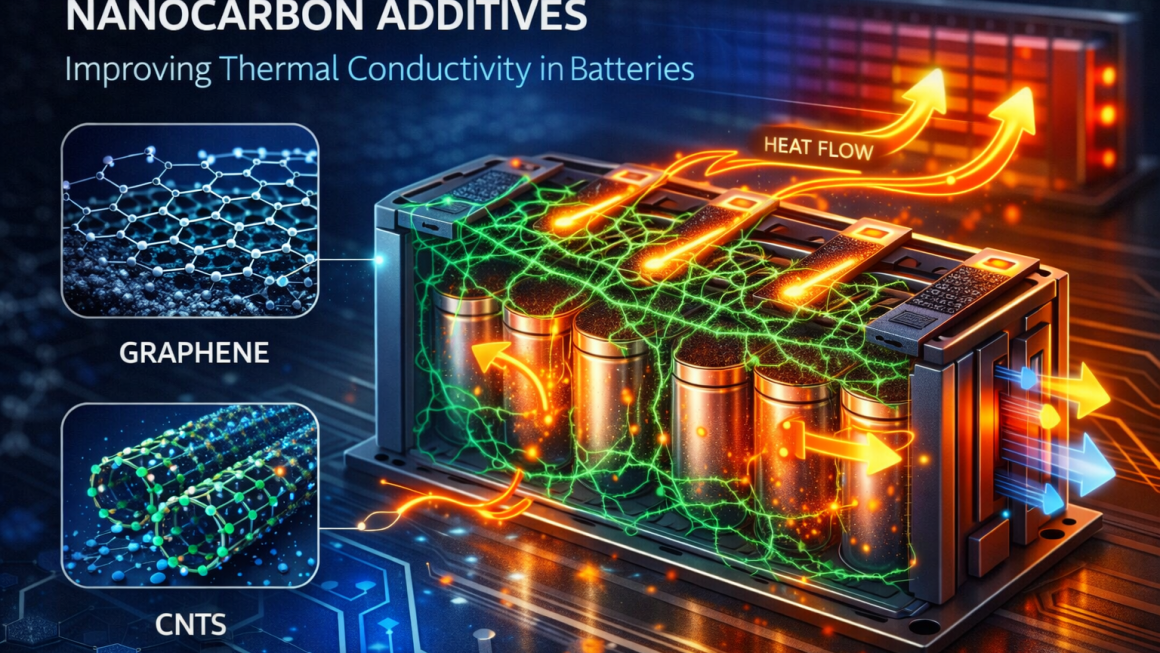
Graphene sheets and CNTs form interconnected networks within the electrode or coating matrix. These networks:
- Transfer heat laterally across the electrode
- Reduce localized temperature spikes
- Improve thermal uniformity across cells
This is particularly valuable in high-rate charge/discharge scenarios.
2. Reducing Thermal Resistance at Interfaces
Heat in batteries often accumulates at interfaces:
- Active material ↔ binder
- Electrode ↔ current collector
- Cell ↔ module components
Nanocarbon additives reduce interfacial thermal resistance by improving contact quality and continuity, allowing heat to move more freely through the structure.
3. Enabling Thinner, More Efficient Thermal Layers
Because nanocarbons are effective at low loadings, manufacturers can:
- Use thinner conductive or thermal coatings
- Maintain energy density
- Reduce overall battery weight
This is especially important for EV and aerospace-related applications.
Graphene vs CNTs: Thermal Roles in Batteries
Both graphene and CNTs improve thermal conductivity, but their roles differ:
| Material | Thermal Role | Typical Applications |
|---|---|---|
| Graphene | In-plane heat spreading | Electrode coatings, current collectors, module coatings |
| CNTs | Through-plane heat bridging | Electrode bulk, conductive networks |
| Hybrid Systems | Balanced thermal pathways | High-performance ESS and EV batteries |
In practice, hybrid graphene–CNT systems often deliver the best balance between thermal, electrical, and mechanical performance.
Applications Across Battery and ESS Components
Nanocarbon-enhanced thermal conductivity is already being applied in:
- Battery electrodes – reducing internal heat accumulation
- Conductive coatings – improving heat dissipation on busbars and tabs
- Battery modules – enhancing heat flow toward cooling systems
- Thermal interface materials (TIMs) – lowering contact resistance between cells and cold plates
For stationary ESS, improved thermal conductivity directly translates into:
- Longer service life
- Higher reliability
- Lower maintenance costs
Why Thermal Conductivity Matters More in ESS Than Ever
Unlike consumer electronics, ESS batteries operate continuously for years, often under fluctuating environmental conditions. Poor thermal management leads to:
- Capacity imbalance across modules
- Frequent derating
- Premature system replacement
By enhancing thermal conductivity at the material level, nanocarbon additives help ESS systems achieve:
- Stable long-term operation
- Improved safety margins
- Higher total energy throughput over system lifetime
This aligns with the growing industry focus on lifetime cost and reliability, not just initial performance.
Design Considerations When Using Nanocarbon Additives
While the benefits are clear, proper design is essential:
- Dispersion quality matters more than loading level
- Binder compatibility must be carefully evaluated
- Thermal improvement should be measured alongside electrical and mechanical effects
When engineered correctly, nanocarbon additives provide system-level value far beyond simple conductivity enhancement.
Thermal conductivity inside batteries is no longer a secondary consideration—it is a core performance and safety parameter. As energy storage systems demand higher power, faster charging, and longer lifetimes, nanocarbon additives such as graphene and CNTs are becoming essential tools.
By creating efficient internal heat pathways, reducing thermal resistance, and enabling lightweight designs, nanocarbon materials are helping batteries operate cooler, safer, and longer.
For battery and ESS manufacturers focused on next-generation performance, thermal conductivity optimization at the material level is no longer optional—it is a strategic advantage.