As energy storage technology evolves, there is an increasing demand for devices capable of delivering high power with rapid charge and discharge cycles. While batteries dominate energy density applications, supercapacitors—also known as ultracapacitors or electrochemical capacitors—have emerged as the go-to solution for high-power, fast-response applications.
From industrial energy buffering and regenerative braking in electric vehicles to grid-level power stabilization, the performance of supercapacitors depends heavily on the materials used. Advanced materials enable faster charging, higher power output, and longer cycle life—critical factors in today’s energy-intensive applications.
This article explores the key materials that enable high-power supercapacitors, why they matter, and how they define the next generation of energy storage devices.
Why Material Choice Matters in High-Power Supercapacitors
Unlike batteries, supercapacitors store energy electrostatically, rather than relying on chemical reactions. This distinction provides several advantages:
- Ultra-fast charging and discharging
- High power density (more than batteries in short bursts)
- Extremely long cycle life
However, delivering these benefits reliably requires materials that satisfy stringent electrical, thermal, and mechanical requirements:
- High surface area for energy storage
- Excellent electrical conductivity to minimize resistive losses
- Efficient thermal management to prevent overheating during rapid cycles
- Mechanical and chemical stability for millions of charge/discharge cycles
The choice of electrode, electrolyte, and separator materials directly impacts these performance factors.
Advanced Electrode Materials
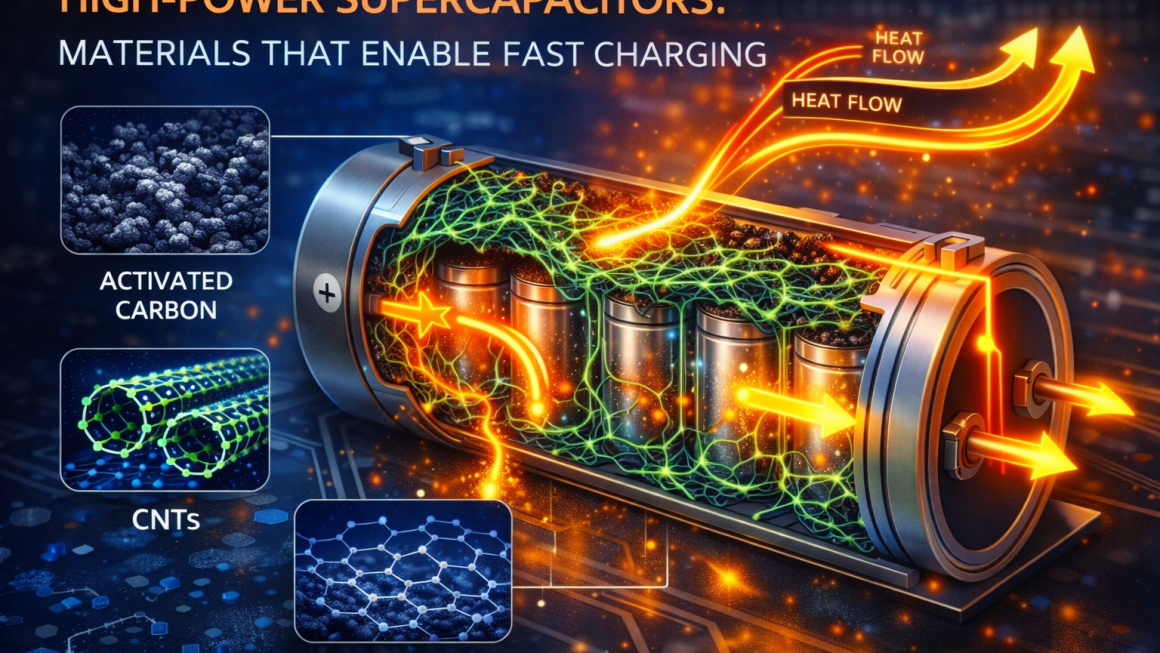
1. Activated Carbon
Activated carbon remains the most widely used material due to:
- High specific surface area (1000–3000 m²/g)
- Affordable cost
- Proven reliability
Limitations for high-power applications:
- Poor electrical conductivity
- Slower ion transport in thicker electrodes
Activated carbon is often combined with conductive additives (e.g., graphene, CNTs) to overcome these limitations.
2. Graphene
Graphene’s high electrical conductivity and surface area make it ideal for high-power supercapacitors:
- Improved charge transfer reduces equivalent series resistance (ESR)
- Thin, high-surface-area sheets enhance ion accessibility
- Mechanical robustness allows flexible electrode design
Graphene-enhanced electrodes enable faster charge/discharge cycles, making them suitable for EV regenerative braking and grid buffering.
3. Carbon Nanotubes (CNTs)
CNTs offer excellent electron mobility and mechanical flexibility:
- Form conductive networks within the electrode
- Bridge gaps in composite materials for uniform current distribution
- Enhance structural integrity for long-term cycling
CNTs are often used in hybrid electrodes (graphene + CNTs) to combine lateral conductivity and structural reinforcement.
4. Conductive Polymers
Conductive polymers, such as polyaniline (PANI) and polypyrrole (PPy), are increasingly used in high-power electrodes:
- Provide pseudocapacitance, increasing energy density
- Maintain high-rate capability if well-integrated with carbon networks
- Can be coated on graphene or CNT scaffolds for hybrid performance
Electrolytes and Separators: Supporting High Power
While electrode materials define the core performance, electrolytes and separators are equally critical:
- Aqueous electrolytes: Extremely fast ion mobility, ideal for very high power, but limited voltage window (~1 V)
- Organic electrolytes: Higher voltage (2.7–3 V), slightly slower kinetics, used in commercial supercapacitors
- Ionic liquids: Wide electrochemical window, excellent thermal stability, used in advanced high-power designs
Separators must be thin, chemically stable, and highly porous to facilitate rapid ion transport while preventing short circuits.
Thermal Management in High-Power Supercapacitors
High-power supercapacitors generate heat during rapid charge/discharge cycles. Without effective thermal management, performance drops and reliability is compromised.
- Nanocarbon additives (graphene, CNTs) enhance thermal conductivity, spreading heat across the electrode
- Thermally conductive binders and coatings reduce hotspots
- Module-level heat sinks or cooling plates ensure safe operation in high-current applications
Efficient thermal design allows continuous high-power operation and extends device lifetime.
Hybrid Materials for Next-Generation Supercapacitors
Modern high-power supercapacitors increasingly rely on hybrid material systems:
- Graphene + CNT composites: Balance lateral and vertical conductivity, improving both electron and heat transport
- Carbon + conductive polymer coatings: Increase energy density without sacrificing power
- Functionalized nanocarbons: Enhance ion-accessible surface area and chemical stability
These approaches allow supercapacitors to deliver unprecedented power while remaining compact and durable.
Applications of High-Power Supercapacitors
- Electric Vehicles: Regenerative braking, acceleration bursts
- Industrial Power Buffers: Smoothing peak demand, UPS systems
- Renewable Integration: Stabilizing fluctuations from solar or wind energy
- High-Power Consumer Devices: Fast-charging electronics, power tools
In all cases, materials selection directly determines the device’s ability to charge and discharge rapidly without degradation.
High-power supercapacitors are reshaping the energy storage landscape. Material innovations—particularly nanocarbons like graphene and CNTs, conductive polymers, and advanced hybrid composites—are at the core of this revolution.
By combining:
- High electrical conductivity
- Rapid ion transport
- Thermal management capabilities
- Mechanical and chemical stability
manufacturers can create supercapacitors capable of fast charging, high-power delivery, and long-term reliability, meeting the demands of modern energy storage applications across EVs, industrial systems, and renewable integration.
For engineers and ESS designers, focusing on the right materials is no longer optional—it is the foundation of high-performance, fast-charging energy storage.