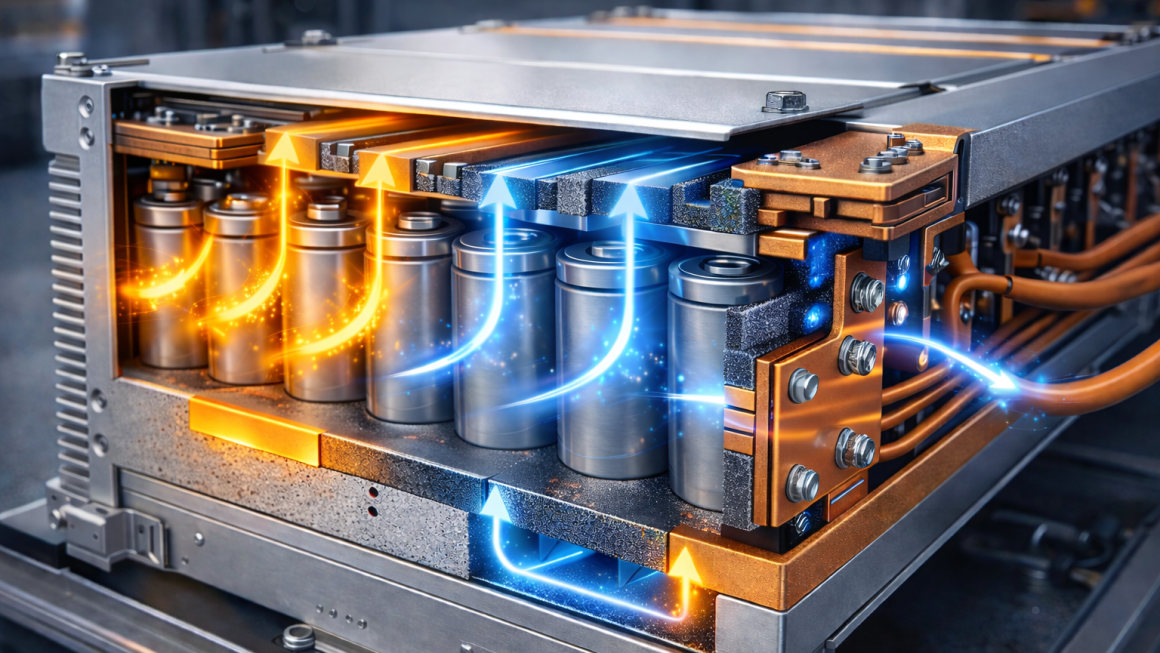
Energy Storage Systems (ESS) are no longer just about battery cells. A significant portion of system performance—efficiency, safety, and reliability—depends on interconnects and busbars, the components that transmit power between cells, modules, and system outputs.
Optimizing these components requires a combination of advanced materials, thoughtful design, and application-specific engineering.
1️⃣ The Role of Interconnects and Busbars
Interconnects and busbars are the critical pathways for electrical energy in ESS modules. They serve multiple purposes:
- Connecting battery cells within a module
- Linking modules to form complete racks or cabinets
- Delivering power to inverters, loads, or the grid
Despite their seemingly passive role, inefficiencies or failures at this level can lead to:
- Excess heat generation
- Voltage drops and energy losses
- Increased stress on cells
- Potential safety hazards
Thus, optimizing interconnects and busbars is essential for high-performance energy storage solutions.
2️⃣ Material Considerations
The choice of materials directly impacts conductivity, thermal performance, and long-term durability.
Common materials include:
- Copper: Excellent electrical conductivity, widely used in high-current applications.
- Aluminum: Lighter and cost-effective, but requires surface treatment or coatings to maintain conductivity.
- Hybrid and composite materials: Incorporate carbon-based additives, graphene, or plated surfaces to enhance conductivity and corrosion resistance.
Advanced conductive coatings can further reduce contact resistance and protect against oxidation, especially in outdoor or industrial environments.
3️⃣ Design Principles
Effective interconnect and busbar design balances electrical, thermal, and mechanical requirements.
Key considerations include:
- Cross-sectional area: Sufficient to carry peak currents without excessive resistive heating
- Shape and layout: Minimize current bottlenecks and allow uniform distribution
- Mechanical robustness: Resist vibration, expansion, and contraction during cycling
- Thermal management: Optimize heat dissipation through material choice and geometry
Additionally, modular design enables scalability and easier maintenance without compromising system efficiency.
4️⃣ Applications in Modern ESS
Optimized interconnects and busbars are critical across diverse applications:
- Residential and commercial energy storage: Ensures efficient power distribution in compact modules
- Data centers: Maintains high power quality and reliability under continuous load
- Hybrid microgrids: Supports rapid response to variable renewable energy generation
- Industrial high-power storage: Handles extreme currents while maintaining thermal and mechanical stability
By applying tailored materials and design practices, system integrators can maximize energy efficiency and safety.
5️⃣ Emerging Trends
New trends in busbar and interconnect engineering include:
- Graphene-enhanced conductive coatings for improved performance and reduced oxidation
- Additive manufacturing to create optimized geometries with reduced weight and enhanced cooling
- Hybrid metal-carbon composites for scalable and cost-efficient solutions
- Integrated thermal management through layered design or embedded conductive paths
These innovations are particularly important for mid-layer ESS solutions, where performance gains at the interface level can significantly improve system ROI.
Interconnects and busbars may seem like secondary components, but they are key enablers of high-performance, reliable, and efficient energy storage systems.
Through careful material selection, thoughtful design, and application-specific optimization, engineers can ensure:
- Reduced energy losses
- Controlled thermal profiles
- Long-term mechanical and electrical reliability
In high-power and modular ESS, success is often determined not just by battery chemistry, but by how effectively energy moves through the system.
Optimized interconnects and busbars bridge the gap between theoretical capacity and practical, real-world performance.