
In high-power energy systems, busbars are more than simple metal connectors. They are the backbone of current distribution, directly influencing efficiency, thermal performance, and long-term reliability.
As power density increases in battery modules and energy storage systems, optimizing busbar performance becomes essential. Conductive coatings are emerging as a key enabler in this evolution.
Why Busbar Optimization Matters
Busbars are responsible for carrying large currents between cells, modules, and system outputs. Under high-load conditions, even small inefficiencies can result in:
- Energy losses
- Localized overheating
- Oxidation and corrosion
- Voltage instability
- Reduced system lifespan
While copper and aluminum remain the primary base materials, surface engineering is now where performance differentiation occurs.
The Role of Conductive Coatings
Conductive coatings are not merely protective layers. When engineered correctly, they serve multiple functions:
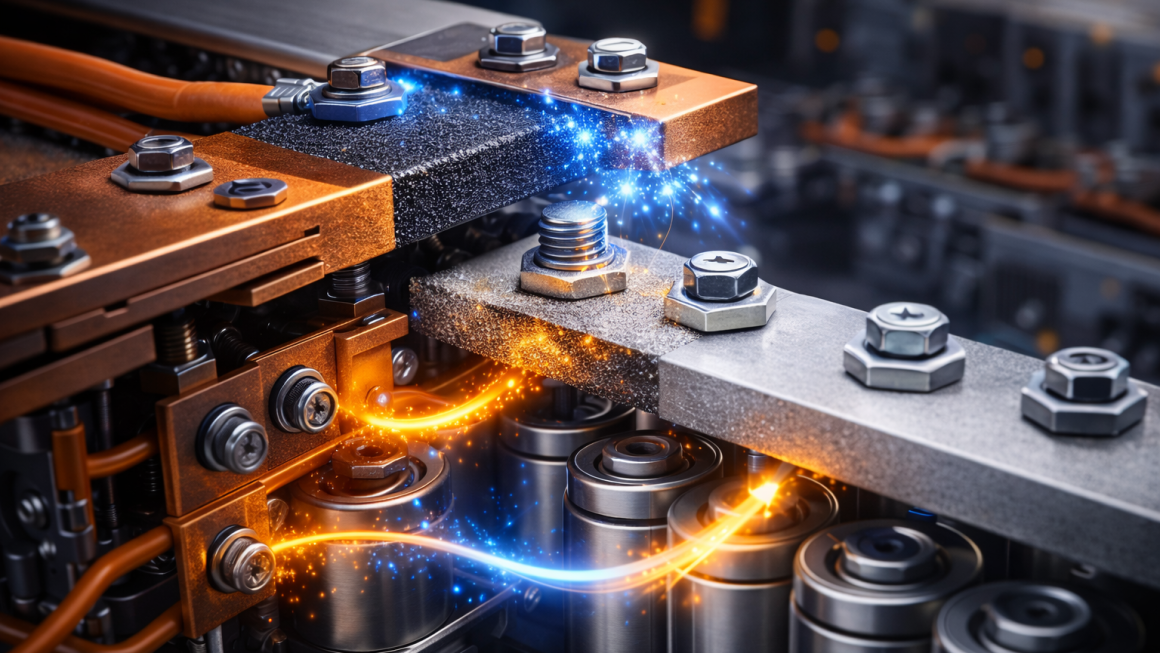
1️⃣ Lower Contact Resistance
Interface resistance at connection points can significantly impact system efficiency.
High-performance coatings:
- Improve surface uniformity
- Enhance electrical contact
- Reduce micro-gap oxidation
- Maintain stable conductivity over time
Lower contact resistance directly translates into reduced I²R losses.
2️⃣ Corrosion and Oxidation Protection
In real-world environments—humidity, temperature cycling, industrial pollutants—bare metals degrade.
Advanced conductive coatings:
- Act as anti-corrosion barriers
- Prevent oxide layer buildup
- Stabilize long-term conductivity
This is especially critical in large battery cabinets and outdoor energy storage systems.
3️⃣ Thermal Stability Under High Load
High current generates heat, particularly at connection interfaces.
Engineered coatings can:
- Improve thermal spreading
- Enhance interface heat transfer
- Maintain structural integrity during thermal cycling
This reduces hot spots and improves safety margins.
4️⃣ Lightweight and Material Efficiency
Aluminum busbars are increasingly used to reduce system weight and cost.
However, aluminum’s surface oxidation creates conductivity challenges. Conductive coatings enable:
- Aluminum performance approaching copper reliability
- Cost-performance optimization
- Scalable manufacturing compatibility
This is where material engineering bridges economic and technical requirements.
Beyond Traditional Plating
Conventional plating methods (tin, nickel, silver) have long been used. But advanced systems are now incorporating:
- Nano-enhanced conductive coatings
- Carbon-based conductive layers
- Hybrid metal-polymer systems
- Graphene-enhanced protective films
These next-generation coatings aim to combine conductivity, corrosion resistance, and thermal stability in a single engineered layer.
System-Level Impact
Optimizing busbars through conductive coatings results in:
- Higher overall system efficiency
- Reduced thermal losses
- Improved safety performance
- Extended operational lifespan
- Lower maintenance requirements
In high-power battery modules and scalable energy systems, performance bottlenecks often occur at interfaces—not at the cell chemistry level.
Engineering those interfaces properly defines the difference between theoretical performance and real-world reliability.
The Middle-Layer Engineering Advantage
While large-scale energy projects focus on megawatt capacity, meaningful performance gains are often achieved through incremental improvements in:
- Electrical pathways
- Contact surfaces
- Interface materials
- Structural integration
Conductive coatings for busbars represent a strategic opportunity for solution providers operating between raw materials and complete energy systems.
Because in high-power systems, efficiency is not just about generating energy —
it is about transmitting it with minimal loss.