



As energy systems become increasingly intelligent and interconnected, the role of Energy Management Systems (EMS) has expanded significantly. Modern EMS platforms are no longer limited to monitoring power flows—they actively optimize energy usage, coordinate distributed resources, and ensure system stability.
In this evolving landscape, battery modules must work seamlessly with advanced EMS platforms to unlock the full potential of energy storage. Proper integration allows storage systems to respond dynamically to real-time conditions, improving efficiency, reliability, and overall system performance.
The Role of Battery Modules in Smart Energy Systems
Battery modules are the building blocks of modern energy storage solutions. They provide the flexibility needed to support a wide range of applications, including:
- Commercial and industrial energy management
- Renewable energy integration
- Peak shaving and load balancing
- Microgrid stabilization
- Backup power systems
However, without intelligent coordination, these modules cannot fully optimize energy flow. This is where advanced EMS platforms play a crucial role.
What an Energy Management System Does
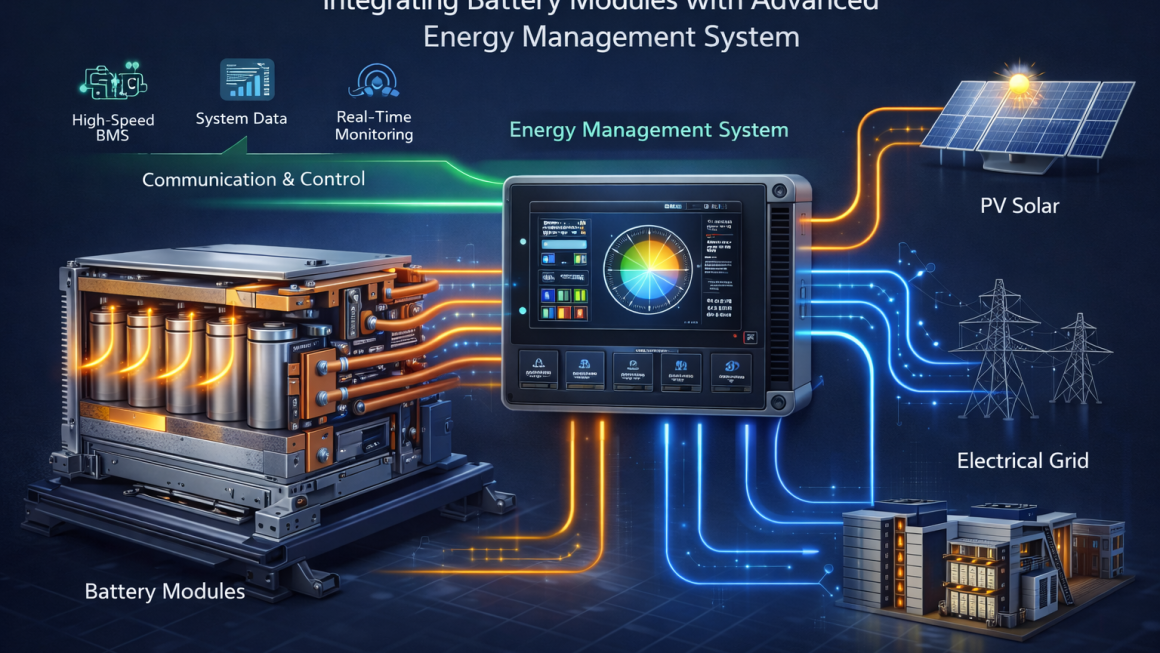
An EMS acts as the central intelligence layer of an energy system. It collects data from multiple sources and uses advanced algorithms to make real-time decisions about energy generation, storage, and consumption.
Typical EMS functions include:
- Monitoring battery state-of-charge (SOC) and health
- Predicting energy demand and supply patterns
- Controlling charge–discharge cycles
- Coordinating renewable energy sources
- Managing grid interaction and demand response
When integrated effectively, the EMS ensures that battery modules operate at optimal performance levels.
Communication Between Battery Modules and EMS
For seamless integration, battery modules must communicate reliably with the EMS through standardized protocols.
Common communication interfaces include:
- CAN bus communication
- Modbus protocols
- Ethernet-based industrial communication systems
- Advanced IoT connectivity platforms
These communication channels allow the EMS to receive critical data such as:
- Voltage and current levels
- Cell temperature distribution
- State of charge (SOC)
- State of health (SOH)
- Fault detection alerts
Real-time data exchange enables faster and more accurate energy management decisions.
Optimizing Charge–Discharge Strategies
One of the key advantages of EMS integration is the ability to optimize battery cycling strategies.
Instead of operating on fixed schedules, intelligent systems adjust battery operation dynamically based on:
- Energy price fluctuations
- Solar or wind generation forecasts
- Building energy consumption patterns
- Grid stability requirements
For example, the EMS may:
- Charge batteries during periods of excess renewable generation
- Discharge during peak demand hours
- Maintain reserve capacity for backup power events
This dynamic optimization improves both economic returns and system efficiency.
Enhancing System Safety and Reliability
Battery systems require continuous monitoring to maintain safe operation. By integrating battery modules with EMS platforms, system operators gain enhanced visibility into operational conditions.
Advanced EMS systems can detect anomalies such as:
- Abnormal temperature rise
- Voltage imbalance between cells
- Unexpected power fluctuations
- Communication failures
Early detection allows corrective action before issues escalate, improving overall system reliability.
Supporting Scalable Energy Storage Architectures
Modern energy systems often require scalable storage architectures that can grow with changing energy demands.
Integrating battery modules with EMS platforms enables:
- Flexible module expansion
- Coordinated operation across multiple battery racks
- Balanced power distribution across storage assets
This modular approach is particularly valuable for commercial energy storage installations where capacity requirements may evolve over time.
Enabling Renewable Energy Integration
As solar and wind power generation continue to expand, managing variability becomes a key challenge.
Battery modules integrated with EMS platforms help stabilize renewable energy systems by:
- Absorbing excess generation during peak production
- Delivering stored energy when renewable output declines
- Smoothing power fluctuations
- Supporting grid frequency regulation
This coordination improves the overall efficiency of renewable energy ecosystems.
The Future of Intelligent Energy Storage
Energy storage systems are rapidly evolving toward fully digitalized, data-driven platforms.
Future EMS-integrated battery systems will incorporate:
- Artificial intelligence for predictive energy optimization
- Advanced data analytics for battery health forecasting
- Cloud-based energy management platforms
- Autonomous grid-interactive capabilities
These technologies will transform battery modules from passive storage components into active participants in intelligent energy networks.
Integrating battery modules with advanced Energy Management Systems unlocks the full potential of modern energy storage solutions. Through real-time monitoring, intelligent control strategies, and seamless communication, EMS platforms ensure that battery systems operate safely, efficiently, and economically.
As the global energy transition accelerates, the synergy between modular battery architecture and intelligent energy management will play a central role in building resilient and sustainable power systems.