

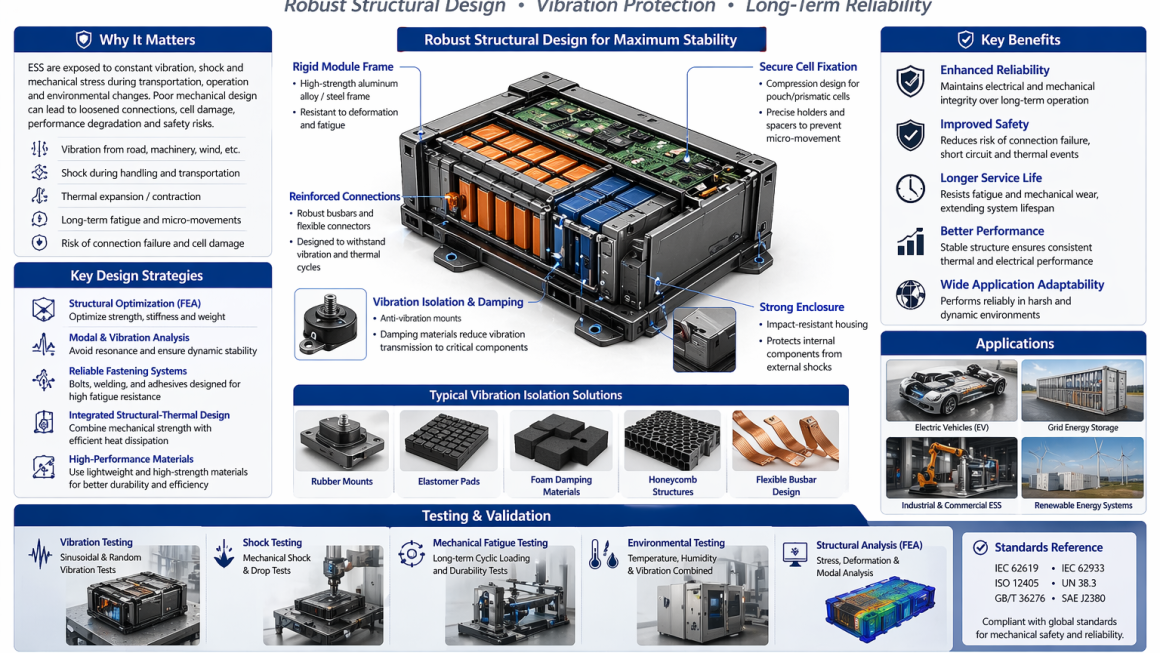
As energy storage systems (ESS) are deployed across increasingly demanding environments—ranging from electric vehicles to industrial sites and renewable energy installations—mechanical stability and vibration resistance have become essential design priorities. These factors directly influence system reliability, safety, and long-term performance.
Why Mechanical Stability Matters in ESS
ESS installations are exposed to continuous and sometimes severe mechanical stresses:
- Vibration from transportation, operation, or nearby machinery
- Shock loads during handling or external impacts
- Thermal expansion and contraction during cycling
- Structural fatigue over long-term use
Without proper mechanical design, these stresses can lead to:
- Cell misalignment or deformation
- Electrical connection failure (busbars, welds)
- Degradation of thermal interfaces
- Increased safety risks
Key Design Objectives
1. Structural Integrity
The ESS must maintain its shape and internal alignment under all conditions:
- Rigid module frames (aluminum, steel, or composites)
- Reinforced enclosure design
- Load distribution across cells and components
2. Vibration Resistance
Designing for vibration involves both prevention and absorption:
- Anti-vibration mounts and damping systems
- Isolation of sensitive components (BMS, connectors)
- Resonance avoidance through structural tuning
3. Shock Protection
- Impact-resistant enclosures
- Energy-absorbing materials
- Secure fastening systems to prevent component displacement
4. Controlled Cell Fixation
Cells must remain stable within the module:
- Precision holders and spacers
- Compression systems for pouch/prismatic cells
- Prevention of micro-movements that cause wear or damage
Critical Components for Stability
1. Module Frame and Housing
- Provides the primary mechanical backbone
- Must resist deformation under load and vibration
- Often integrated with thermal management systems
2. Fastening and Joining Methods
- Bolted, welded, or adhesive bonding
- Designed to withstand cyclic loads
- Must maintain electrical and mechanical integrity over time
3. Damping and Isolation Materials
- Elastomers, foams, or rubber mounts
- Reduce vibration transmission to sensitive components
- Improve overall system durability
4. Busbars and Electrical Connections
- Flexible or reinforced designs to accommodate movement
- Prevent fatigue failure under vibration
Design Challenges
Fatigue Over Time
Repeated vibration cycles can weaken materials and joints.
Trade-Off Between Rigidity and Flexibility
Too rigid → stress concentration
Too flexible → instability
Integration with Thermal Design
Mechanical stability must not compromise heat dissipation.
Weight Constraints
Especially important in EVs and mobile systems.
Testing and Validation
To ensure reliability, ESS designs undergo rigorous testing:
- Vibration testing: sinusoidal and random vibration profiles
- Shock testing: drop and impact simulations
- Mechanical fatigue testing: long-term cyclic loading
- Environmental testing: combined temperature, humidity, and vibration
Standards often referenced include automotive and industrial vibration protocols.
Advanced Design Strategies
1. Finite Element Analysis (FEA)
Simulates stress distribution, resonance, and deformation.
2. Modal Analysis
Identifies natural frequencies to avoid resonance conditions.
3. Integrated Structural-Thermal Design
Combines mechanical strength with heat dissipation functions.
4. Lightweight Composite Materials
Provide high strength with reduced weight.
Emerging Trends
- Structural battery systems: combining energy storage with load-bearing functions
- Smart monitoring: sensors detect vibration and structural stress in real time
- Modular platforms: standardized designs improve consistency and scalability
- Carbon-based reinforcement materials: enhance both mechanical and thermal performance
Best Practices
- Design for worst-case vibration and shock scenarios
- Use multi-layer damping and isolation strategies
- Validate through combined environmental testing
- Ensure robust fastening and connection design
- Monitor long-term structural performance in real applications
Mechanical stability and vibration resistance are fundamental to the safe and reliable operation of energy storage systems. By combining strong structural design, effective damping strategies, and rigorous testing, engineers can ensure ESS performance remains stable even under dynamic and harsh conditions.
As applications continue to expand into more demanding environments, mechanical design will play an increasingly critical role in enabling durable, high-performance energy storage solutions.