Ensuring Long-Term Performance and Safety in Integrated Energy Systems
As hybrid photovoltaic (PV) and energy storage systems (ESS) are deployed more frequently for residential, commercial, and industrial applications, one critical yet often overlooked aspect of system design is thermal management. Efficient and safe energy production and storage require systems that can operate within optimal temperature ranges. Without effective thermal management, the performance and lifespan of both solar panels and battery storage can be severely compromised, leading to increased maintenance costs, reduced system efficiency, and even safety hazards.
This article will discuss the thermal challenges in PV + storage systems and provide engineering-driven strategies to mitigate those challenges.
1. Thermal Challenges in PV + Storage Systems
1.1 PV System Thermal Management
- Solar Panels and Temperature Coefficients: Solar panels are sensitive to temperature changes. As temperature rises, the efficiency of solar panels decreases. This is especially true in regions with high ambient temperatures, where solar panels may lose 0.4% to 0.5% of their rated efficiency for every degree Celsius increase above 25°C.
- Overheating Risk: Excessive heat can cause solar panel degradation, resulting in loss of power output and, in some cases, permanent damage. High temperatures can also reduce the effectiveness of components like cabling and junction boxes.
1.2 Battery Thermal Management
- Temperature Sensitivity of Batteries: Battery systems, particularly lithium-ion batteries, are sensitive to extreme temperatures. Overheating can cause thermal runaway—a chain reaction that can lead to fires or explosions.
- Performance Degradation: Operating at high temperatures accelerates battery degradation, significantly reducing both capacity and cycle life. On the other hand, operating in cold conditions can limit discharge capacity and reduce efficiency.
- Optimal Operating Range: Most batteries have an optimal temperature range between 20°C and 30°C. Outside this range, the battery performance drops and safety risks increase.
2. Thermal Management Strategies for PV Systems
2.1 Passive Cooling Methods
- Ventilated Roof or Wall Spaces: One common approach to managing PV panel temperature is to maximize airflow around the panels by installing them in a way that allows natural ventilation. This helps dissipate heat and reduces the temperature of the panels.
- Heat-Sink Materials: Some installations use materials like aluminum or copper as heat sinks to absorb and dissipate heat from the panels.
- Tilt Angles: The angle at which panels are installed can influence their exposure to sunlight. Panels with optimal tilt angles can reduce overheating, especially in regions where cooling is critical.
2.2 Active Cooling Systems
For applications with high heat loads or in hot climates, active cooling systems may be necessary:
- Water-Cooled Panels: Some PV systems use water-cooling techniques to reduce panel temperatures. These systems circulate water through pipes behind the panels to absorb heat.
- Forced Air Cooling: In some systems, fans are used to push cool air through a network of ducts behind the solar panels, helping to lower temperatures.
- Phase Change Materials (PCMs): PCMs can absorb excess heat and release it gradually as the temperature drops, helping to maintain a more consistent temperature for PV panels.
3. Thermal Management for Energy Storage Systems
3.1 Active Cooling for Battery Storage
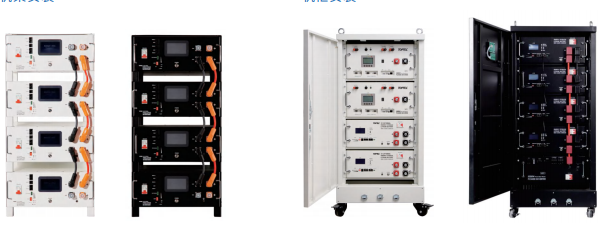
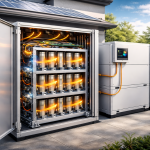
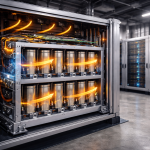
- Air Cooling: Air cooling systems use fans or blowers to direct air across battery modules, preventing them from overheating. This is the most common method and is cost-effective for smaller systems.
- Liquid Cooling: Liquid cooling systems circulate coolant (usually a glycol-water mixture) around the battery pack to draw heat away. This method is more effective for larger, high-density battery systems or systems in hotter climates.
- Refrigerant-Based Systems: In some large-scale or industrial setups, refrigerant cooling systems, similar to HVAC systems, are used to regulate battery temperatures effectively.
3.2 Thermal Management at the Battery Pack Level
- Individual Cell Cooling: More advanced thermal management systems use thermal pads or heat pipes at the cell level to ensure that temperature is uniformly distributed across the battery cells. This prevents certain cells from overheating, which could lead to thermal runaway.
- BMS-Integrated Thermal Monitoring: A Battery Management System (BMS) can monitor individual cell temperatures and ensure that they remain within the safe operating range. If temperatures rise beyond predefined limits, the BMS can trigger cooling or shut down the system to prevent damage.
3.3 Insulation and Heat Shields
- Insulation helps to maintain the temperature of the battery pack, protecting it from both excessive heat and cold.
- Heat Shields can be installed around battery packs to block excessive external heat or to protect other components from heat generated during charging and discharging.
4. Integrated Thermal Management for Hybrid PV + Storage Systems
4.1 Coordination Between PV and Storage Cooling Systems
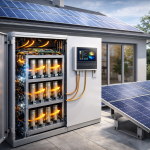
An integrated thermal management strategy should align the cooling needs of both the PV array and the energy storage system. The key is to manage the thermal load so that both systems operate efficiently without compromising safety.
- Solar and Battery Coordination: In a hybrid system, when solar output is high and temperatures rise, energy storage systems may need more cooling to keep battery cells within safe operating temperatures. Similarly, when the PV system experiences a sudden drop in output (e.g., cloudy weather), the battery system must be prepared to support the load while maintaining its own thermal stability.
- Thermal Buffering: Hybrid systems can incorporate thermal buffering strategies, where the excess heat from the PV system is used to maintain the storage system’s temperature in colder conditions, or vice versa.
4.2 Monitoring and Control Systems
The Energy Management System (EMS) in a hybrid PV + storage system can monitor the temperature of both PV panels and batteries in real-time. By integrating thermal management algorithms, the EMS can:
- Optimize cooling strategies based on real-time temperature data
- Adjust charging and discharging rates to ensure that thermal limits are respected for both PV and storage systems
- Activate cooling or ventilation when necessary, ensuring optimal efficiency for both systems.
5. Sustainable Thermal Management for Long-Term Performance
Effective thermal management is crucial to maintaining the safety, performance, and lifespan of hybrid PV + storage systems. By adopting a combination of passive and active cooling strategies, integrating thermal monitoring systems, and ensuring system-level coordination, hybrid energy systems can operate efficiently, even in extreme conditions.
For EPCs and system integrators, thermal management is not a “nice-to-have”—it’s a fundamental design principle that protects the system from the long-term effects of heat and temperature-related degradation. With the right approach, PV + storage systems can deliver reliable, sustainable, and cost-effective energy for years to come.