

Energy Storage Systems (ESS) are becoming a critical backbone of modern energy infrastructure, supporting renewable integration, grid stability, and distributed power applications. As deployment scales globally, two requirements consistently define system success:
Safety and long-term efficiency
However, these two factors are deeply interconnected—and both are strongly influenced by materials engineering.
Rather than being purely a function of system design or electronics, the longevity of an ESS often depends on how well advanced materials are selected, integrated, and optimized across different layers of the system.
Understanding ESS Longevity: Beyond Cycle Life
Traditionally, ESS lifespan has been evaluated using:
- Cycle life (number of charge/discharge cycles)
- Capacity retention over time
- Calendar aging
While these are important metrics, they do not fully capture real-world system behavior.
A More Complete Definition of Longevity Includes:
- Thermal stability over time
- Resistance to degradation mechanisms
- Consistency under variable load conditions
- System-level fault tolerance
In practice, ESS longevity is a result of maintaining safe and efficient operation across thousands of cycles under dynamic conditions.
The Link Between Safety and Efficiency
Safety and efficiency are often treated separately, but in ESS they are closely linked:
- High internal resistance → increased heat generation → safety risk
- Poor thermal management → accelerated degradation → reduced efficiency
- Material instability → structural failure → safety incidents
This relationship can be summarized as:
Efficiency losses often manifest as heat—and heat is the primary driver of safety risks.
Therefore, improving efficiency at the material level directly contributes to enhanced safety and longer system life.
Where Materials Make the Difference
Advanced materials influence ESS performance at multiple levels:
1. Inside the Cell: Conductive Networks
Within battery cells, conductive materials determine how efficiently electrons move.
Key Roles:
- Reducing internal resistance
- Improving active material utilization
- Enabling uniform current distribution
Emerging conductive materials, including carbon-based structures, can form three-dimensional conductive networks that improve electrical pathways compared to traditional additives.
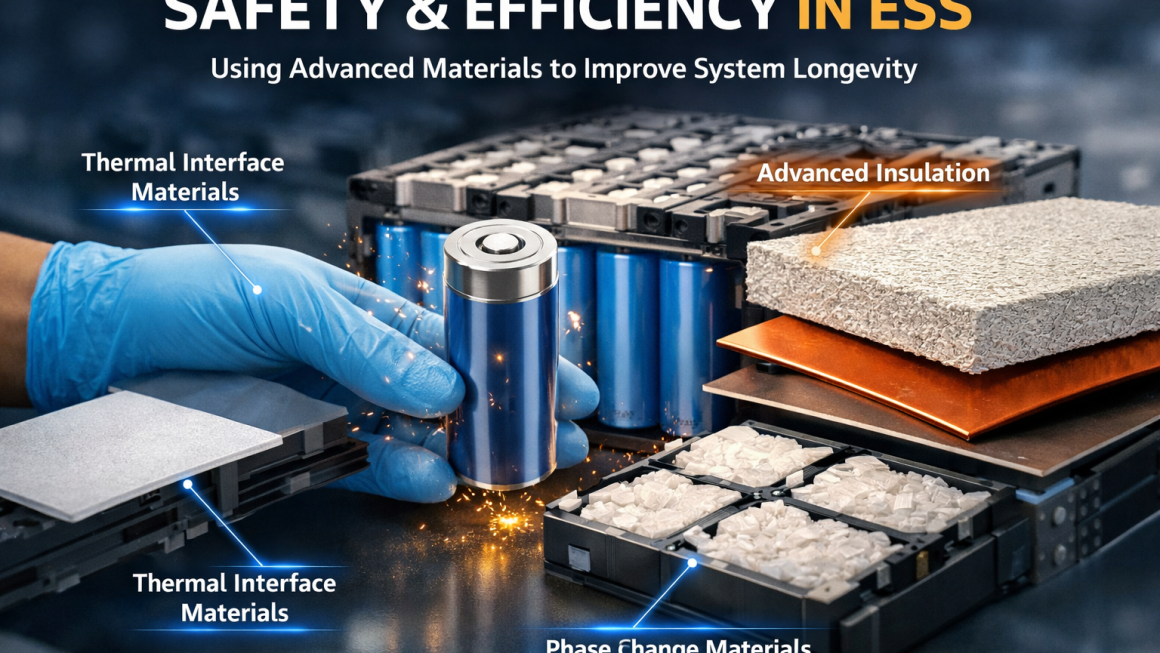
2. Thermal Interface Materials (TIMs)
Heat management is one of the most critical aspects of ESS safety.
Functions of TIMs:
- Transfer heat away from cells
- Reduce thermal resistance between components
- Improve temperature uniformity
Advanced TIMs with enhanced thermal conductivity help prevent:
- Localized hotspots
- Uneven aging
- Thermal runaway propagation
3. Structural and Interface Materials
Mechanical and interfacial stability are often overlooked but crucial for long-term reliability.
Key Contributions:
- Maintaining contact integrity between components
- Absorbing mechanical stress from expansion and contraction
- Preventing micro-cracks and delamination
Over time, weak interfaces can lead to increased resistance and heat generation.
Thermal Management: The Core of Safety
Among all factors, thermal management has the most direct impact on both safety and longevity.
Challenges in ESS Thermal Behavior:
- High energy density leads to concentrated heat
- Fast charge/discharge increases thermal stress
- Large-scale systems amplify heat accumulation
Material-Driven Thermal Solutions:
Heat Spreading Materials
These materials distribute heat evenly across surfaces, preventing hotspots.
Phase Change Materials (PCMs)
PCMs absorb heat during phase transitions, stabilizing temperature spikes.
Thermally Conductive Coatings
Coatings improve heat transfer at interfaces where traditional materials fall short.
Key Insight:
Uniform temperature is more important than low temperature.
Even small temperature differences between cells can lead to uneven aging and reduced system life.
Electrical Efficiency and Its Impact on Longevity
Electrical inefficiencies directly translate into energy loss and heat.
Sources of Electrical Loss:
- Internal resistance within cells
- Contact resistance between components
- Uneven current distribution
Material-Based Optimization:
- Conductive additives to enhance electron pathways
- Low-resistance coatings for current collectors
- Improved interconnect materials
Reducing resistance not only improves efficiency but also:
- Lowers operating temperature
- Reduces degradation rates
- Enhances overall system stability
Module-Level Implications
Materials influence not just individual cells, but also module-level performance.
Key Areas:
Cell-to-Cell Consistency
Uniform materials and interfaces help maintain:
- Balanced charge/discharge behavior
- Consistent thermal profiles
Safety Barriers
Advanced insulating and fire-resistant materials can:
- Delay or prevent thermal runaway propagation
- Provide additional safety margins
Mechanical Integrity
Materials that accommodate expansion help prevent:
- Structural stress
- Connection failures
System-Level Efficiency Gains
At the system level, material improvements accumulate into significant benefits.
Examples:
- Lower cooling requirements → reduced energy consumption
- Improved efficiency → higher usable capacity
- Enhanced stability → reduced maintenance needs
Energy Efficiency Cascade Effect
A small improvement at the material level can cascade through the system:
Lower resistance → less heat → reduced cooling → higher net efficiency → longer lifespan
Failure Prevention Through Material Design
Many common ESS failures can be traced back to material limitations.
Thermal Runaway
Mitigation strategies include:
- High thermal conductivity materials
- Flame-retardant separators and coatings
- Heat dissipation pathways
Interface Degradation
Solutions include:
- Flexible conductive materials
- Stable bonding interfaces
- Corrosion-resistant coatings
Aging and Capacity Loss
Material optimization can slow:
- Electrochemical degradation
- Structural breakdown
- Loss of active material
The Role of Intermediate Layers
Between raw materials and full systems lies a critical layer:
Interface and integration engineering
This includes:
- Contact surfaces
- Coatings
- Composite structures
Optimizing these layers can significantly improve:
- Energy transfer efficiency
- Mechanical stability
- Thermal performance
Balancing Performance and Practical Constraints
While advanced materials offer significant potential, practical considerations remain:
- Cost and scalability
- Manufacturing compatibility
- Long-term stability
Therefore, material selection should focus on:
- Mechanism validation
- System compatibility
- Incremental improvement pathways
How gr-newenergy.com Approaches ESS Longevity
At gr-newenergy.com, our focus is on exploring how advanced materials can enhance safety and efficiency across different layers of energy storage systems.
We emphasize:
- Understanding the fundamental mechanisms behind performance improvements
- Supporting component and module-level optimization
- Bridging material science with system-level design
Rather than focusing on end-product claims, our approach highlights:
How material-level innovation can enable more reliable and longer-lasting ESS architectures
Safety and efficiency in energy storage systems are not isolated objectives—they are deeply interconnected outcomes shaped by material design, system architecture, and integration strategies.
Advanced materials play a central role in:
- Reducing resistance and energy loss
- Managing heat and preventing safety risks
- Enhancing structural and interface stability
- Extending system lifespan
As ESS continues to scale across applications, the importance of material-driven optimization will only increase.
Ultimately, the path to longer-lasting energy storage systems lies in understanding and improving the connections between:
Materials → Interfaces → Modules → Systems