

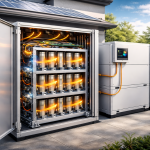


High-power applications demand more than just higher capacity. They require precision engineering at the module level to ensure safety, efficiency, thermal balance, and long-term reliability.
From EV acceleration bursts to industrial backup systems and grid frequency regulation, battery modules operating under high power conditions must withstand rapid charge–discharge cycles, elevated thermal loads, and significant electrical stress.
For solution providers who focus on system-level integration rather than large-scale utility deployment, optimizing battery modules becomes the true technical differentiator.
1️⃣ Current Density and Internal Resistance Control
High-power output means higher current flow.
If internal resistance is not properly managed, the system faces:
- Excessive heat generation
- Voltage drop under load
- Reduced efficiency
- Accelerated degradation
Optimization strategies include:
- Low-resistance busbar design
- Shorter conductive pathways
- High-conductivity materials (copper alloys, enhanced aluminum systems)
- Stable interconnection architecture
The goal is not simply to “increase output,” but to maintain voltage stability under dynamic load conditions.
2️⃣ Advanced Thermal Management
Power and heat are inseparable.
In high-power modules, temperature gradients can develop rapidly between cells, especially during peak discharge events. Uneven thermal distribution leads to:
- Cell imbalance
- Capacity mismatch
- Safety risks
Effective optimization includes:
- Conductive interface materials
- Engineered thermal pads
- Heat-spreading plates
- Structural design that enables controlled airflow or liquid cooling
Thermal design must be integrated from the early mechanical layout stage—not added as an afterthought.
3️⃣ Mechanical Integrity Under Stress
High-power cycling introduces mechanical expansion and contraction within cells.
Over time, repeated stress can weaken:
- Weld points
- Connectors
- Structural frames
A properly optimized module considers:
- Compression management
- Shock and vibration resistance
- Reinforced module housing
- Flexible yet stable electrical connections
This is particularly critical in mobile or industrial environments.
4️⃣ Smart Monitoring and Protection
High-power systems require more responsive protection systems.
Optimized modules often integrate:
- High-speed BMS architecture
- Temperature mapping sensors
- Current monitoring at multiple nodes
- Rapid fault isolation mechanisms
Protection must react within milliseconds—not seconds.
5️⃣ Materials as Performance Enablers
Material selection directly impacts module performance.
Conductive materials influence electrical efficiency.
Thermal materials influence safety and cycle life.
Structural materials influence durability and integration flexibility.
This is where intermediate solution providers create value—by engineering the interface between cells and the broader system.
From Cells to Systems: The Middle-Layer Advantage
While utility-scale energy storage focuses on megawatt output, real optimization happens at the module level.
By focusing on:
- Conductivity
- Thermal balance
- Structural integrity
- Intelligent monitoring
We bridge the gap between raw battery chemistry and real-world performance.
High power is not just about delivering energy quickly.
It is about delivering it safely, repeatedly, and predictably.