


As energy storage systems (ESS) scale in size and power, busbars—often overlooked components—play a critical role in determining overall system efficiency, reliability, and thermal performance. These conductive pathways connect battery cells, modules, and power electronics, enabling the safe and efficient flow of electrical current throughout the system.
In high-power ESS applications, even small inefficiencies in busbar design can lead to energy losses, overheating, and reduced system lifespan. As a result, advanced materials and optimized designs are becoming essential to meet the demands of modern energy storage systems.
Why Busbars Matter in Energy Storage Systems
Busbars serve as the electrical backbone of battery modules and packs. They are responsible for:
- Conducting high currents between battery cells and modules
- Connecting battery systems to inverters and power electronics
- Maintaining stable electrical performance under dynamic loads
In commercial and industrial ESS environments, busbars must handle:
- High current densities
- Continuous charge and discharge cycles
- Thermal stress from resistive heating
- Mechanical stress from vibration and expansion
Poorly designed busbars can result in:
- Increased electrical resistance
- Excessive heat generation
- Uneven current distribution
- Reduced system efficiency
This makes busbar optimization a key focus area for engineers designing high-performance ESS systems.
Key Materials Used in Busbars
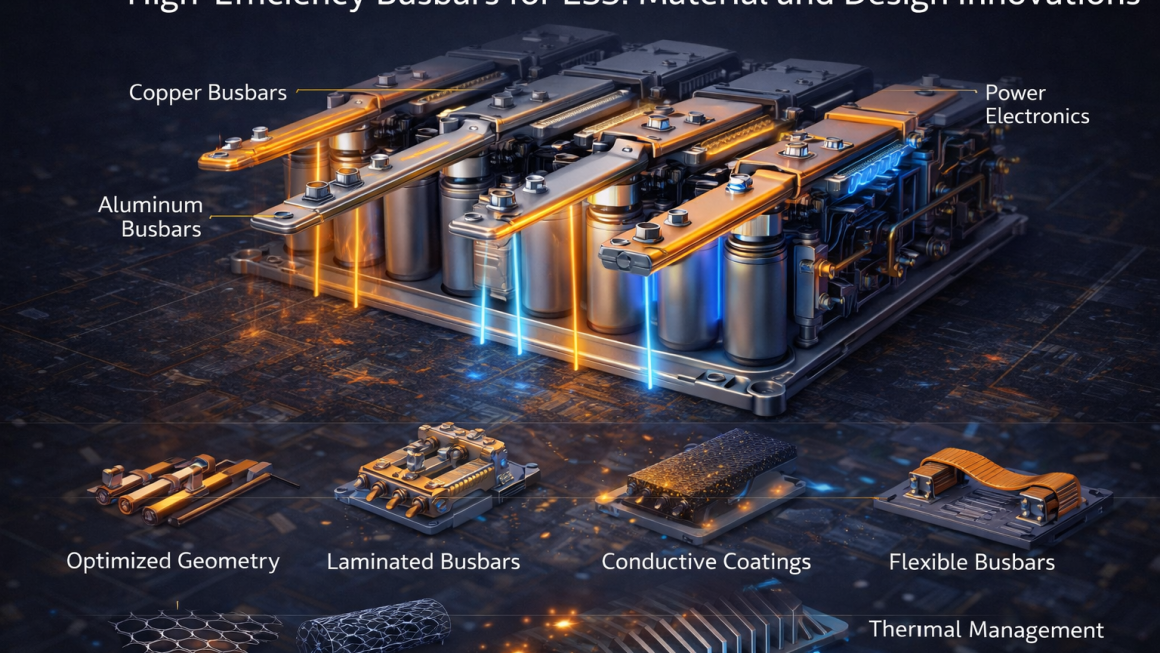
Material selection is fundamental to busbar performance. The most commonly used materials include copper and aluminum, each offering unique advantages.
Copper Busbars
Copper is widely used due to its excellent electrical conductivity.
Advantages:
- Low electrical resistance
- High current-carrying capacity
- Stable performance under high loads
Challenges:
- Higher cost compared to aluminum
- Greater weight
- Susceptibility to oxidation without proper coatings
Aluminum Busbars
Aluminum is increasingly used in large-scale ESS systems due to its lightweight and cost efficiency.
Advantages:
- Lower cost
- Reduced weight
- Good thermal conductivity
Challenges:
- Higher electrical resistance compared to copper
- Requires larger cross-sections to carry the same current
- Surface oxidation can impact conductivity
Hybrid Designs
To balance performance and cost, some systems use copper-aluminum hybrid busbars, combining the strengths of both materials.
These designs enable:
- Optimized conductivity
- Reduced material costs
- Improved mechanical flexibility
Design Innovations for High-Efficiency Busbars
Modern ESS systems require more than just conductive materials. Advanced design strategies are essential for maximizing efficiency.
1. Optimized Geometry
Busbar shape and thickness directly affect electrical resistance and heat generation.
Design improvements include:
- Wider and thinner profiles for better heat dissipation
- Layered structures for compact module design
- Reduced path length to minimize resistance
2. Laminated Busbars
Laminated busbars consist of multiple conductive layers separated by insulating materials.
Benefits:
- Reduced inductance
- Improved electromagnetic compatibility (EMC)
- Enhanced thermal management
- More compact system integration
These structures are particularly useful in high-frequency and high-power applications.
3. Flexible Busbars
Flexible busbars are designed to accommodate thermal expansion and mechanical stress within battery modules.
Advantages include:
- Improved durability
- Reduced mechanical strain on connections
- Easier assembly in compact designs
Conductive Coatings and Surface Engineering
Surface treatment is a critical but often underestimated aspect of busbar performance.
Advanced coatings can significantly improve:
- Electrical conductivity at contact interfaces
- Corrosion resistance
- Long-term reliability
Graphene and Carbon-Based Coatings
Emerging technologies include graphene-enhanced conductive coatings and carbon-based materials.
These coatings offer:
- Reduced contact resistance
- Improved current distribution
- Enhanced thermal conductivity
- Protection against oxidation
By applying advanced coatings, manufacturers can extend the lifespan of busbars and reduce energy losses in ESS systems.
Thermal Management and Busbar Performance
Busbars generate heat due to resistive losses, especially under high current conditions.
Effective thermal management strategies include:
- Integrating busbars with heat spreaders
- Using thermally conductive coatings
- Designing airflow or liquid cooling paths
- Optimizing contact interfaces with thermal materials
Reducing heat buildup not only improves efficiency but also enhances system safety and reliability.
Integration with Battery Module Design
Busbars must be carefully integrated into the overall battery system architecture.
Key considerations include:
- Alignment with battery cell layout
- Compatibility with battery management systems (BMS)
- Mechanical stability under vibration
- Ease of assembly and maintenance
A well-designed busbar system ensures:
- Uniform current distribution
- Reduced energy loss
- Consistent performance across all modules
The Role of Advanced Materials in Future ESS Busbars
As ESS systems evolve toward higher power densities, the role of advanced materials will continue to grow.
Future developments may include:
- Ultra-low resistance conductive coatings
- Integrated thermal-electrical materials
- Lightweight composite conductors
- Smart materials with sensing capabilities
These innovations will enable busbars to become more than passive components—transforming them into active contributors to system efficiency and safety.
High-efficiency busbars are essential for the performance and reliability of modern energy storage systems. Through the combination of advanced materials, optimized designs, and surface engineering, busbars can significantly reduce energy losses and improve thermal management.
As commercial ESS systems continue to scale, innovations in busbar technology—particularly in conductive coatings and hybrid material designs—will play a key role in enabling high-power, long-lasting, and efficient energy storage solutions.