


Balancing Power and Safety
As energy storage systems (ESS) evolve, high-performance modules must deliver both peak power and uncompromised safety. Achieving this balance requires careful integration of advanced materials, thermal management, and intelligent design.
Graphene—a two-dimensional nanocarbon—has emerged as a game-changing material in high-performance ESS modules. Its unique combination of electrical conductivity, thermal conductivity, and mechanical robustness enables modules to operate efficiently under demanding conditions while maintaining safety and longevity.
This article explores how graphene is applied in ESS modules, its impact on power delivery, thermal control, and safety, and practical considerations for real-world deployment.
1. Why High-Performance ESS Modules Need Advanced Materials
High-performance ESS modules face multiple challenges:
- High current demands during peak load or rapid charging
- Thermal hotspots that threaten cell longevity
- Voltage imbalances across cells and modules
- Mechanical stress from expansion, vibration, or compression
Traditional materials such as copper, aluminum, and standard carbon additives may meet some requirements but struggle to provide simultaneous high power, thermal management, and long-term reliability.
Graphene addresses these limitations by offering multi-functional performance enhancements without significantly increasing system complexity.
2. Graphene-Enhanced Thermal Management
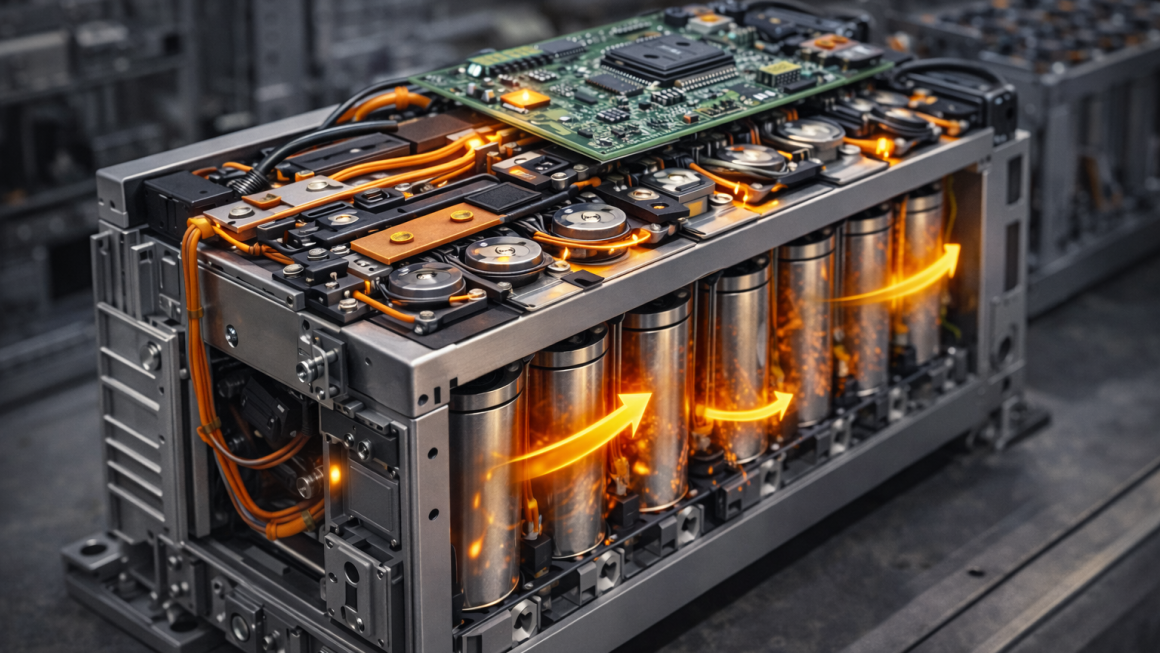
Graphene is renowned for its exceptional in-plane thermal conductivity, often exceeding 2000 W/m·K. In ESS modules:
- Coatings or composite plates with graphene spread heat laterally across cells
- Reduces hotspots, extending cell lifespan
- Improves efficiency of passive cooling, reducing reliance on fans or liquid cooling
- Works synergistically with other nanocarbon additives (e.g., CNTs) for 3D thermal networks
Effective thermal management directly translates to higher power output without compromising safety.
3. Electrical Conductivity and Power Optimization
Graphene improves electrical pathways in high-performance ESS modules:
- Enhances current collection within electrodes and busbars
- Reduces resistive losses during rapid charge/discharge
- Supports higher C-rate operation without excessive heating
Modules with graphene-enhanced contacts and conductive coatings maintain stable voltage profiles under peak loads, ensuring reliable energy delivery for residential, commercial, and industrial applications.
4. Mechanical Reinforcement and Module Integrity
Mechanical stress is a subtle but critical factor in ESS reliability:
- Expansion and contraction during cycling can loosen electrical contacts
- Vibrations during transport or operation may cause microfractures
Graphene-reinforced composites improve structural stability:
- Coatings resist micro-cracking
- Laminated sheets maintain consistent cell compression
- Modules remain robust under vibration, thermal cycling, and mechanical shock
This reinforcement ensures that power and thermal pathways remain intact over the lifetime of the module.
5. Graphene in Smart Modules
Integrating graphene with smart modules amplifies system-level benefits:
- Sensors can leverage graphene coatings for improved thermal and electrical signal distribution
- Thermal derating algorithms respond to more uniform heat profiles
- Cell balancing is more effective when conductive pathways are optimized
Together, graphene and smart control maximize module performance while minimizing risk.
6. Safety Implications
Graphene contributes to safety in several ways:
- Prevents localized overheating by spreading heat efficiently
- Reduces electrical resistance and the likelihood of hotspots or voltage spikes
- Enhances mechanical stability, limiting the chance of internal short circuits
- Supports passive thermal management, lowering failure risk in compact or sealed enclosures
By integrating graphene, high-performance ESS modules can achieve a balance of power and safety that traditional materials struggle to provide.
7. Practical Considerations for ESS Module Design
When deploying graphene in ESS modules, engineers should consider:
- Form factor: Thin coatings, composite sheets, or additives in adhesives
- Dispersion quality: Uniform graphene distribution ensures consistent performance
- Compatibility: Ensure graphene integrates well with electrodes, busbars, and housing materials
- Cost vs. benefit: Target high-stress areas for graphene application to maximize ROI
Proper implementation transforms graphene from a lab-scale material into a reliable system-level enhancer.
8. Case Example: Residential & Commercial ESS Modules
In real-world ESS deployments:
- Residential modules benefit from graphene in thin thermal and electrical coatings, enabling compact, fan-free designs
- Commercial or industrial modules leverage graphene in composite busbars and structural reinforcements, allowing high C-rate operation with reduced thermal management costs
Across applications, graphene improves power density, thermal stability, and mechanical durability simultaneously.
Graphene is no longer just a laboratory curiosity. In high-performance ESS modules, it provides multi-functional enhancements that improve:
- Thermal management
- Electrical conductivity
- Mechanical integrity
- Safety and longevity
By strategically integrating graphene, engineers can deliver modules that meet modern energy storage demands, balancing peak power and safety in a way that traditional materials alone cannot achieve.