


As the demand for higher-performing energy storage systems continues to grow, increasing energy density has become one of the most critical challenges in battery technology. Applications ranging from electric vehicles to portable electronics and grid storage all require batteries that can store more energy within the same or smaller volume.
Among the many advanced materials being explored, graphene has attracted significant attention due to its exceptional electrical, thermal, and mechanical properties. While its large-scale commercial deployment in batteries is still evolving, graphene offers compelling theoretical pathways to enhance battery performance—particularly at the material and interface level.
This article explores the theoretical role of graphene in improving battery pack energy density, focusing on mechanisms, material integration strategies, and system-level implications.
Understanding Energy Density in Battery Systems
Energy density refers to the amount of energy stored per unit mass (gravimetric) or volume (volumetric). It is influenced by multiple factors:
- Electrode material capacity
- Electrolyte stability
- Internal resistance
- Thermal behavior
- Structural design at cell and pack levels
Improving energy density is not simply about increasing active material capacity—it requires system-wide optimization, where materials play a foundational role.
Why Graphene Is Considered a Promising Material
Graphene is a two-dimensional carbon material with a unique combination of properties:
- Extremely high electrical conductivity
- Large specific surface area (~2630 m²/g)
- High mechanical strength
- Excellent thermal conductivity
These properties make graphene a strong candidate for enhancing:
- Electron transport
- Heat dissipation
- Structural stability
However, its true value lies not in replacing existing materials, but in enhancing existing battery architectures.
Mechanisms for Energy Density Improvement
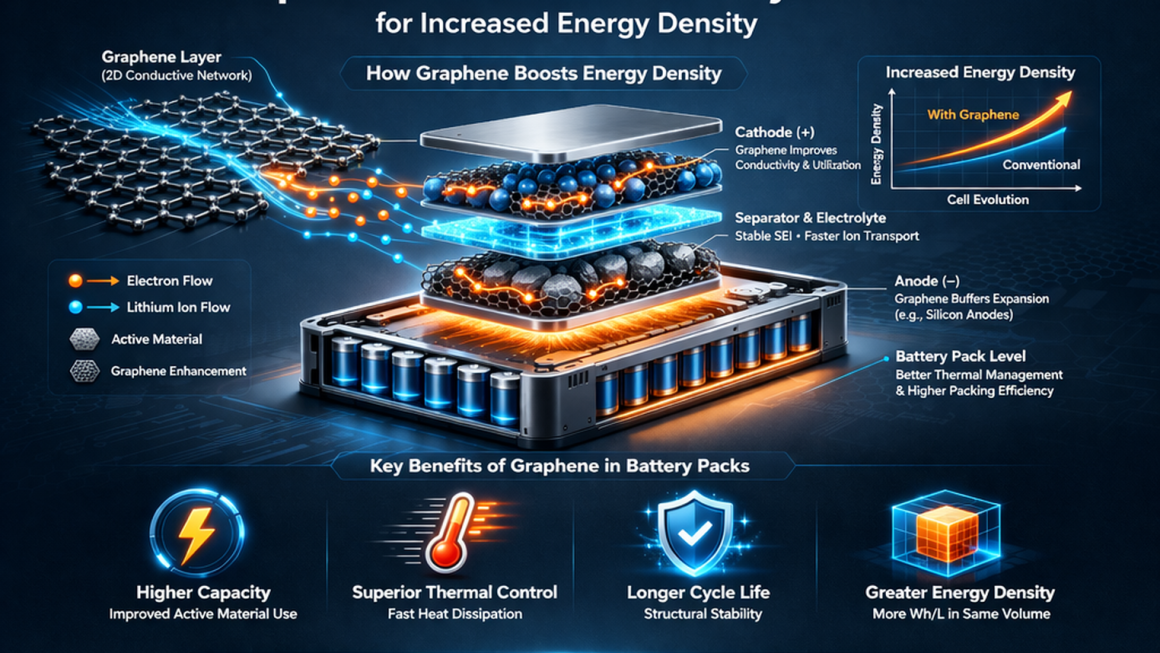
Graphene contributes to energy density improvements through several theoretical mechanisms:
1. Enhanced Electrical Conductivity
One of the primary limitations in battery electrodes is electron transport efficiency.
Graphene can form conductive networks within electrodes, enabling:
- Faster electron mobility
- Reduced internal resistance
- Improved utilization of active materials
This allows electrodes to operate more efficiently, potentially increasing the effective energy storage without changing the base chemistry.
2. Improved Active Material Utilization
In conventional electrodes, not all active material participates fully in electrochemical reactions due to:
- Poor conductivity
- Particle agglomeration
- Limited ion accessibility
Graphene’s high surface area and conductive structure help:
- Disperse active materials more evenly
- Create better संपर्क between particles
- Facilitate ion diffusion pathways
This leads to higher practical capacity, contributing to improved energy density at the cell level.
3. Structural Reinforcement
Battery electrodes undergo repeated expansion and contraction during charge-discharge cycles.
Graphene can act as a mechanical support matrix, helping to:
- Maintain electrode integrity
- Reduce cracking and degradation
- Improve long-term stability
This structural stability indirectly supports energy density by preserving performance over time.
4. Thermal Management Enhancement
As energy density increases, thermal management becomes more critical.
Graphene’s high thermal conductivity allows:
- Faster heat dissipation
- Reduced temperature gradients
- Lower risk of thermal hotspots
This enables batteries to operate safely at higher energy densities without compromising stability.
5. Interface Optimization
Battery performance is highly dependent on interfaces:
- Electrode–electrolyte interface
- Solid electrolyte interphase (SEI)
- Current collector interfaces
Graphene can influence these interfaces by:
- Providing uniform conductive pathways
- Reducing interfacial resistance
- Stabilizing electrochemical reactions
This leads to improved efficiency and energy retention.
Graphene Integration Pathways
Rather than being used as a standalone material, graphene is typically integrated into battery systems through various approaches:
Conductive Additives
Graphene can replace or complement traditional carbon black additives, forming more efficient conductive networks.
Composite Electrodes
Graphene can be combined with active materials such as:
- Silicon
- Lithium iron phosphate (LFP)
- Nickel-rich cathodes
These composites aim to balance conductivity, stability, and capacity.
Coatings and Surface Modifications
Graphene layers can be applied to:
- Enhance electrode conductivity
- Protect active materials
- Improve interface stability
Current Collector Enhancements
Graphene-based coatings may improve current collection efficiency and reduce resistive losses.
From Cell to Pack: System-Level Implications
While graphene operates at the material level, its effects can propagate to the battery pack level.
1. Reduced Internal Losses
Improved conductivity and interface efficiency reduce energy losses, increasing overall system efficiency.
2. Higher Packing Efficiency
If thermal management is improved, cells can be arranged more densely within a pack, contributing to higher volumetric energy density.
3. Enhanced Thermal Uniformity
Better heat distribution reduces the need for oversized cooling systems, potentially freeing up space for active materials.
4. Improved Lifecycle Stability
More stable electrodes can maintain performance over longer cycles, effectively increasing usable energy over time.
Challenges and Limitations
Despite its promising properties, graphene integration faces several challenges:
Dispersion Issues
Graphene tends to agglomerate, which can reduce its effectiveness if not properly dispersed.
Cost Considerations
High-quality graphene materials remain relatively expensive compared to traditional additives.
Process Compatibility
Integrating graphene into existing battery manufacturing processes requires careful adaptation.
Standardization
There is currently a lack of standardized methods for evaluating graphene performance in batteries.
These challenges highlight that graphene is not a simple drop-in solution, but rather a complex material requiring careful engineering integration.
Theoretical vs Practical Perspective
It is important to distinguish between:
- Theoretical potential
- Commercial implementation
Graphene offers strong theoretical advantages in:
- Conductivity
- Thermal management
- Structural stability
However, real-world performance depends on:
- Material quality
- Integration methods
- System-level design
As such, graphene should be viewed as a platform material for innovation, rather than a guaranteed performance enhancer.
The Role of Materials in Future Battery Systems
As battery systems evolve toward higher energy density, materials will play an increasingly important role.
Future developments may include:
- Hybrid material systems combining graphene with other nanomaterials
- Advanced electrode architectures
- Improved interface engineering
- Integration with next-generation battery chemistries
Graphene is likely to be part of a broader ecosystem of advanced materials shaping the next generation of energy storage.
How gr-newenergy.com Approaches Graphene Applications
At gr-newenergy.com, we focus on the material and intermediate layers of energy storage systems:
- Graphene-related materials for conductivity and thermal enhancement
- Support for electrode and interface optimization
- Exploration of material integration pathways rather than end-product claims
Our approach emphasizes:
- Understanding mechanisms before scaling
- Bridging material science and application engineering
- Supporting early-stage and pilot-level innovation
This aligns with the current stage of graphene development in battery systems.
Graphene-enhanced battery packs represent a promising direction for improving energy density, but their value lies primarily in material-level optimization and system integration pathways.
Through its unique properties, graphene can theoretically:
- Improve conductivity
- Enhance thermal performance
- Stabilize electrode structures
- Optimize interfaces
These effects contribute to higher efficiency and potentially greater energy density at the system level.
However, the journey from material potential to practical application requires careful engineering, realistic expectations, and continued research.
As the energy storage industry evolves, graphene will likely play an important—though not standalone—role in shaping the future of high-performance battery systems.