
What Europe’s Offshore Wind Commitment Really Means for Materials and System Design
1. Why the 100 GW Announcement Is Not Just Political Noise
When European leaders announced a collective commitment to deploy 100 GW of additional offshore wind capacity, many headlines focused on ambition, climate targets, and geopolitics.
But for engineers, project developers, and system integrators, this announcement signals something much more concrete:
Offshore wind in Europe is no longer an experimental renewable —
it is now critical infrastructure.
Critical infrastructure does not tolerate uncertainty.
And uncertainty is where materials either prove their value or disappear.
2. Offshore Wind Is Entering a “Capital Protection Phase”
What is often overlooked in policy coverage is the financial mechanism behind the expansion.
Europe is reinforcing offshore wind investment through:
- Contracts for Difference (CfD)
- Price floor / revenue stabilization mechanisms
- Long-term grid integration guarantees
This changes the engineering mindset entirely.
In early-stage renewables, cost minimization dominates.
In infrastructure-scale systems, risk minimization dominates.
That shift fundamentally alters how materials are evaluated:
- Not “lowest cost per kg”
- But lowest risk over 25–30 years
3. The North Sea Reality: Offshore Wind Is a Materials Stress Test
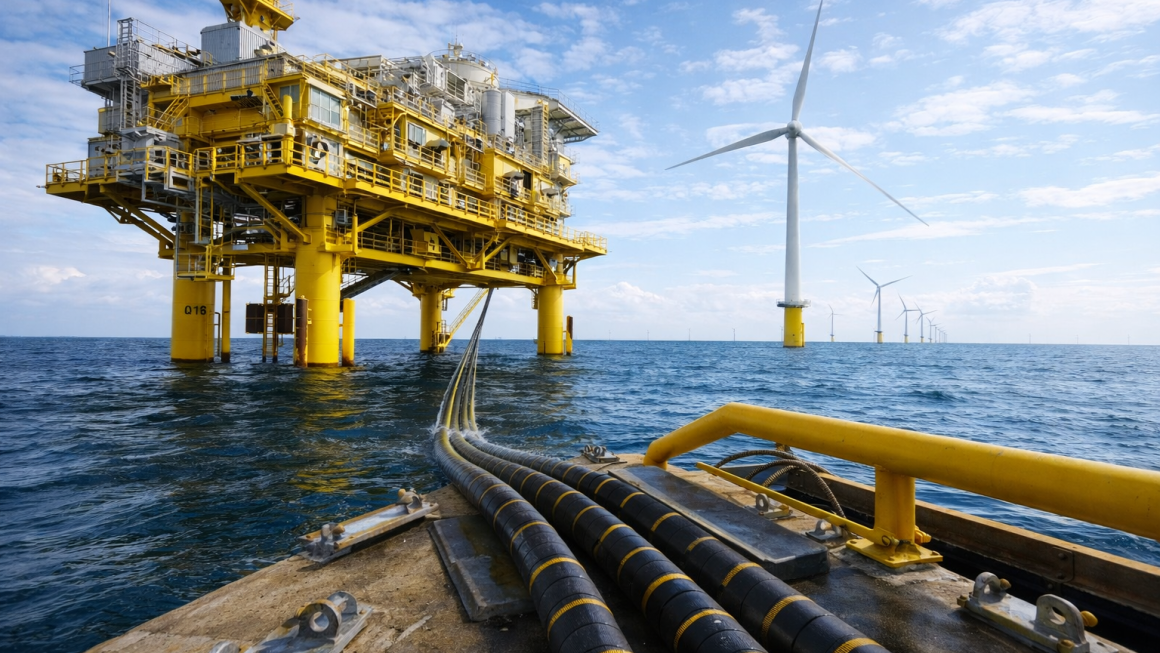
The North Sea is not a friendly environment.
Offshore wind systems must survive:
- Constant salt spray and chloride corrosion
- High humidity and condensation cycles
- Continuous vibration and fatigue loading
- Temperature swings and long service intervals
This means:
- Failure is not catastrophic — it is inevitable unless engineered out
- Maintenance is expensive, logistically complex, and politically sensitive
As a result, materials are no longer passive components.
They are active risk-control tools.
4. Where Engineering Attention Is Quietly Shifting
As offshore wind scales, attention is moving away from headline components like turbines and blades, and toward less visible but system-critical layers:
- Structural interfaces and joints
- Power electronics enclosures
- Cable systems and connectors
- Corrosion protection and grounding layers
- Thermal paths in power and storage modules
These “middle layers” do not generate press releases —
but they determine uptime, safety, and lifetime cost.
5. Why This Matters Now — Not Later
Europe already operates more than 250 GW of offshore wind capacity.
The additional 100 GW will not be isolated projects — it will integrate into existing grids, ports, and maintenance ecosystems.
This creates a powerful constraint:
New systems must be compatible with existing operational logic.
That favors:
- Incremental material upgrades
- Drop-in performance improvements
- Solutions that reduce failure probability without changing system architecture
In other words:
Evolution, not revolution.
6. The Takeaway for Materials and System Suppliers
Europe’s offshore wind expansion sends a clear message:
- Longevity beats novelty
- Reliability beats laboratory performance
- Predictability beats aggressive claims
Materials that succeed will not be those that promise disruption —
but those that quietly extend service life, stabilize performance, and reduce maintenance risk.