

How Smart Modules Optimize Battery Performance
Modern energy storage systems are no longer passive collections of battery cells. They are intelligent, self-monitoring systems where sensing, data processing, and control logic actively shape performance, safety, and lifetime.
At the center of this evolution are smart battery modules—integrated units that combine energy storage with sensing and control capabilities. These modules enable batteries to operate closer to their optimal limits while maintaining safety and reliability.
This article explains how energy sensing and control work at the module level, and why they are essential for optimizing battery performance in today’s energy storage systems.
1. Why Energy Sensing Is Fundamental to Battery Performance
Batteries do not fail suddenly—they drift out of optimal operating conditions over time.
Without accurate sensing:
- Temperature gradients go unnoticed
- Cell imbalance increases
- Internal resistance rises silently
- Degradation accelerates
Energy sensing provides real-time visibility into how a battery is behaving, not just how it is rated on paper.
Key sensing targets include:
- Voltage (cell, module, pack)
- Current (charge, discharge, transient peaks)
- Temperature (cell surface, module core, hotspots)
These signals form the foundation of intelligent control.
2. From Raw Data to Action: The Role of Control Logic
Sensing alone is not enough. The true value lies in how the system responds.
Smart control modules use sensor data to:
- Adjust charge and discharge rates
- Balance cells dynamically
- Limit operation under thermal or electrical stress
- Coordinate with inverters and EMS
This closed-loop approach allows batteries to operate closer to optimal efficiency without sacrificing safety.
3. Smart Battery Modules: What Makes Them “Smart”
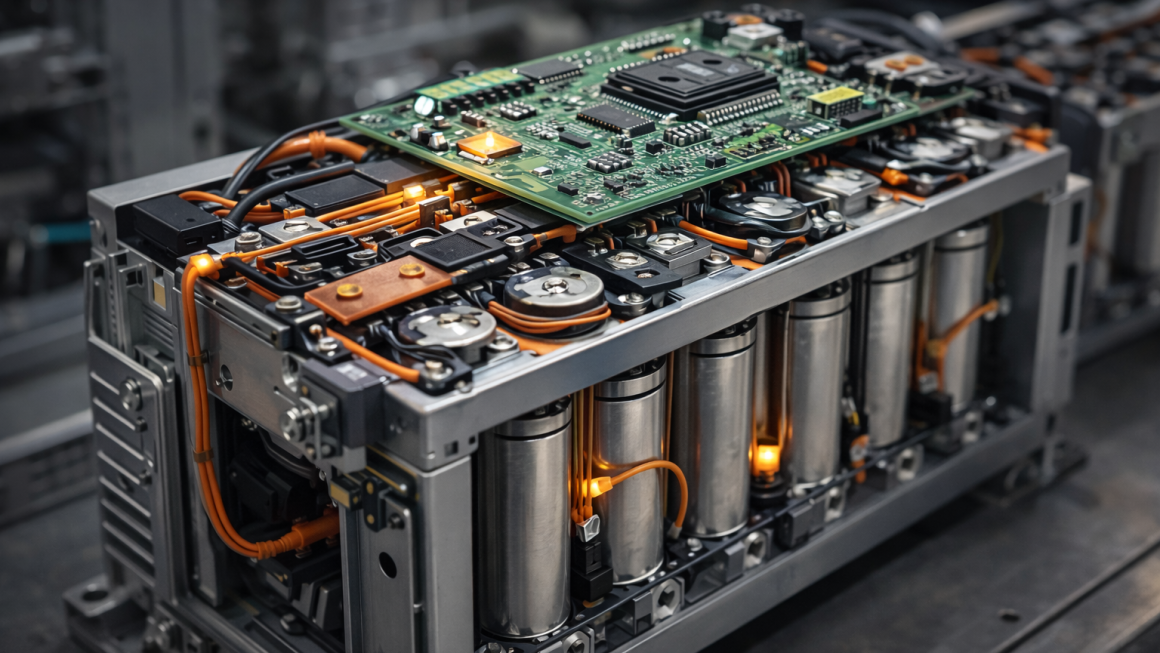
A smart battery module integrates multiple layers of functionality:
Integrated Sensors
- Distributed temperature sensors reduce blind spots
- High-precision voltage sensing improves SOC and SOH accuracy
- Fast current sensing captures transient events
Local Processing
- Module-level microcontrollers reduce latency
- Pre-processed data improves system-level decisions
- Local fault detection isolates issues early
Embedded Control
- Active balancing strategies
- Thermal derating based on real conditions
- Protective actions before system-level shutdown is required
4. Thermal Control Enabled by Sensing
Thermal behavior is one of the most critical—and dynamic—factors in battery performance.
Smart modules use temperature feedback to:
- Identify emerging hotspots
- Optimize heat dissipation pathways
- Coordinate with passive or active cooling systems
When combined with graphene-enhanced thermal materials, sensing-driven control ensures that heat is not only detected, but managed efficiently at the material and system levels.
5. Electrical Optimization Through Intelligent Control
Electrical sensing and control directly influence efficiency and lifespan.
Benefits include:
- Reduced resistive losses
- Minimized overcurrent stress
- Improved charge acceptance consistency
Smart modules can adapt to:
- Fast charging events
- High-power discharge demands
- Grid or load-side fluctuations
This adaptability is essential in residential, commercial, and hybrid ESS installations.
6. Predictive Maintenance and Long-Term Reliability
One of the most powerful outcomes of energy sensing is predictive insight.
By analyzing trends over time, smart modules enable:
- Early detection of abnormal degradation
- Condition-based maintenance instead of fixed schedules
- Accurate lifetime prediction
For system owners, this translates to:
- Lower total cost of ownership
- Fewer unexpected outages
- Improved confidence in long-term performance
7. System-Level Benefits of Smart Control
At the system level, energy sensing and control improve:
- Overall energy efficiency
- Safety margins
- Compliance with grid and safety standards
- Integration with energy management systems (EMS)
Smart modules act as building blocks for scalable, intelligent energy storage architectures.
8. Designing Smart Modules: Integration Matters
Effective sensing and control depend on more than electronics.
Successful designs align:
- Sensor placement with thermal pathways
- Control logic with material behavior
- Mechanical structure with signal stability
This integration ensures that data reflects reality, not assumptions.
Energy sensing and control transform batteries from passive components into adaptive, intelligent systems. Through smart modules that combine sensing, processing, and control, energy storage systems achieve higher efficiency, longer life, and greater reliability.
As energy storage applications grow more demanding, intelligence at the module level will define performance at the system level.
Smart modules do not simply protect batteries—they help them perform at their best, every day.