
Urban areas around the world are experiencing unprecedented energy demand growth due to population density, electrification of transport, and the proliferation of smart devices. This increasing demand poses unique challenges for the deployment of energy storage systems, especially in environments where space is limited and grid stability is critical.
To address these challenges, compact modular energy storage solutions have emerged as a promising approach, combining scalability, flexibility, and high performance in urban settings.
The Urban Energy Challenge
Cities face a unique combination of constraints that make energy storage particularly challenging:
1. Limited Space
Urban areas often lack the physical space for traditional, large-scale energy storage facilities. Rooftops, basements, and small utility rooms are often the only available locations for energy storage systems.
2. High Energy Density Requirements
Urban energy storage solutions must deliver high power and energy density in a limited footprint. This ensures they can meet peak demand, support distributed generation, and maintain power quality.
3. Grid Reliability
Urban grids must support dense populations and critical infrastructure such as hospitals, transport systems, and commercial hubs. Energy storage must provide reliable backup, voltage stabilization, and load management to prevent outages and maintain quality of service.
4. Integration with Renewable Energy
As cities adopt solar PV, wind micro-generation, and other distributed energy sources, storage solutions must efficiently integrate these intermittent sources to maximize self-consumption and reduce reliance on the grid.
What Makes Modular Energy Storage Ideal for Urban Environments
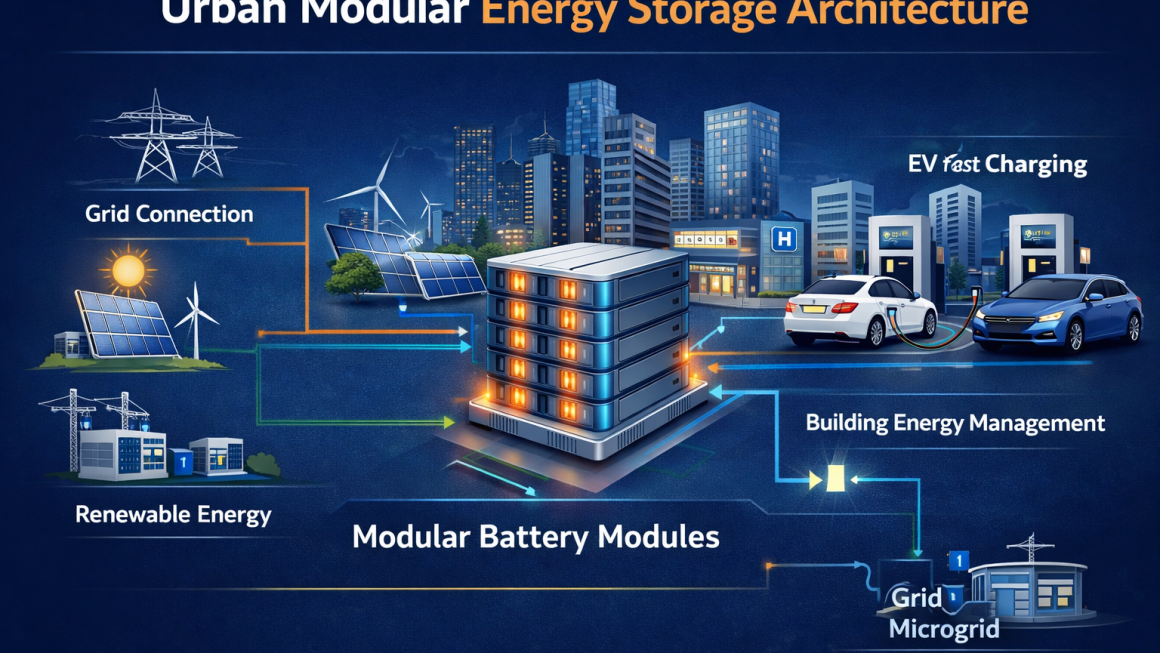
Modular energy storage systems are composed of individual energy units or modules, each equipped with batteries, management electronics, and cooling systems. These modules can be combined to create larger systems that meet specific energy and power requirements.
Key advantages include:
Scalability
- Modules can be added or removed to match changing energy needs.
- Allows urban operators to incrementally expand capacity without major infrastructure upgrades.
Compact Footprint
- Standardized module designs are optimized for high energy density and minimal space usage.
- Modules can be stacked or configured to fit into tight urban spaces.
Maintenance and Flexibility
- Individual modules can be serviced or replaced without shutting down the entire system.
- Supports redundancy, ensuring uninterrupted energy supply.
Integration with Advanced Energy Management
- Each module can communicate with the building energy management system (BEMS) or microgrid EMS.
- Enables real-time optimization of charging, discharging, and grid interaction.
Key Applications in Urban Areas
1. Peak Shaving and Load Management
In high-density urban centers, energy demand often peaks during business hours. Modular energy storage systems allow operators to:
- Store energy during low-demand periods
- Release energy during peak hours
- Reduce peak load on the grid and avoid costly demand charges
2. Renewable Energy Integration
Urban solar PV installations often face intermittency challenges. Modular energy storage solutions can:
- Store excess solar generation for later use
- Smooth fluctuations in power output
- Increase self-consumption rates and reduce grid reliance
3. Backup and Critical Load Support
Hospitals, data centers, public transport, and commercial buildings require reliable backup power. Modular storage systems provide:
- Instantaneous backup during outages
- Support for critical loads without requiring large diesel generators
- Reduced operational noise and emissions compared to traditional backup systems
4. Microgrid Enablement
Modular energy storage can serve as the backbone of urban microgrids, enabling:
- Islanded operation during grid failures
- Integration with local generation sources like PV, CHP, or wind
- Optimization of energy flow across multiple buildings or districts
Design Considerations for Compact Modular Systems
1. Battery Chemistry and Performance
- Lithium-ion chemistries, such as NMC or LFP, are commonly used due to their high energy density, long cycle life, and safety.
- Emerging technologies, including solid-state and high-power Li-ion variants, offer higher energy density and better thermal performance.
2. Thermal Management
Urban deployments require efficient cooling strategies to prevent overheating:
- Air cooling for low to moderate power modules
- Liquid cooling for high-power, high-density modules
- Thermal interface materials and heat spreaders to ensure uniform temperature distribution
3. Safety and Fire Protection
High-density energy storage systems in confined urban spaces demand rigorous safety features:
- Battery Management Systems (BMS) with real-time monitoring
- Fire suppression systems integrated within module enclosures
- Redundant protective circuits to prevent overcharge, overdischarge, or short circuits
4. Form Factor and Installation Flexibility
- Modules must be designed to fit diverse urban settings, from rooftops to basements and containerized solutions.
- Modular enclosures simplify transport, installation, and expansion.
Integration with Building and Grid Infrastructure
Effective urban deployment requires close coordination with local grid and building systems:
- Grid-Friendly Operation: Supports peak shaving, frequency regulation, and voltage stabilization.
- Building Energy Management Integration: Optimizes energy use in commercial and residential buildings.
- Smart Charging Integration: Modules can coordinate with EV chargers, enabling demand response and renewable charging.
This integration ensures that modular energy storage not only stores energy but also actively enhances urban energy efficiency and resilience.
Economic and Environmental Benefits
Cost Optimization
- Reduces peak demand charges and energy procurement costs
- Enables gradual expansion rather than large upfront capital investment
Environmental Impact
- Facilitates the adoption of renewable energy in urban areas
- Reduces reliance on diesel generators for backup power
- Contributes to lower urban emissions and carbon footprint
Operational Efficiency
- Modular systems allow targeted maintenance without full shutdown
- Intelligent EMS ensures optimal use of energy, prolonging battery life and minimizing losses
Challenges and Considerations
Despite their advantages, compact modular energy storage systems must address several challenges in urban areas:
- Space Constraints: Even compact modules must be carefully designed to fit urban footprints.
- Noise and Heat: Cooling systems and high-power operation must be managed to avoid disturbances.
- Regulatory Compliance: Urban deployments often face stricter safety, fire, and electrical regulations.
- Grid Interaction Complexity: Multi-building or multi-source integration requires advanced EMS coordination.
Addressing these challenges requires a holistic approach that combines materials science, module engineering, and system-level design.
The Future of Urban Energy Storage
As cities continue to grow, compact modular energy storage solutions will play a key role in:
- Enabling fully renewable-powered urban districts
- Supporting electric mobility infrastructure
- Creating resilient and intelligent microgrids
- Integrating energy management with smart city initiatives
Emerging trends include:
- Second-life battery modules for cost-effective urban storage
- AI-driven energy optimization across multiple buildings
- Higher energy density and safer battery chemistries for tighter urban spaces
In this context, modularity, compactness, and flexibility are no longer optional—they are fundamental to urban energy planning.
How gr-newenergy.com Supports Urban Storage Solutions
At gr-newenergy.com, we specialize in bridging materials, modules, and system integration for urban energy solutions:
- Advanced thermal and conductive materials for high-density modules
- Modular battery solutions optimized for compact urban deployment
- System-level integration support for buildings, microgrids, and renewable assets
Our approach focuses on enabling efficient, scalable, and reliable energy storage without over-promising large-scale production, perfectly suited for the constraints and opportunities of urban areas.
Urban energy landscapes are evolving rapidly, with rising demand, electrification, and renewable integration challenging traditional infrastructure. Compact modular energy storage solutions offer a scalable, flexible, and high-performance response, enabling:
- Peak shaving and load management
- Renewable energy integration
- Backup and critical load support
- Microgrid enablement
By combining advanced materials, intelligent module design, and system-level engineering, these solutions provide urban areas with resilient, efficient, and sustainable energy storage, paving the way for smarter and greener cities.