

How Modular ESS Delivers Predictable, Replicable Financial Returns
Industrial parks across Asia, the Middle East, Africa, and emerging markets are increasingly evaluating commercial energy storage systems (ESS) as a tool for lowering electricity costs and stabilizing power supply. While large-scale battery deployments often attract attention, the most sustainable business case often comes from modular, mid-sized storage systems—designed to solve real operational pain points with predictable ROI.
This article provides a replicable ROI evaluation framework, explains key financial drivers, and shares a small-scale, real-world case suitable for EPCs, integrators, and industrial park energy managers.
1. A Replicable ROI Framework for Industrial Parks
A commercial ESS ROI model should be simple, repeatable, and based on measurable operational outcomes—not theoretical assumptions. The following four-step framework is widely applicable across different industrial parks:
Step 1: Define the Energy Problems
Industrial parks typically face:
- High peak demand charges
- Unstable grid supply or voltage fluctuations
- Low utilization of existing PV infrastructure
- Limited visibility over multiple tenant loads
- Inefficient transformer loading and capacity allocation
Clarifying the problem determines the ROI pathway.
Step 2: Evaluate Load Profiles
Gather 7–30 days of data:
- Max/average/min load per tenant
- Peak spikes and daily patterns
- TOU pricing windows
- PV output curves (if applicable)
This determines the required ESS size and discharge duration.
Step 3: Map Benefit Streams to ESS Capabilities
ESS value usually comes from 3–5 financial sources:
- Peak shaving
- TOU arbitrage
- PV self-consumption improvement
- Backup power value
- Transformer/feeder optimization
Industrial parks often combine at least two of these.
Step 4: Build a Payback + Cashflow Model
A reliable ROI model includes:
- CAPEX (batteries, PCS, EMS, installation)
- OPEX (maintenance + EMS SaaS if applicable)
- Annual cost savings
- Payback period
- 10-year cashflow projection
This produces a transparent, investor-ready evaluation.
2. Key Cost Drivers in Commercial ESS ROI
ROI depends heavily on the following cost drivers:
1. System Size and Discharge Duration
- 1C systems cost more but provide better peak-shaving performance.
- 0.5C systems are cheaper but may limit immediate economic benefits.
2. Modular vs. Integrated Architecture
Modular ESS:
- Reduces initial CAPEX
- Allows staged investment
- Minimizes risk of over-sizing
This significantly improves payback.
3. EMS Intelligence Level
A strong EMS improves ROI by:
- Automating TOU optimization
- Predicting load spikes
- Coordinating PV charging
- Providing accurate performance reporting
Poor EMS control can reduce ROI by 20–40%.
4. Installation and Site Conditions
Costs vary depending on:
- Cable distance
- Transformer capacity
- Indoor vs. outdoor mounting
- Existing PV infrastructure
5. Local Electricity Tariff Structure
Industrial park ROI improves when tariffs include:
- Demand charges
- High peak-valley price gaps
- Penalties for exceeding contracted capacity
These create a clear financial incentive for storage.
3. Key Savings Components in ESS ROI
Industrial parks benefit from storage across several revenue or savings categories. Below are the most universal and predictable ones.
1. Peak Demand Reduction
This is the primary ROI driver for industrial parks.
Typical results: 10–25% peak reduction
Impact: Lower demand charges + transformer stability
2. Time-of-Use (TOU) Optimization
Charge during valley, discharge during peak.
Typical price difference: 15–50% depending on region
Impact: Direct electricity bill reduction
3. PV Self-Consumption Boost
ESS stores excess solar energy for later use.
Benefit:
- Higher rooftop PV utilization
- Lower grid import
- Reduced curtailment
4. Backup Power for Critical Loads
Industrial parks with warehouses, data rooms, or telecom nodes benefit from improved uptime.
5. Transformer Load Optimization
ESS flattens peaks, allowing:
- Additional tenants
- Avoiding transformer replacement
- Lowering thermal stress
Each of these components is measurable and repeatable—ideal for a consistent ROI narrative.
4. Why Modular ESS Improves ROI Predictability
Modular commercial ESS offers several financial advantages:
1. Lower Initial Investment
Industrial parks can start with:
- 100–500 kWh
- Expand later to 1–5 MWh
Reduces financial risk.
2. Scalable Architecture
More battery racks or cabinets can be added without redesigning the entire system.
3. Fast Deployment
Modular ESS:
- Fits existing spaces
- Requires minimal construction
- Can be installed without interrupting tenants
4. Higher System Availability
Module-level redundancy ensures uptime even during maintenance.
5. Better Alignment with Real Load Data
Parks can increase capacity only when load data proves the benefit—preventing over-investment.
These features significantly improve long-term ROI stability.
5. Case Study: Small-Scale Modular ESS in a Mixed-Use Industrial Park
Location: Southeast Asia
Park Size: 11 medium-sized factories
Challenge:
- High monthly demand charges
- Increasing tenant electricity consumption
- Existing PV underutilized
Solution:
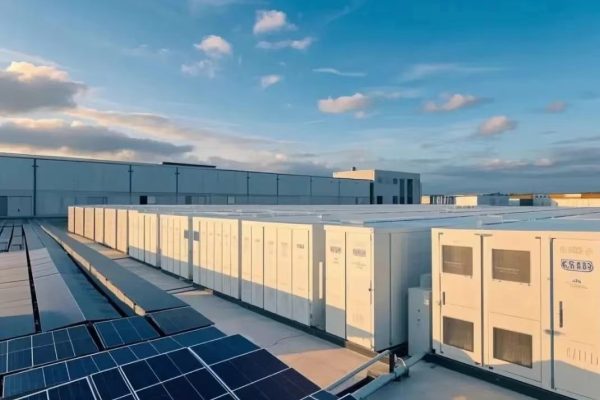
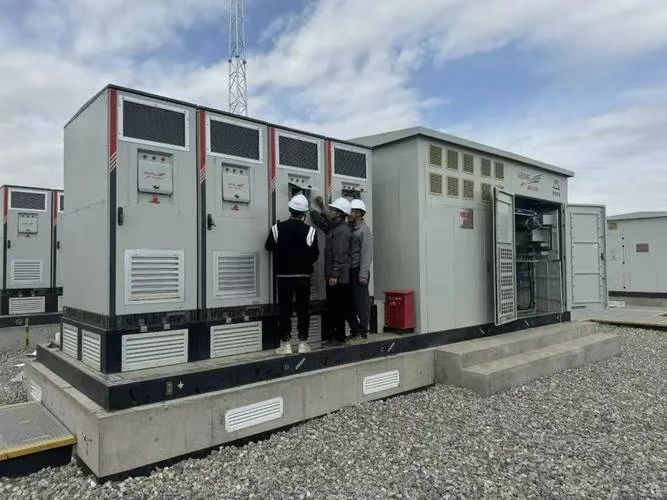
- 400 kWh modular outdoor ESS (2 × 200 kWh cabinets)
- 1C power capacity for peak shaving
- EMS with TOU + PV forecast control
Results After 6 Months:
- 18% peak demand reduction
- 14% improvement in PV utilization
- 11% reduction in total monthly electricity cost
- Payback period: 3.1 years
Why This Case Is Replicable
- Small, modular system
- No custom engineering
- Simple EMS rules
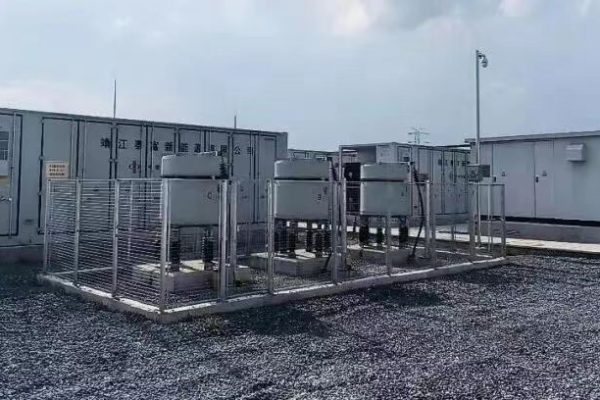
- Standard container-type installation
- Works for 80%+ industrial parks with similar load profiles
6. Practical ROI Recommendations for Industrial Parks
For Owners and Operators
- Start with a small modular system to validate savings
- Implement high-resolution load monitoring across tenants
- Prioritize ESS with N+1 redundancy and remote monitoring
- Build an ROI model for each tariff component separately
For EPCs and Integrators
- Keep system design simple and modular
- Size power (kW) based on spikes, not just energy (kWh)
- Deploy EMS early and tune it over 30–60 days
- Avoid oversizing on the first deployment phase
A slow, controlled deployment delivers the most stable ROI.
Commercial ESS provides a strong, predictable, and repeatable ROI for industrial parks when deployed with a modular architecture and intelligent EMS control.
By combining peak shaving, TOU optimization, improved PV utilization, and transformer load balancing, industrial parks can generate steady financial returns with manageable CAPEX.
This ROI framework and case example demonstrate that even small-scale modular ESS can deliver meaningful savings—making energy storage a practical tool for industrial park energy management.