


As battery systems evolve toward higher power density, faster charging, and longer service life, thermal management has shifted from a pack-level problem to a material-level design challenge. Among advanced thermal additives, carbon nanotubes (CNTs) and graphene stand out as two of the most effective nanocarbon materials.
Both materials significantly improve thermal and electrical performance—but they are not interchangeable. Understanding their differences is essential for battery manufacturers, ESS integrators, and material engineers making real-world design decisions.
This article compares CNTs and graphene in battery thermal management, focusing on performance mechanisms, trade-offs, and practical selection strategies.
Why Comparing CNTs and Graphene Matters
In many battery and ESS projects, the question is no longer “Should we use nanocarbon additives?”
It is now “Which nanocarbon is better for this specific application?”
CNTs and graphene differ in:
- Geometry and structure
- Heat transport directionality
- Dispersion behavior
- Cost-performance balance
Choosing the wrong material can lead to:
- Marginal thermal improvement
- Processing difficulties
- Unnecessary cost increases
Structural Differences: 1D vs. 2D Heat Pathways
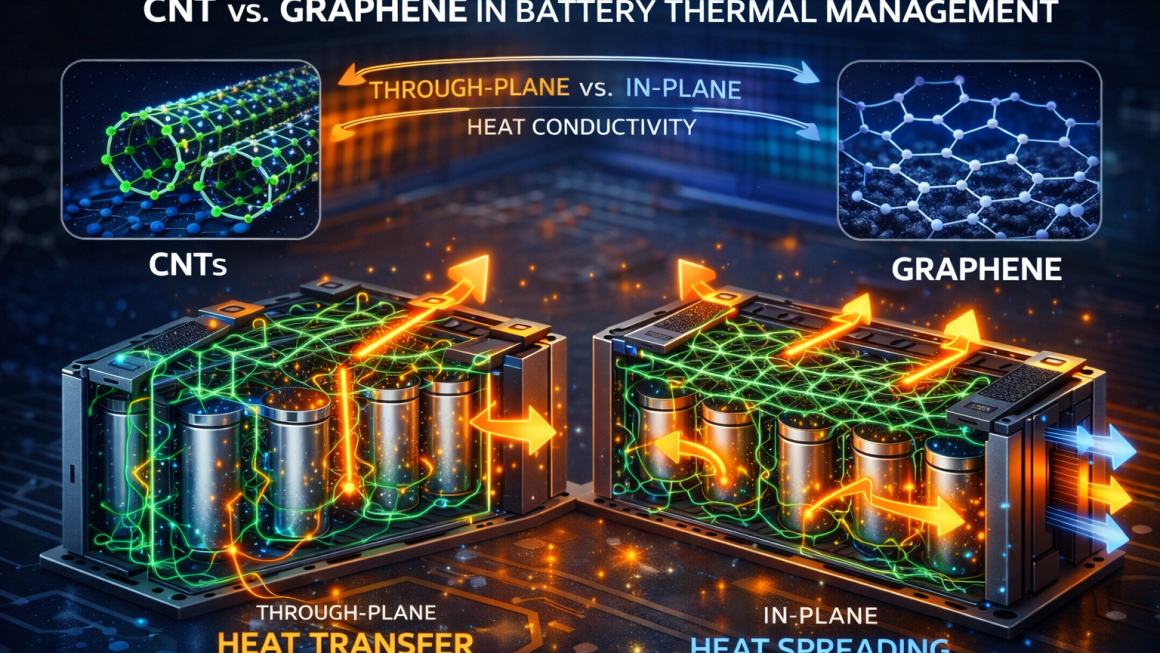
Carbon Nanotubes (CNTs): One-Dimensional Heat Bridges
CNTs are cylindrical, high–aspect ratio structures that excel at:
- Forming percolation networks through bulk materials
- Bridging gaps between particles, binders, and interfaces
In batteries, CNTs are particularly effective at:
- Improving through-plane thermal conductivity
- Enhancing heat transfer from electrode interior toward current collectors
Graphene: Two-Dimensional Heat Spreaders
Graphene consists of atomically thin, planar sheets that:
- Spread heat efficiently in-plane
- Cover large surface areas at low loading
Graphene is especially effective at:
- Reducing localized hotspots
- Improving lateral heat distribution across electrodes or coatings
Thermal Performance: How They Work in Practice
| Aspect | CNTs | Graphene |
|---|---|---|
| Heat direction | Through-plane | In-plane |
| Network formation | Strong | Moderate |
| Hotspot suppression | Good | Excellent |
| Interface heat spreading | Moderate | Strong |
| Loading efficiency | Moderate | High |
Key takeaway:
- CNTs move heat through the structure
- Graphene spreads heat across the structure
This distinction is critical in battery design.
Electrical vs. Thermal Trade-Offs
While both materials improve thermal conductivity, electrical behavior must also be controlled, especially in battery and ESS applications.
- CNTs often form conductive networks at very low loading, which can:
- Benefit electrodes
- Create leakage risks in insulation-sensitive components
- Graphene allows:
- High thermal conductivity
- More controllable electrical pathways, especially in coatings and composite layers
For near-insulating thermal layers, graphene is often easier to engineer safely.
Processing and Dispersion Considerations
CNT Challenges
- Agglomeration risk
- Requires strong dispersion techniques
- Sensitive to shear history during compounding
Graphene Challenges
- Sheet restacking if not properly exfoliated
- Orientation control affects performance
In practice:
- CNTs favor bulk composite enhancement
- Graphene favors coatings, films, and surface layers
Application-Specific Recommendations
Battery Electrodes
- CNTs improve internal heat conduction and electrical percolation
- Often used at low loading as multifunctional additives
Conductive & Thermal Coatings
- Graphene provides superior heat spreading with minimal thickness
- Ideal for current collectors, tabs, and module-level coatings
Battery Modules & ESS Assemblies
- Graphene enhances lateral heat flow toward cooling plates
- CNTs support vertical heat extraction inside cells
Hybrid CNT–Graphene Systems: Best of Both Worlds
Increasingly, high-performance batteries and ESS designs use hybrid nanocarbon systems, combining:
- CNTs for vertical heat transport
- Graphene for lateral heat spreading
This approach:
- Minimizes thermal resistance in all directions
- Reduces hotspot formation
- Improves long-term thermal stability
Hybrid systems are particularly effective in:
- Fast-charging batteries
- High-power ESS modules
- Compact designs with limited cooling space
Cost–Performance Considerations
From a commercial perspective:
- CNTs often provide strong performance at very low dosages
- Graphene offers scalability advantages for coatings and large-area applications
The optimal choice depends on:
- Target thermal improvement
- Processing route
- System-level performance goals
For ESS projects focused on lifetime reliability rather than peak power, graphene-based solutions are often preferred.
CNTs and graphene are both powerful tools in battery thermal management—but they solve different problems.
- CNTs excel at internal heat transport and network formation
- Graphene excels at heat spreading and interface control
- Hybrid systems deliver the most balanced performance
As battery and energy storage systems continue to scale, material-level thermal design will increasingly define system reliability and safety. Selecting the right nanocarbon additive is no longer a materials question—it is a system engineering decision.