
As energy storage systems become more powerful and compact, thermal management has become one of the most critical aspects of battery module design. During charging and discharging, batteries generate heat. If this heat is not properly dissipated, it can lead to performance degradation, reduced cycle life, and potential safety risks.
One of the key technologies that enables efficient thermal control inside battery packs is the use of Thermal Interface Materials (TIMs). These materials improve heat transfer between battery cells, cooling plates, and module structures, helping maintain safe operating temperatures across the system.
In modern energy storage solutions, advanced TIMs are essential for ensuring reliability, performance, and long-term durability.
Why Thermal Interface Materials Matter in Battery Modules
Battery cells generate heat due to internal resistance during operation. In high-power applications such as commercial energy storage systems (ESS), the heat load can become significant.
Without effective thermal pathways, several problems may occur:
- Localized overheating of battery cells
- Uneven temperature distribution within the module
- Reduced battery capacity over time
- Increased risk of thermal runaway
Thermal interface materials help solve these issues by bridging the microscopic air gaps between surfaces and enabling efficient heat transfer.
Because air is a poor thermal conductor, eliminating these gaps dramatically improves the efficiency of heat dissipation.
How TIMs Work in Battery Modules
TIMs are typically placed between heat-generating components and cooling structures.
Common contact interfaces include:
- Battery cells to cooling plates
- Battery modules to heat spreaders
- Power electronics to heat sinks
- Busbars and conductive components to structural plates
These materials conform to surface irregularities and create a continuous thermal path, allowing heat to move efficiently toward cooling systems such as liquid cooling plates or aluminum heat spreaders.
The result is more stable battery operation and improved system efficiency.
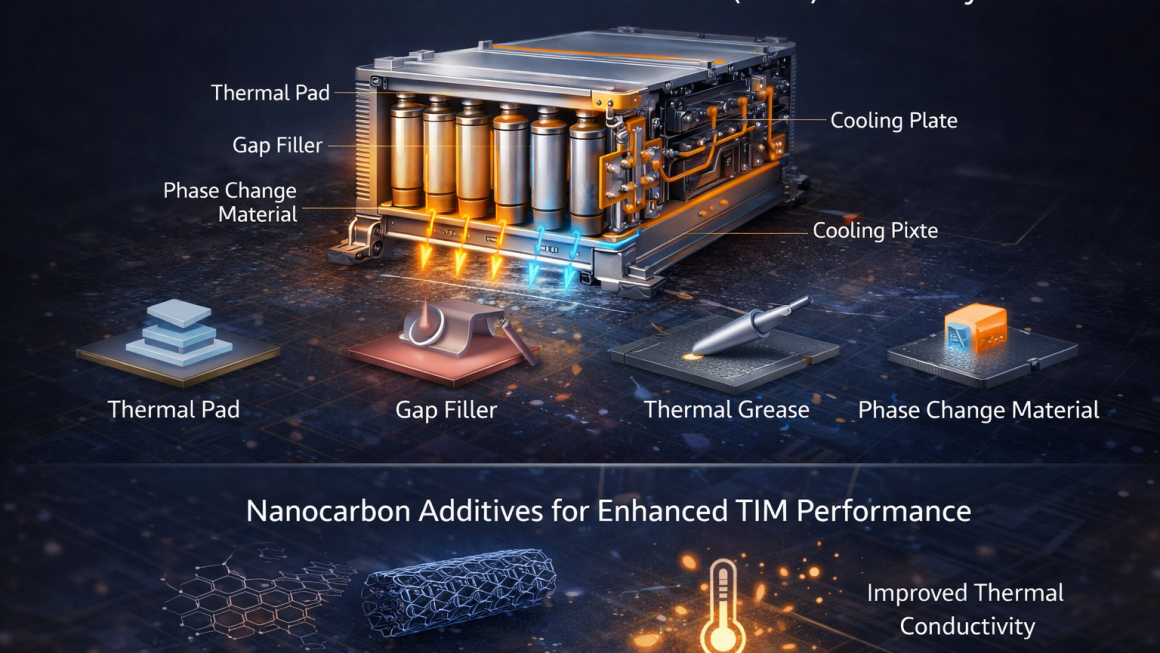
Types of Thermal Interface Materials Used in ESS
Several types of TIMs are commonly used in battery module design. Each has advantages depending on the application and system architecture.
Thermal Pads
Thermal pads are soft, compressible materials placed between components to improve thermal contact.
Key benefits include:
- Easy installation
- Electrical insulation
- Good mechanical stability
- Reliable thermal conductivity
They are often used between battery cells and cooling plates in modular battery packs.
Thermal Gap Fillers
Gap fillers are highly conformable materials designed to fill larger gaps between components.
Advantages include:
- Excellent surface conformity
- Strong vibration resistance
- Good thermal performance under compression
They are frequently used in large-format battery modules where dimensional tolerances create larger thermal gaps.
Thermal Greases and Pastes
Thermal greases provide very low thermal resistance and are often used in high-performance electronic systems.
However, they may require careful application and containment structures to prevent migration over time.
Phase Change Materials (PCM)
Phase change materials transition from solid to semi-liquid at certain temperatures, allowing them to fill microscopic gaps and improve heat transfer.
These materials combine low thermal resistance with long-term stability, making them useful in certain battery pack designs.
Advanced Materials for High-Performance TIMs
Recent developments in materials engineering have significantly improved the performance of thermal interface materials.
One of the most promising approaches involves nanocarbon-based additives, including:
- Graphene
- Carbon nanotubes (CNTs)
- Hybrid carbon conductive networks
These advanced materials offer several advantages:
- Higher intrinsic thermal conductivity
- Improved heat spreading capability
- Enhanced mechanical strength
- Reduced thermal resistance at interfaces
By incorporating nanocarbon materials into TIM formulations, manufacturers can achieve higher thermal conductivity without sacrificing flexibility or processability.
Thermal Management Challenges in High-Power ESS
Modern commercial energy storage systems often operate under demanding conditions, including:
- High charge/discharge currents
- Continuous cycling
- Dense module packaging
- Large battery arrays
In these environments, even small thermal inefficiencies can accumulate across hundreds or thousands of cells.
Advanced TIM solutions help address these challenges by:
- Improving temperature uniformity across battery modules
- Enhancing heat transfer to cooling plates
- Reducing hotspots inside battery packs
- Supporting higher power densities
Effective thermal management ultimately leads to longer battery lifetimes and more reliable system performance.
Integration with Battery Module Design
TIMs are most effective when integrated into a holistic thermal design strategy. This includes coordination between multiple system components such as:
- Battery cell arrangement
- Cooling plate design
- Structural materials
- Busbar layouts
- Thermal sensors and control systems
By optimizing these elements together, engineers can create battery modules that maintain stable operating temperatures even under heavy load conditions.
The Future of TIMs in Energy Storage
As energy storage technologies continue to evolve, the demands on thermal interface materials will only increase.
Future developments may focus on:
- Ultra-high thermal conductivity composites
- Lightweight materials for compact battery packs
- Electrically conductive thermal materials for integrated functions
- Advanced coatings that combine thermal and electrical performance
These innovations will help enable the next generation of high-performance, long-lasting energy storage systems.
Thermal interface materials play a crucial role in the performance and reliability of modern battery modules. By improving heat transfer between components, TIMs help maintain safe operating temperatures and support efficient system operation.
With the growing demand for high-power energy storage systems, advanced TIM technologies—especially those incorporating nanocarbon materials such as graphene and carbon nanotubes—are becoming increasingly important.
As energy storage systems scale in size and power, well-designed thermal interface solutions will remain a key factor in achieving safe, durable, and high-performance battery modules.