
Practical Design Strategies to Convert Lost Heat into Dispatchable Energy
In many industrial and commercial facilities, waste heat is the largest unused energy resource on site. Exhaust gases, hot cooling water, compressor discharge heat, and process losses often represent 20–50% of total energy input, yet most of this energy is simply released into the environment.
When waste heat recovery (WHR) is integrated with thermal energy storage, lost heat becomes a dispatchable, controllable energy asset rather than an unpredictable byproduct.
This article focuses on how to practically integrate waste heat recovery with thermal storage, emphasizing system architecture, control logic, and real-world reliability.
1. Why Waste Heat Alone Is Not Enough
Many WHR projects fail to deliver expected value—not because heat is unavailable, but because heat supply and demand rarely align in time.
Common issues include:
- Waste heat available during low demand periods
- Thermal demand peaks occurring after production stops
- Process heat that fluctuates with load or batch cycles
- Recovered heat that cannot be used immediately
Without storage, waste heat recovery is opportunistic.
With storage, it becomes strategic.
2. The Role of Thermal Storage in WHR Systems
Thermal storage decouples:
- When heat is generated
- When heat is needed
This enables:
- Continuous heat recovery even during low demand
- Stable process operation without thermal dumping
- Reduced reliance on auxiliary boilers or heaters
- Higher overall energy utilization
In practice, thermal storage is what turns WHR into a reliable energy supply.
3. Identifying Suitable Waste Heat Sources
Not all waste heat is equal. Effective integration starts with source characterization.
Common Recoverable Heat Sources
- Engine and generator exhaust
- Compressor discharge heat
- Hot cooling water loops
- Furnace exhaust air
- Process condensate
- Data center and refrigeration heat rejection
Key parameters to assess:
- Temperature level
- Flow stability
- Contamination risk
- Operating hours
- Seasonal variation
4. Matching Heat Quality with Storage Type
Sensible Heat Storage (Hot Water Tanks)
Best for:
- Low to medium temperature heat (40–95°C)
- Process pre-heating
- Space heating
- Domestic hot water
Advantages:
- Low cost
- Long lifespan
- Simple integration
High-Temperature Storage
Used when:
- Heat exceeds 100°C
- Direct process reuse is required
Trade-offs:
- Higher material and insulation costs
- More complex safety requirements
Phase Change Materials (PCM)
Best for:
- Narrow temperature bands
- Space-limited installations
Limitations:
- Cost
- Long-term cycling uncertainty
- Less forgiving control margins
5. System Architecture: Practical Integration Models
A robust WHR + thermal storage system typically includes:
- Heat exchangers at waste heat sources
- Thermal storage tanks
- Pumps and control valves
- Auxiliary heat sources (boilers, heat pumps)
- EMS or local thermal controller
Key Design Principle
Waste heat recovery should never interfere with core industrial processes.
This means:
- Always maintain process cooling capacity
- Include bypass paths
- Prioritize process safety over heat capture
6. Control Strategies That Work in Real Facilities
Heat-First, Storage-Second Logic
A proven hierarchy:
- Recover waste heat without affecting process operation
- Charge thermal storage whenever heat is available
- Serve thermal loads from storage when possible
- Use auxiliary heating only when storage is insufficient
This logic is stable, predictable, and easy to operate.
Storage as a Shock Absorber
Thermal storage smooths:
- Sudden production changes
- Equipment start-up surges
- Intermittent waste heat availability
This reduces stress on both:
- Heat recovery equipment
- Downstream thermal users
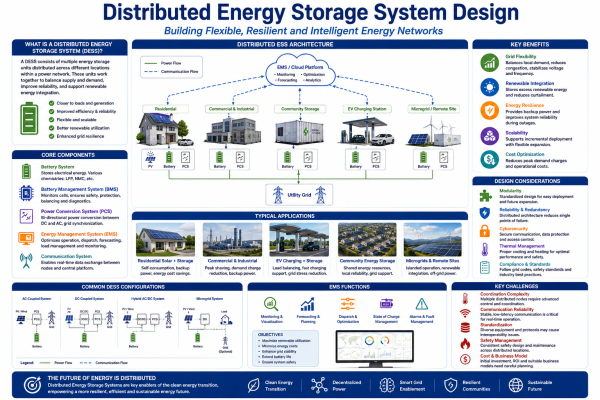
7. Integrating WHR with PV and Electrical Systems
The highest value systems combine:
- Waste heat recovery
- Thermal storage
- PV and battery systems
Example Synergies
- Use waste heat first, PV-driven heat pumps second
- Charge thermal storage with PV when waste heat is unavailable
- Reduce battery cycling by shifting thermal demand
- Stabilize microgrids by reducing thermal-driven electrical peaks
Thermal storage becomes the central buffer between electrical and thermal domains.
8. Common Design Mistakes to Avoid
- Overestimating usable waste heat
- Ignoring fouling and maintenance requirements
- Undersizing storage capacity
- Overcomplicating control logic
- Assuming constant heat availability
Conservative assumptions and simple controls outperform aggressive designs over time.
9. What EPCs and System Integrators Should Focus On
To deliver successful WHR + thermal storage projects:
- Start with real operating data
- Design for partial, not perfect, heat recovery
- Oversize storage slightly for flexibility
- Ensure clear process isolation
- Train operators on system behavior
Waste Heat + Storage Turns Losses into Assets
Waste heat recovery alone improves efficiency.
Waste heat recovery with thermal storage changes system economics.
Together, they:
- Reduce fuel consumption
- Lower operating costs
- Improve energy resilience
- Extend equipment life
- Support decarbonization goals
For EPCs and system integrators, WHR + thermal storage integration is one of the most reliable and underutilized pathways to long-term energy savings in industrial and commercial systems.