
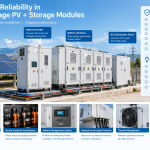
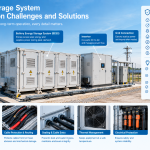


Industrial facilities are increasingly adopting modular energy storage systems to manage peak loads, reduce electricity costs, and stabilize power usage. Load shifting has become one of the most effective ways for factories and industrial parks to lower operational expenses without interrupting production.
This article outlines practical implementation strategies, followed by real case insights. All methods are based on replicable engineering practices and proven small-scale deployments.
1. Understanding Load Profiles Before System Design
Accurate load analysis is the foundation of any successful industrial load shifting project. Industrial users often have complex consumption patterns with sharp peaks from equipment such as compressors, pumps, chillers, or boilers.
What to Analyze
- 24-hour and 7-day load curves
- Demand spikes and shift-change patterns
- Seasonal variations
- TOU tariff structure (peak/mid/valley pricing)
- List of critical and non-critical loads
Why This Matters
This baseline allows engineers to:
- Identify realistic peak reduction targets
- Determine required storage capacity
- Avoid unnecessary oversizing
- Build a cost-effective, modular expansion plan
Facilities that skip this step often end up with poor ROI or unstable system performance.
2. Choosing the Right Modular Storage Architecture
Modularity is essential for industrial sites with changing production levels. A modular energy storage system allows step-by-step investment while ensuring operational flexibility.
Common Architecture Options
- Rack-based systems for indoor installations
- Outdoor cabinet systems for space-limited factories
- Containerized modular ESS for mid-sized industrial loads
- Hybrid modular solutions combining multiple battery units + PCS modules
Key Benefits
- Scalability as production increases
- Simple maintenance via module-level isolation
- N+1 redundancy for critical power support
- Easier installation in constrained industrial environments
Modular designs significantly reduce project risk and simplify long-term O&M.
3. EMS Integration for Automated Load Shifting
A modular storage system delivers value only when paired with an intelligent Energy Management System (EMS). Load shifting needs real-time control and predictive scheduling.
Core EMS Capabilities
- Automatic charge/discharge planning
- Load forecasting and TOU optimization
- Peak shaving with millisecond-level response
- PV + storage coordination (if solar is installed)
- Performance monitoring and reporting
Advanced Features
- AI-based load prediction
- Multi-site energy optimization across industrial parks
- Real-time spike detection
- Remote diagnostics and maintenance support
For industrial users, EMS is the “brain” that turns storage capacity into measurable cost savings.
4. Case Study 1 – Textile Plant Achieves 450 kW Peak Reduction
Location: Mid-sized textile dyeing factory
Challenge: Boiler startup and pump cycles created sharp load spikes
Solution:
- 500 kWh modular outdoor ESS
- EMS configured for peak shaving and load scheduling
Results:
- 450 kW peak demand reduction
- 12% annual electricity cost savings
- Higher production stability
- ESS capacity expanded easily after six months
This example shows how a small-to-mid-size modular system can deliver strong economic results.
5. Case Study 2 – Injection Molding Facility Eliminates Micro-Peaks
Location: Plastics manufacturing plant
Challenge: Injection machines created short, intense demand spikes
Solution:
- 300 kWh modular rack-based ESS
- High-power PCS for rapid response
- Real-time peak suppression via EMS
Results:
- Eliminated ~90% of micro-peaks
- Improved power factor and reduced penalties
- ROI in 2.8 years
This case demonstrates how modular storage is ideal for fast, unpredictable industrial loads.
6. Practical Deployment Recommendations
For EPCs and System Integrators
- Begin with high-resolution load monitoring
- Use modular ESS to reduce initial CAPEX and installation risk
- Integrate EMS into the design stage—not after installation
For Industrial End Users
- Define specific KPI goals (e.g., 10–20% peak reduction)
- Request N+1 redundancy for continuity
- Plan future scaling based on output growth
A structured approach ensures predictable performance and long-term reliability.
Modular energy storage is transforming how industrial facilities manage electricity costs and reduce peak loads. With proper load analysis, flexible modular architecture, and intelligent EMS integration, factories can achieve reliable and repeatable results.
Our case studies show that even small-scale modular ESS deployments can produce significant savings and improved operational stability.
If you want a similar load shifting solution customized for your industrial site, our engineering team can provide:
- Load analysis
- Modular ESS design
- EMS integration
- Deployment and O&M support